8D8D + cause verification
- Contain the leak; verify the cause
- Turn a plausible explanation into a cause test
Read the illustrated lesson →A3A3 thinking + administrative gemba
- Tell one connected problem-solving story
- Observe readiness, then test one channel
Read the illustrated lesson →DMAICDMAIC + measurement + control
- Make each DMAIC phase produce evidence
- Compare fairly and respond when performance slips
Read the illustrated lesson →6S6S + routine + replenishment
- Make Find, Use, Return a dependable routine
- Replenish from a signal, then verify the reset
Read the illustrated lesson →Lean / VSMLean + VSM + office flow
- Show the waiting as well as the work
- Make a future-state hypothesis testable
Read the illustrated lesson →Daily managementDaily management + gemba + escalation
- Make tomorrow ready before promising it
- Close the loop from huddle to gemba
Read the illustrated lesson →6S6S through a small PDCA experiment
- Test one shelf before changing the whole cafe
- Teach the reset and check it on another shift
Read the illustrated lesson →Simple improvementOffice management + ownership + pull
- Give each request one visible next owner
- Trace five requests from arrival to acceptance
Read the illustrated lesson →6STool readiness + clean/inspect/respond
- Make the next-job tool kit obvious
- Link operator care to maintenance response
Read the illustrated lesson →6SPreparation readiness + TPM/OEE
- Separate searching from a ready change kit
- Read equipment losses without hiding them
Read the illustrated lesson →6SKit standard + quality at source
- Build the correct kit before fit-up
- Observe the condition before choosing the fix
Read the illustrated lesson →6SPart readiness + synchronized flow + yamazumi
- Refill the right component for the next frame
- Balance work to demand using a yamazumi
Read the illustrated lesson →6SStock identity + FIFO + SMED
- Keep stock identity through the whole route
- Prepare externally; protect the controlled change
Read the illustrated lesson →Lean and TPS foundationsDefine customer need
- TPS: people, quality and synchronized flow
- Connect the customer gap to two response paths
Read the illustrated lesson →Lean and TPS foundationsObserve arrival variation
- Muda, mura and muri reinforce each other
- Show how a release surge becomes a queue
Read the illustrated lesson →Flow, pull and material supplyDefine available time and demand
- Takt, cycle time and lead time are different
- Keep the planning rhythm separate from two observed clocks
Read the illustrated lesson →Flow, pull and material supplyFix identical task times
- Batch transfer versus one-piece flow
- Compare transfer timing and unchanged person-work
Read the illustrated lesson →Flow, pull and material supplyWithdraw authorized container
- Production and withdrawal kanban
- Follow W04, C21 and P21 through one replenishment
Read the illustrated lesson →Flow, pull and material supplyAgree ready/done
- Office pull: capacity, blocked work and aging
- A blocked card remains inside the active limit
Read the illustrated lesson →Flow, pull and material supplyConfirm volume and mix
- Heijunka mix and pitch release
- Reconcile five pitches with the whole day
Read the illustrated lesson →Flow, pull and material supplyTest direct flow feasibility
- Connect processes: flow, bounded FIFO or supermarket
- Choose a connection from the handoff evidence
Read the illustrated lesson →Standard work and changeoverObserve repeatable cycle
- Standardized work: sequence, takt and standard WIP
- Audit the route, clocks and stock positions
Read the illustrated lesson →Standard work and changeoverTime elements
- Manual, walking and machine time
- Explain fifty elapsed seconds without losing any work
Read the illustrated lesson →Standard work and changeoverObserve repeated cycles
- Yamazumi: movable elements and constraints
- Reconcile E4 ownership before approving the trial
Read the illustrated lesson →Standard work and changeoverObserve full changeover
- SMED: externalize safely, verify first good output
- Move preparation without moving the acceptance boundary
Read the illustrated lesson →Flow, pull and material supplyMeasure usage and refill delay
- Replenishment stock: lead time and uncertainty
- Separate stock status from replenishment uncertainty
Read the illustrated lesson →Flow, pull and material supplyVerify item and use
- PFEP to point-of-use replenishment
- Follow a packaging discrepancy into the route
Read the illustrated lesson →Frontline problem solvingDefine abnormality
- Jidoka and andon: detect, respond, verify restart
- A reset is not the restart decision
Read the illustrated lesson →Frontline problem solvingDefine failure mechanism
- Poka-yoke: prevention versus detection
- Show where prevention and detection interrupt the error path
Read the illustrated lesson →Frontline problem solvingDefine gap
- 5 Whys with evidence and alternative branches
- Test two explanations before closing the why chain
Read the illustrated lesson →Frontline problem solvingProtect current operation
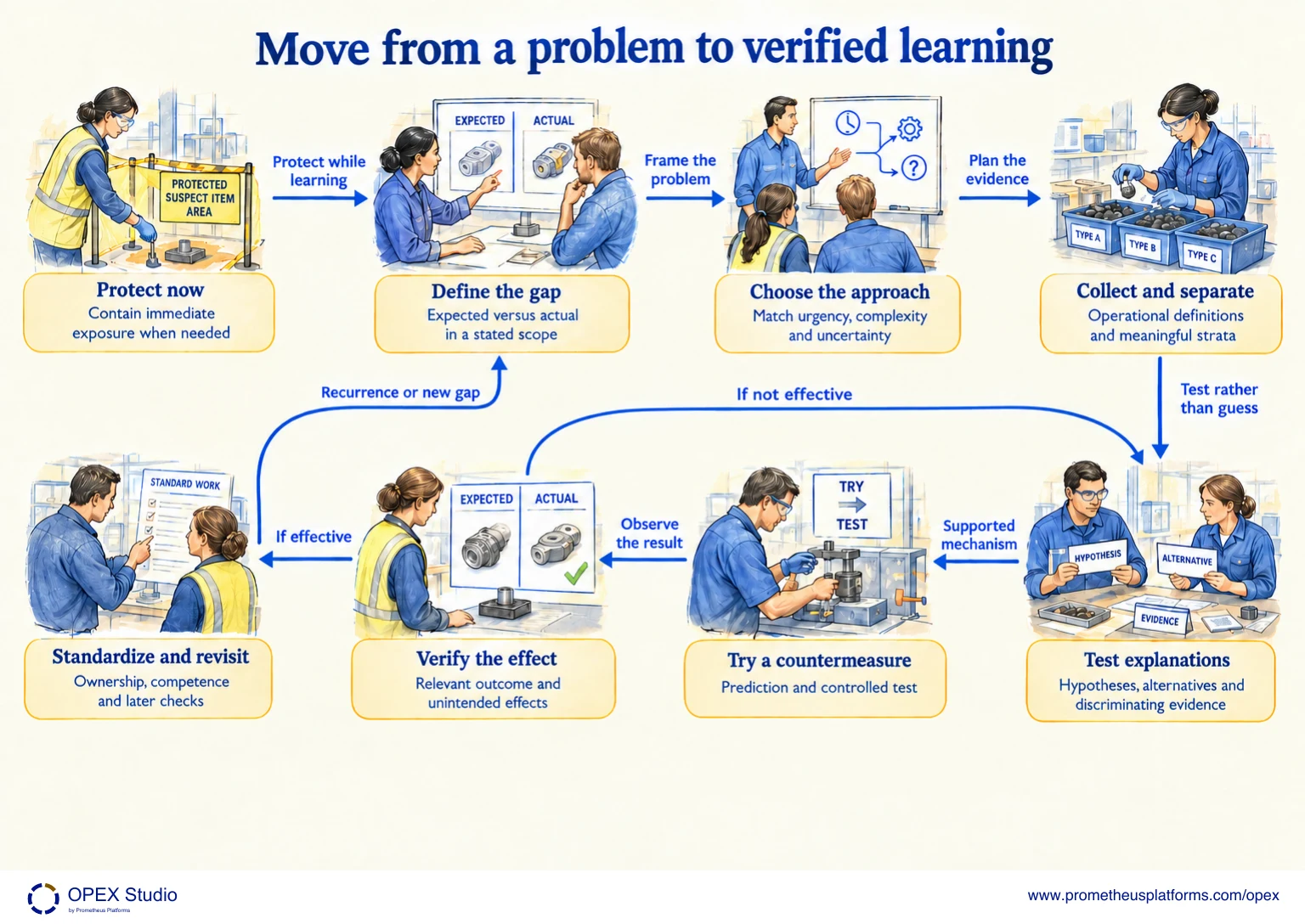
- Choose a problem-solving approach
- Route four work problems by the learning they require
Read the illustrated lesson →Frontline problem solvingDefine event and denominator
- From broad complaint to a testable problem
- Keep volume, error rate and next question together
Read the illustrated lesson →Leadership and daily managementAgree purpose
- Gemba: observe work, ask, follow through
- Separate what was seen from what was assumed
Read the illustrated lesson →Leadership and daily managementChoose support routines
- Leader standard work supports problem solvers
- Follow one commitment from board to work and back
Read the illustrated lesson →Leadership and daily managementCompare actual with standard
- Daily board: measure, respond, learn
- Make six blocked orders actionable
Read the illustrated lesson →Leadership and daily managementDefine strategic gap
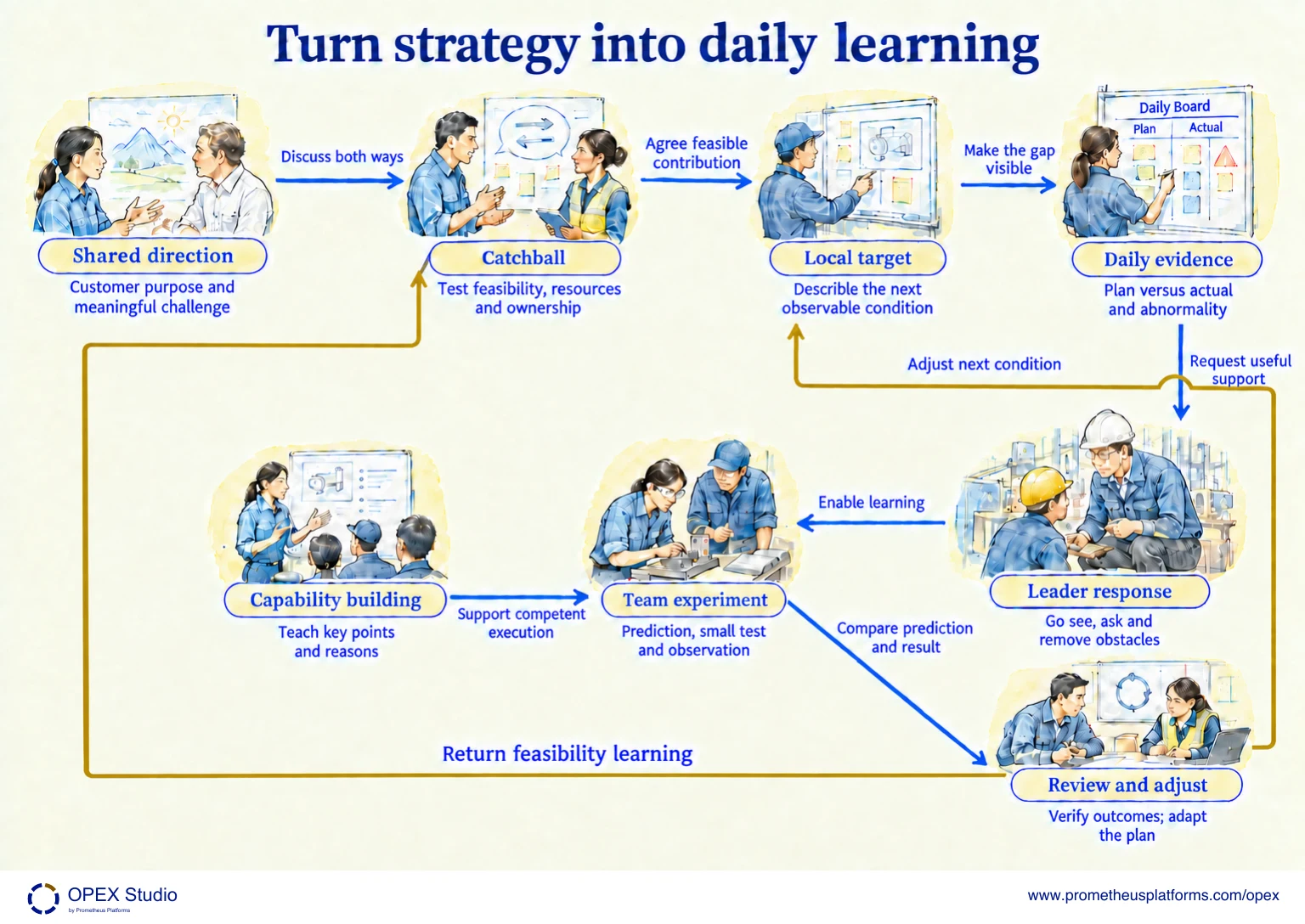
- Hoshin: align strategy through catchball
- Turn conflicting departmental promises into one testable contribution
Read the illustrated lesson →Leadership and daily managementUnderstand challenge
- Improvement and coaching kata
- Use a missed prediction to choose the next experiment
Read the illustrated lesson →Standard work and changeoverPrepare learner and materials
- Job instruction: steps, key points and reasons
- Teach the key point and its reason
Read the illustrated lesson →Equipment wellness and TPMDefine expected condition
- Shine and sustain: evidence over time
- Read the condition history before claiming sustain
Read the illustrated lesson →Equipment wellness and TPMDefine authorized checks
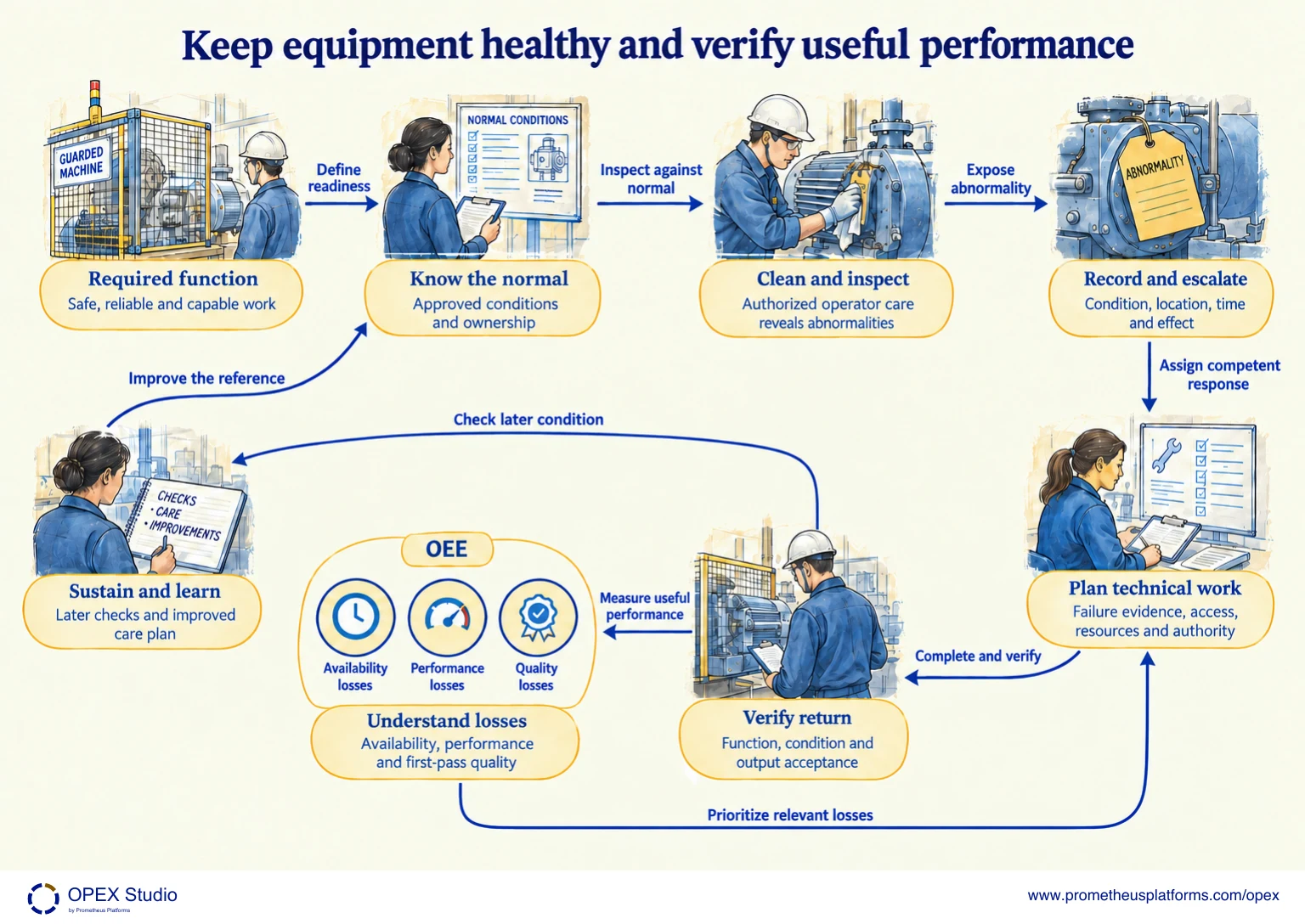
- Operator care and specialist maintenance
- Turn a recurring trace into an owned condition record
Read the illustrated lesson →Equipment wellness and TPMReview function and failures
- Planned maintenance: criticality to verified return
- Challenge the plan before adding maintenance activity
Read the illustrated lesson →Equipment wellness and TPMDeclare planned production time
- OEE loss waterfall with denominator discipline
- Reconcile OEE to good ideal time
Read the illustrated lesson →Equipment wellness and TPMDescribe defect mechanism
- Quality maintenance: control conditions, not just inspect output
- Verify the maintained condition and the product result
Read the illustrated lesson →Theory of ConstraintsIdentify constraint
- TOC five focusing steps
- Return to the current constraint after improvement
Read the illustrated lesson →Theory of ConstraintsDefine goal and boundary
- Find the constraint: evidence, not the biggest queue
- Test the lowest-rate hypothesis against the real route
Read the illustrated lesson →Theory of ConstraintsSchedule constraint
- Drum-buffer-rope: schedule, protect, release
- Connect each drum appointment to its release time
Read the illustrated lesson →Theory of ConstraintsDefine buffer and units
- Buffer management: priorities and recurring causes
- Dispatch eligible work and respond to exposed blockers
Read the illustrated lesson →Theory of ConstraintsDefine goal units/time
- Throughput versus local utilization
- Compare contribution per scarce minute within real limits
Read the illustrated lesson →Theory of ConstraintsDefine deliverable and task dependencies
- Critical chain: dependencies, resources and buffers
- Separate resource order from the integration dependencies
Read the illustrated lesson →Theory of ConstraintsState shared objective
- Conflict cloud: challenge assumptions
- Test the assumption behind the batch-size conflict
Read the illustrated lesson →Lean and TPS foundationsDefine system outcome
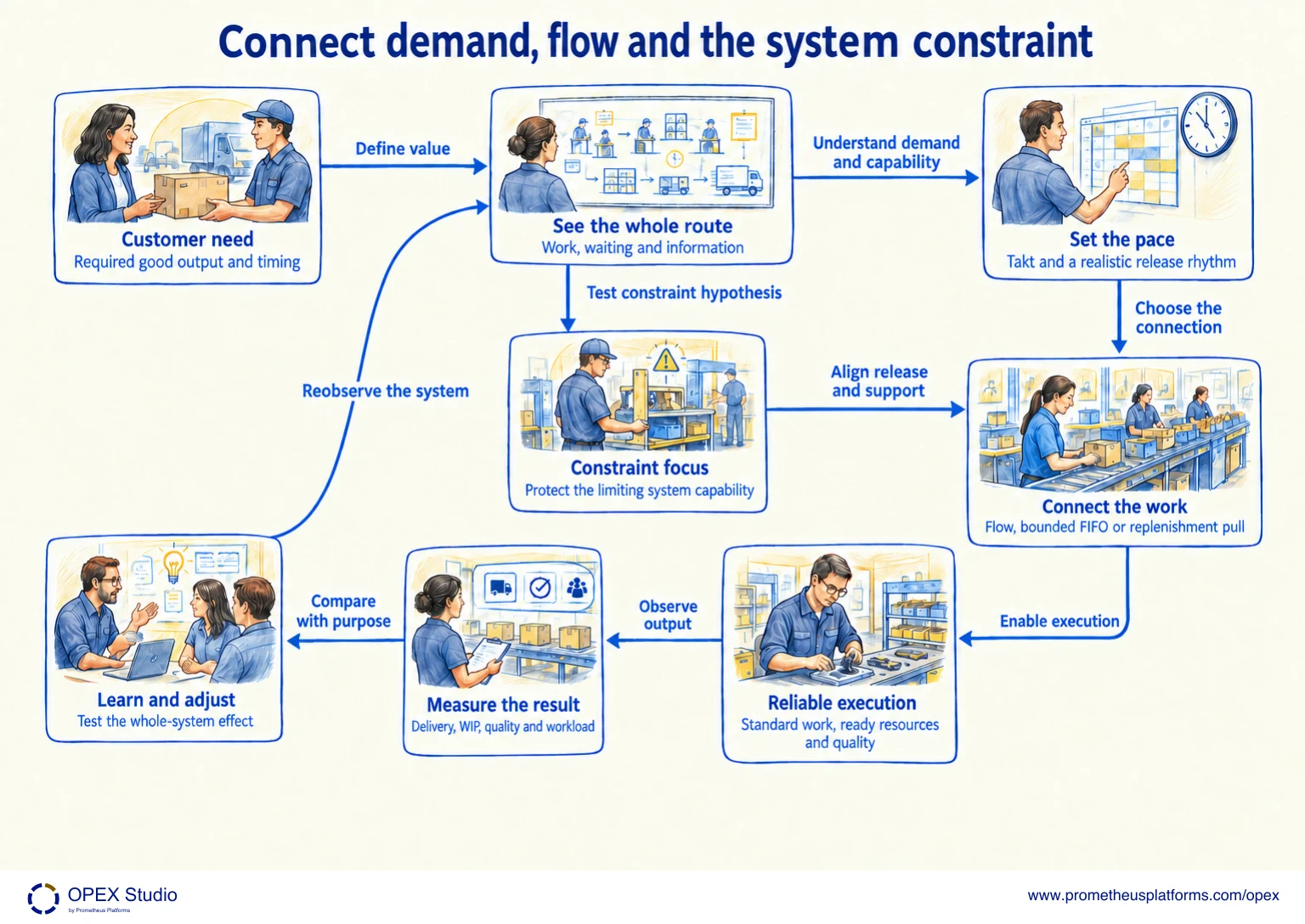
- Lean and TOC: complementary questions, distinct controls
- Choose an intervention from a shared system problem
Read the illustrated lesson →Quality toolsState the decision question in ordinary language.
- Choose the quality tool for the question
- Match the question to the evidence and the decision
Read the illustrated lesson →Quality toolsDefine the inspected unit and each nonconformity category.
- Record defects without changing the denominator
- Reconcile units and fault marks before reporting a rate
Read the illustrated lesson →Quality toolsChoose one basis: count, cost, time or another defined burden.
- Rank problems on one declared basis
- Choose a priority without confusing counts, time and causes
Read the illustrated lesson →Quality toolsDefine the measured characteristic and unit.
- See the distribution without losing the sequence
- Account for every value before interpreting the shape
Read the illustrated lesson →Quality toolsDefine what each paired observation represents.
- Test a relationship without declaring a cause
- Move from an observed association to a defensible test
Read the illustrated lesson →Quality toolsPreserve product, source, shift or other relevant labels.
- Unmix the data before blaming a shift
- Unmix counts, rates and source explanations
Read the illustrated lesson →Quality toolsDefine one observable effect and scope.
- Turn fishbone branches into testable hypotheses
- Turn three proposed causes into a discriminating test record
Read the illustrated lesson →Statistical process controlSeparate measurements, nonconforming units and nonconformities.
- Select a chart from the data and sampling plan
- Choose the chart from the observation and its sampling plan
Read the illustrated lesson →Statistical process controlIdentify the baseline source and time order.
- Separate control limits from specifications
- Record product status and process signal separately
Read the illustrated lesson →Statistical process controlTake five comparable readings in each defined subgroup.
- Read spread before the subgroup average
- Read range, then mean, then record the response
Read the illustrated lesson →Statistical process controlKeep the individual readings in original time order.
- Monitor one reading at a time
- Separate historical limits from later observations
Read the illustrated lesson →Statistical process controlClassify each inspected unit once as conforming or nonconforming.
- Chart nonconforming units with the right denominator
- Match each unit fraction to its own sample-size limits
Read the illustrated lesson →Statistical process controlDefine one nonconformity and the inspection exposure.
- Chart nonconformities per exposure
- Preserve the opportunity behind every nonconformity rate
Read the illustrated lesson →In-station and process controlRecognize the approved signal and notify its owner.
- Respond to a signal with a defined owner
- Reconcile the 40-unit initial exposure across three locations
Read the illustrated lesson →Statistical process controlVerify measurement fitness and process stability.
- Check stability before capability
- Separate the capability calculation from the approval decision
Read the illustrated lesson →Measurement systemsSelect representative parts, appraisers and conditions.
- Separate part variation from measurement variation
- Explain two honest percentages from one measurement study
Read the illustrated lesson →Measurement systemsEstablish the reference classifications and difficult items.
- Check inspection agreement and escape risk
- Read agreement and both error directions separately
Read the illustrated lesson →Automotive quality systemsIdentify operation, risk and controlled characteristic.
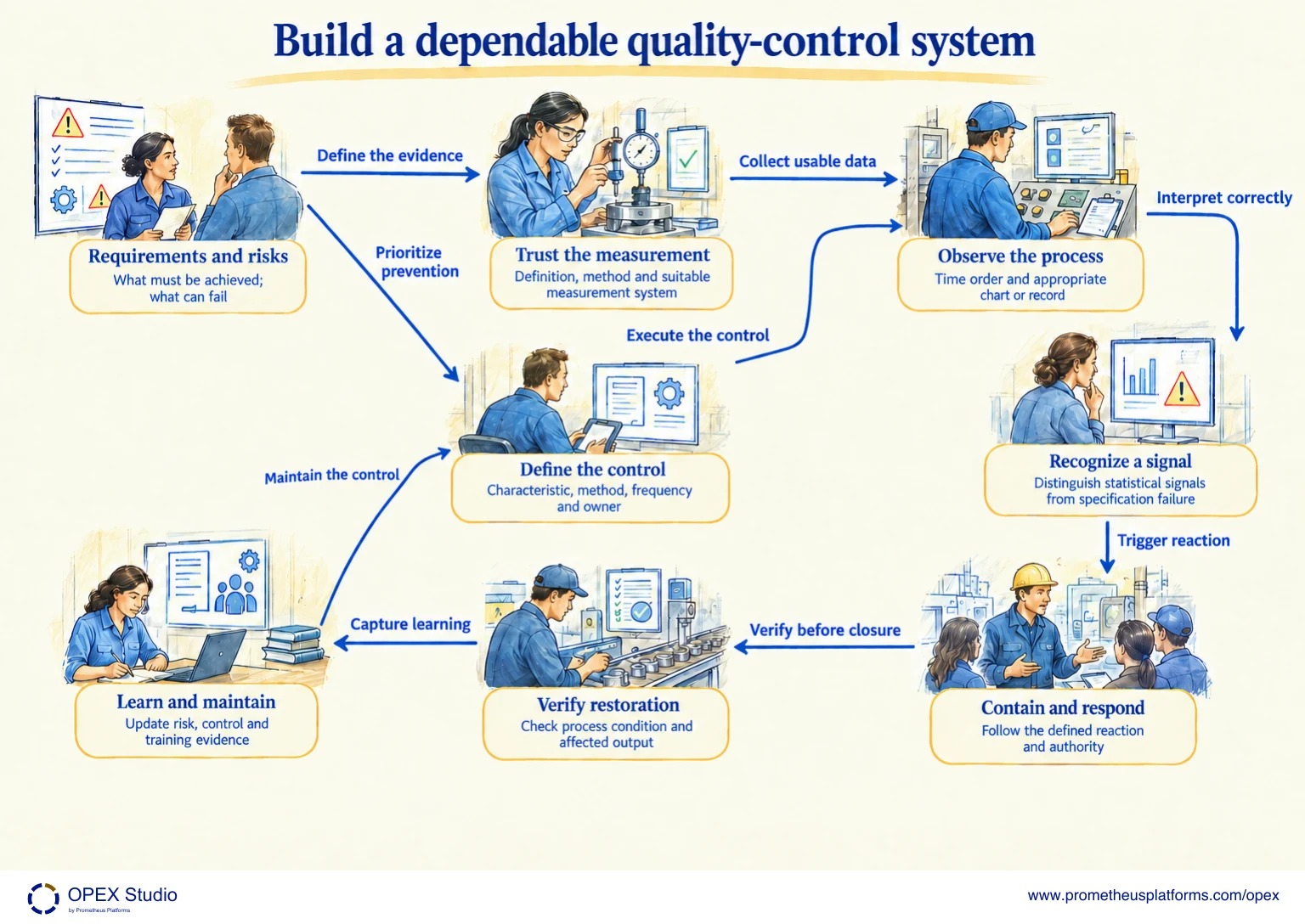
- Link a process risk to an executable control plan
- Connect the risk to the check, record and reaction
Read the illustrated lesson →In-station and process controlConfirm product identity and the current instruction.
- Make the station check and reaction inseparable
- Keep the abnormal reading connected to containment and verification
Read the illustrated lesson →Automotive quality systemsPlan scope and map structure and intended functions.
- Build PFMEA from a failure chain to verified action
- Connect a failure cause to a verified risk action
Read the illustrated lesson →Automotive quality systemsTranslate customer needs into a connected launch plan.
- Use APQP gates to expose launch risk early
- Make the three open launch risks visible at the gate
Read the illustrated lesson →Automotive quality systemsConfirm customer submission and change requirements.
- Distinguish PPAP evidence from production authorization
- Keep submission, evidence and authorization as separate states
Read the illustrated lesson →In-station and process controlIdentify the suspect input or output and its scope.
- Trace one suspect lot through split, merge and rework
- Reconcile the material and prove where it went
Read the illustrated lesson →In-station and process controlChoose specific questions tied to critical process controls.
- Audit whether critical controls are actually followed
- Keep observation, response and effectiveness connected
Read the illustrated lesson →Special processes and NadcapDetermine applicable process, customer and qualification scope.
- Control special processes through qualified conditions and records
- Prove the job-to-procedure-to-run evidence chain
Read the illustrated lesson →Special processes and NadcapConfirm the relevant process, site and customer scope.
- Prepare a Nadcap audit with scope-linked evidence
- Link scope, job evidence and verified gap closure
Read the illustrated lesson →Special processes and NadcapDocument the nonconformance and immediate exposure.
- Close an NCR with verified action against recurrence
- Close the evidence chain from overdue condition to verified system action
Read the illustrated lesson →Automotive quality systemsIdentify organization, customer and certification scope.
- Locate the applicable automotive requirements
- Keep the standard, scheme Rules and revision plan separate
Read the illustrated lesson →In-station and process controlIdentify setpoint, measured variable and sign convention.
- Distinguish a feedback controller from statistical monitoring
- Separate the defined error from the authorized control action
Read the illustrated lesson →Measurement systemsDefine the measurand and relevant conditions.
- Connect calibration to a defensible measurement result
- Connect the measured result to uncertainty and the decision rule
Read the illustrated lesson → No lessons match those words. Try the task or a broader method, or choose All methods.
 OPEXSTUDIO