Facilitator guide
Case objectives, demonstration plans, debriefs, common mistakes and application checks across all 81 workplace cases and method lessons.
Download Facilitator guide PDF · 166 pages · 65.1 MB OPEXSTUDIO
Daily management + gemba + escalation. Follow the visual, practise a decision, then check your thinking.
Fictional teaching examples and AI-generated illustrations. Proposed changes and goals are not achieved results. Use the written instructions and check local conditions before applying a method.
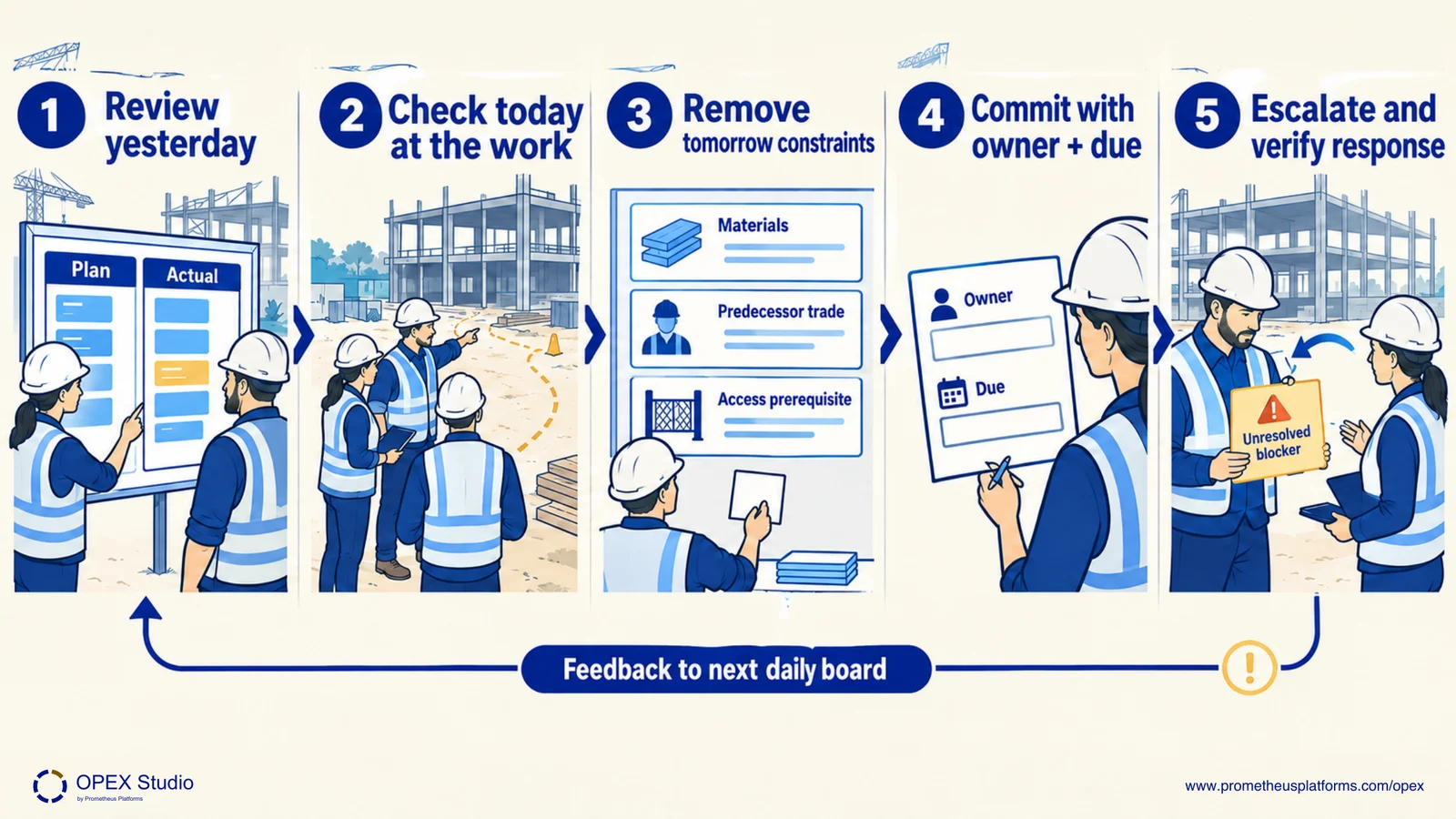
A daily meeting is useful when it changes what happens next. The sample has 82 of 120 commitments completed by their agreed time; the next 120 have a goal of at least 102. Review missed promises, confirm current conditions, expose tomorrow's prerequisites and assign a response. State when an unresolved constraint must be escalated and who verifies the response. A board entry does not authorize work or prove a task is safe.
Baseline: 82 / 120 commitments completed on time = 68.3% (rounded). Proposed next-period goal: at least 102 / 120 = 85%.
A ready commitment needs its prerequisites, accountable owner, due time and verification rule. A planning-board entry is not authorization to begin work.
When is an issue closed: when an owner is assigned, or when the response is verified?
When the defined response and its effect are verified; assignment is only a commitment.
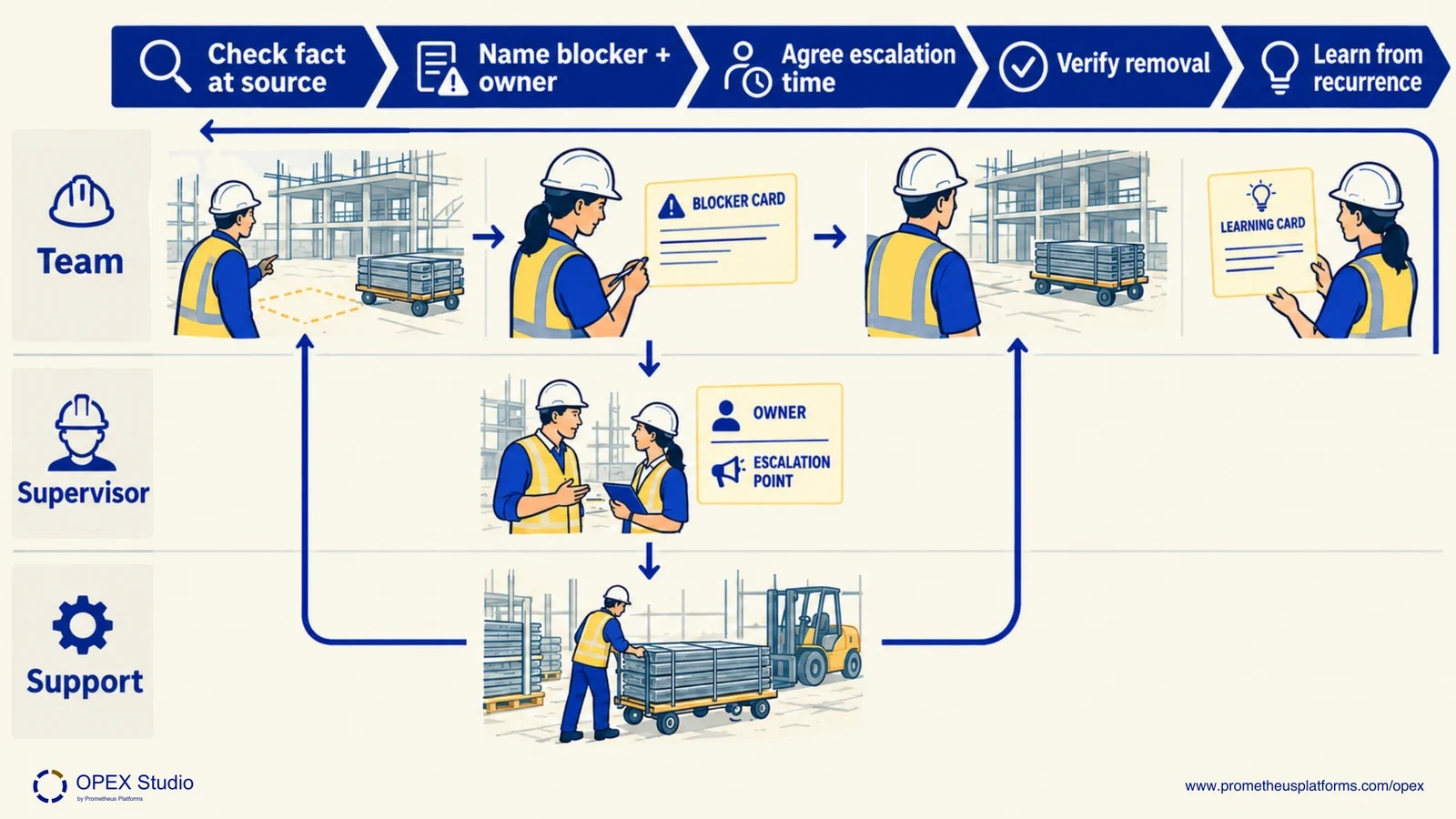
Use a proposed ten-minute huddle cadence as a starting design, not a universal Lean rule: review outcomes, check current readiness, agree the next response and confirm follow-up. Leaders then go to the work to understand unresolved conditions. Record recurring blockers for structured problem solving. Keep urgent hazards on the existing immediate response route rather than waiting for tomorrow's meeting.
First blocking constraints across 38 misses: permit or release 12; material unavailable 10; preceding work incomplete 9; crew availability 7.
Example prerequisites include inspection release, correct fixtures, preceding-trade completion and authorized access. Check their actual removal before closing the issue.
A ten-minute huddle is an authored starting design, not a mandatory method standard. Urgent hazards follow the immediate response route.
What should the leader ask at the work?
What is the expected condition, what is happening now, what is stopping progress, and what support or next test is needed?
Visual management makes standards, deviations and performance understandable and actionable through routines for discussion, response and coaching.
Attractive displays without actionable meaning or ongoing maintenance do not constitute effective visual management.Direct observation and inquiry where value-producing work occurs establish current conditions before action; following a process across departments can reveal its end-to-end operation.
Gemba applies to service and office work as well as manufacturing.PDCA repeats planning, a small trial, review of results and learning, and action informed by that learning.
Check includes analysis and learning; do not reduce it to an approval tick.Read the lessons online or use these PDFs to prepare, practise and review with your team. No sign-in needed.
Case objectives, demonstration plans, debriefs, common mistakes and application checks across all 81 workplace cases and method lessons.
Download Facilitator guide PDF · 166 pages · 65.1 MBPrintable case worksheets, blank observation records and five calculation exercises; answers are separate.
Download Learner workbook PDF · 169 pages · 10.7 MBReasoned sample responses, worked calculations and coaching guidance; fictional examples are clearly labelled.
Download Answer key and coaching notes PDF · 105 pages · 8.5 MBThe native method mechanisms and worked applications for all 68 detailed lessons, in a separate bookmarked portrait reference.
Download Method and application reference PDF · 141 pages · 10.2 MBFive illustrated system chapters: 15 Flare concept maps and 26 original workplace teaching cards, with links to all 81 supporting cases and method lessons.
Download Illustrated systems atlas PDF · 69 pages · 55.8 MBUse an A3 when a recurring cross-team blocker needs a connected explanation and agreed countermeasure.
Explore the connected method →A recurring defect that exposes customers needs protection and verified cause work, not repeated promises at the board.
Explore the connected method →