Facilitator guide
Case objectives, demonstration plans, debriefs, common mistakes and application checks across all 81 workplace cases and method lessons.
Download Facilitator guide PDF · 166 pages · 65.1 MB OPEXSTUDIO
Confirm the relevant process, site and customer scope.. Follow the visual, practise a decision, then check your thinking.
Fictional teaching examples and AI-generated illustrations. Proposed changes and goals are not achieved results. Use the written instructions and check local conditions before applying a method.
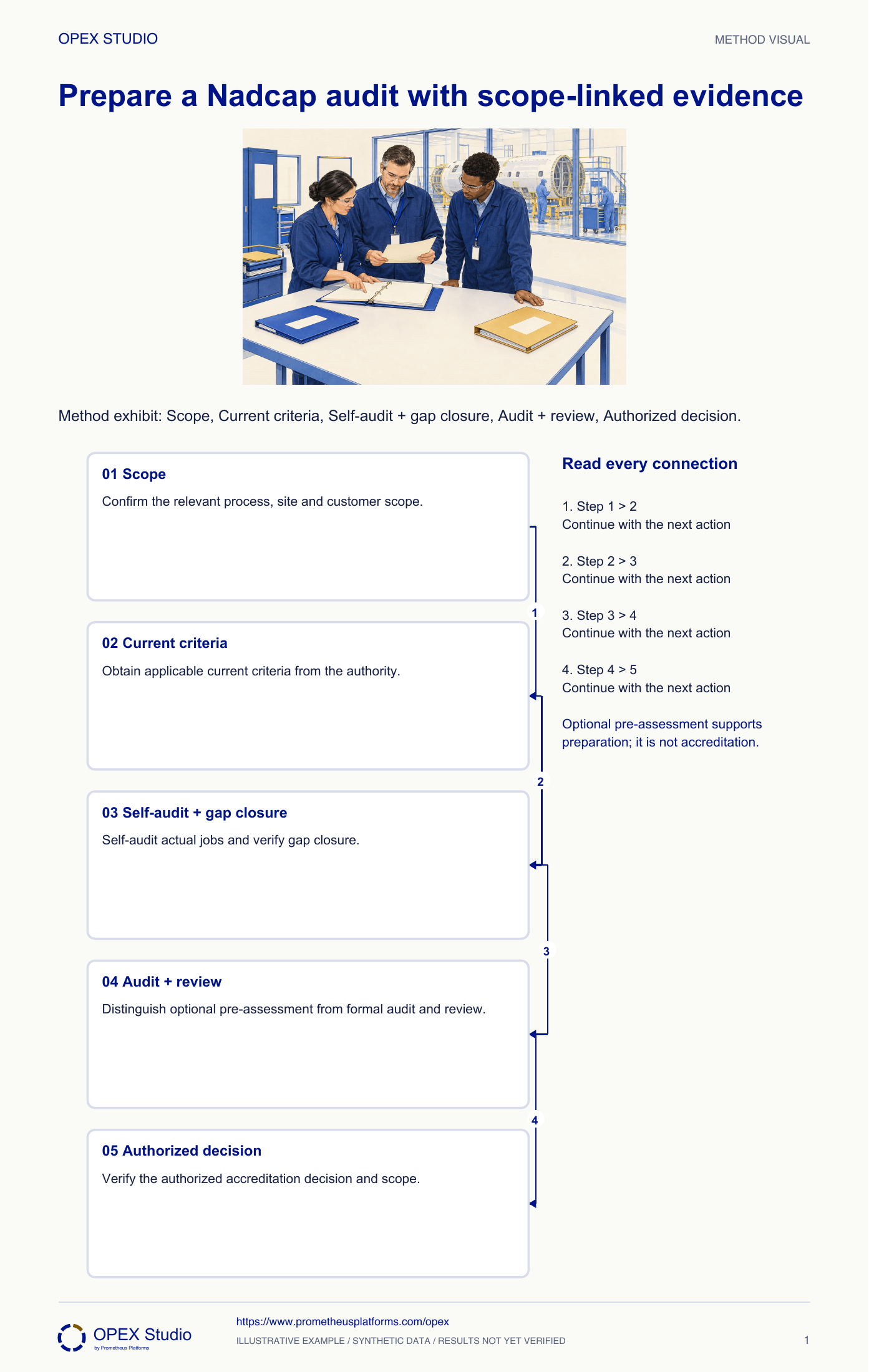
Nadcap readiness starts with the applicable scope and criteria, not with a universal binder template. Confirm the relevant process and site requirements using the current PRI and customer authorities. Perform the required preparation and self-audit with actual job evidence, identify gaps and verify corrective action. An optional pre-assessment can help preparation but is not the accreditation decision. The formal audit and subsequent review follow the authorized program process. Keep evidence linked to the criteria revision and the job being examined. This original preparation workflow does not prescribe an audit sample size, a universal checklist or assurance that accreditation will be granted.
Scope, criteria revision and actual job evidence come first.
No official audit sample size or universal checklist is supplied.
Self-audit, optional pre-assessment and accreditation decision differ.
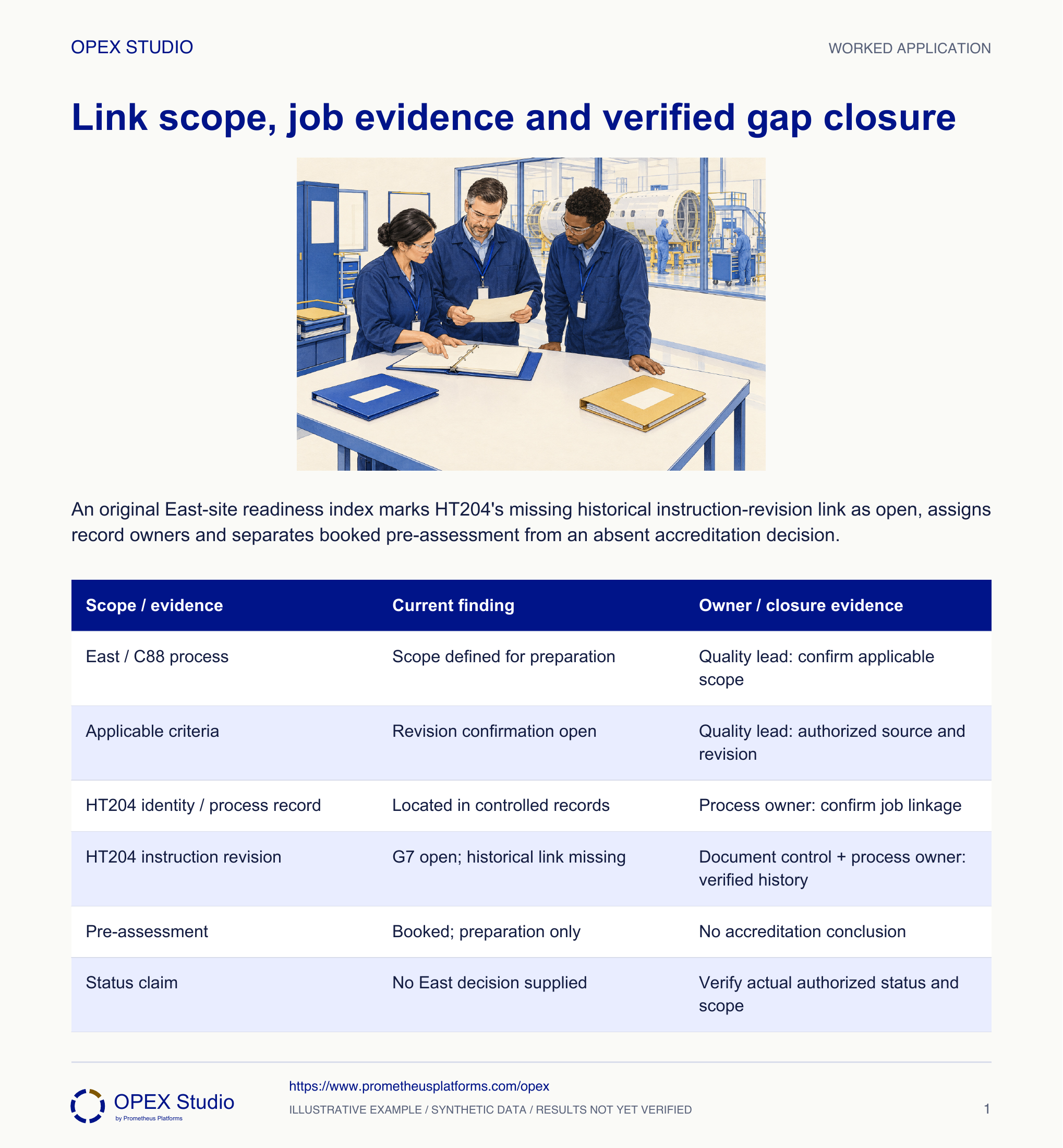
Fictional preparation exercise: quality lead Ren works at Alder Aerospace, East site. A customer request concerns a defined heat-treatment process at East. The company’s West site has a separate scope record. Ren is assembling a self-audit evidence trail for job HT204, but the training record is missing the link between its processing instruction and the applicable revision. No accreditation decision is supplied for East.
Keep G7 open, seek controlled revision/effectivity history and assess affected-job implications through the process owner. Do not reconstruct an unsupported signature or backdate a record.
The missing fact concerns historical applicability, not whether a PDF exists. A file-count metric would close the wrong problem.
Build a traceable preparation record for a defined site/process scope, distinguish an evidence gap from a completed action, and describe readiness without claiming accreditation.
Fictional preparation exercise: quality lead Ren works at Alder Aerospace, East site. A customer request concerns a defined heat-treatment process at East. The company’s West site has a separate scope record. Ren is assembling a self-audit evidence trail for job HT204, but the training record is missing the link between its processing instruction and the applicable revision. No accreditation decision is supplied for East.
Role: Quality lead coordinating the process owner and document-control owner; program questions go through the appropriate PRI channel.
The actual site/process/customer scope, applicable authorized criteria and job evidence are linked and current. Preparation status and accreditation status are recorded separately.
Management wants to mark preparation complete because a folder exists and an optional pre-assessment is booked. The job-to-instruction link remains unverified.
| Fictional evidence item | Status supplied to Ren |
|---|---|
| Requested scope | East site; defined heat-treatment process; customer request C88 |
| Criteria access | Authorized source identified; exact applicable revision to be confirmed |
| Job HT204 | Job identity, equipment reference and process record located |
| Instruction linkage | Job record lacks a confirmed applicable instruction revision |
| Other site | West scope record exists; applicability to East not established |
| Program status | Optional pre-assessment booked; no East accreditation decision supplied |
Ren records East, the requested process and customer request C88. He keeps West’s status in a separate reference and identifies who must confirm the actual scope.
Why: A company name alone cannot establish that another site or process is covered. Scope errors make a polished evidence folder misleading.
Evidence: The preparation cover sheet names East and the requested process without claiming accredited status.
The quality lead obtains the relevant current audit criteria through the authorized PRI system and resolves applicability questions with the appropriate program contact. Exact revision and access date are recorded locally.
Why: A downloaded template or an old internal checklist cannot be assumed current. This lesson supplies no real audit clauses to fill that gap.
Evidence: The source/revision entry remains open until confirmed; the training index is not labelled an official form.
Ren follows HT204 from job identity to process instruction, equipment record, execution evidence and required verification records under the applicable criteria. He records the missing instruction-revision link rather than checking the row complete.
Why: An evidence trail must support the actual job, not merely show that a procedure exists somewhere.
Evidence: Gap G7 identifies the unverified link, its document-control/process owners and the evidence needed to resolve it.
The owners retrieve the controlled instruction history and assess HT204 against it. A reviewer checks the resulting link and any affected-job implications before closing G7.
Why: Uploading a current procedure does not establish which instruction governed an earlier job. Historical uncertainty may require additional investigation.
Evidence: Closure requires retrievable job-specific evidence and a review record; future findings are not fabricated in this example.
Ren records the optional pre-assessment as preparation activity only. Formal audit, review, nonconformance response and the authorized decision follow the applicable program process.
Why: A booked or completed pre-assessment is not accreditation. The organization must verify actual status and scope before making an external claim.
Evidence: Readiness remains conditional on open gaps; no East accreditation or customer approval is asserted.
| Scope / evidence | Current finding | Owner / closure evidence |
|---|---|---|
| East / C88 process | Scope defined for preparation | Quality lead: confirm applicable scope |
| Applicable criteria | Revision confirmation open | Quality lead: authorized source and revision |
| HT204 identity / process record | Located in controlled records | Process owner: confirm job linkage |
| HT204 instruction revision | G7 open; historical link missing | Document control + process owner: verified history |
| Pre-assessment | Booked; preparation only | No accreditation conclusion |
| Status claim | No East decision supplied | Verify actual authorized status and scope |
Document control finds today’s approved instruction but cannot show whether that revision applied when HT204 was processed. The folder is now complete by file count.
Keep G7 open, seek controlled revision/effectivity history and assess affected-job implications through the process owner. Do not reconstruct an unsupported signature or backdate a record.
The missing fact concerns historical applicability, not whether a PDF exists. A file-count metric would close the wrong problem.
A defensible job/revision link or an explicitly managed unresolved condition is required; any product/customer response follows its actual authority.
New fictional case: North site prepares a defined NDT scope. A South-site status document is available. Job ND71 has an equipment identifier, but the record does not link the person performing the work to the applicable qualification evidence. An optional pre-assessment has identified the gap; no formal North accreditation decision is supplied.
| Input | Supplied fact |
|---|---|
| Requested scope | North site; defined NDT process |
| Available status document | South site only |
| Job ND71 | Equipment identified; personnel-evidence link missing |
| Preparation activity | Optional pre-assessment completed |
| Missing authority | No North accreditation decision supplied |
State that North is preparing the specified NDT scope and has an open job-evidence gap; the supplied records do not establish North accreditation.
The process/qualification record owners must retrieve applicable evidence linking the person, role and job conditions, with reviewer verification and any necessary affected-job assessment. Do not invent qualifications or reproduce an official requirement not supplied.
The South record applies only to its actual scope, and the optional pre-assessment is preparation evidence, not an accreditation decision. Verify actual status through the authorized program records before any claim.
| Record field | Applicable evidence | Decision / next owner |
|---|---|---|
| Scope | North / specified NDT | Preparation; no North decision supplied |
| Gap | ND71 personnel evidence linkage | Named process and qualification owners |
| Closure | Applicable job-specific evidence | Independent verification; assess implications |
| Status | South record / pre-assessment | Neither establishes North accreditation |
What can this learning index establish, and what requires the program authority?
Does today’s procedure prove yesterday’s applicability?
Which exact link is missing for ND71?
How would you describe progress without claiming accreditation?
Sort each supplied fact into scope, preparation, job evidence or authorized status before completing the gap record.
Owner: Site quality lead with the responsible process and record owners
Record: Controlled preparation index linked to applicable criteria, actual job evidence and gap verification
Review: At preparation reviews and after each verified gap closure; use actual program requirements for scheduling
Evidence: Current scope/criteria references, traceable job records, closed-gap verification and separately verified accreditation status
Retain the open gap and address applicability through qualified owners/PRI channels; avoid unsupported external status claims.
Preparation includes the applicable audit criteria, self-audit, audit, NCR closure and task-group decision, with records managed in PRI EAN.
PRI EAN is formerly eAuditNet. Timelines are illustrative and scope-dependent; no fixed audit deadline is claimed here.Optional pre-assessment helps preparation but is not part of the accreditation decision.
Do not conflate this with the required self-audit or consulting/certification.Read the lessons online or use these PDFs to prepare, practise and review with your team. No sign-in needed.
Case objectives, demonstration plans, debriefs, common mistakes and application checks across all 81 workplace cases and method lessons.
Download Facilitator guide PDF · 166 pages · 65.1 MBPrintable case worksheets, blank observation records and five calculation exercises; answers are separate.
Download Learner workbook PDF · 169 pages · 10.7 MBReasoned sample responses, worked calculations and coaching guidance; fictional examples are clearly labelled.
Download Answer key and coaching notes PDF · 105 pages · 8.5 MBThe native method mechanisms and worked applications for all 68 detailed lessons, in a separate bookmarked portrait reference.
Download Method and application reference PDF · 141 pages · 10.2 MBFive illustrated system chapters: 15 Flare concept maps and 26 original workplace teaching cards, with links to all 81 supporting cases and method lessons.
Download Illustrated systems atlas PDF · 69 pages · 55.8 MBExplore this connected method and its separate application conditions.
Explore the connected method →Explore this connected method and its separate application conditions.
Explore the connected method →Explore this connected method and its separate application conditions.
Explore the connected method →