Facilitator guide
Case objectives, demonstration plans, debriefs, common mistakes and application checks across all 81 workplace cases and method lessons.
Download Facilitator guide PDF · 166 pages · 65.1 MB OPEXSTUDIO
Verify item and use. Follow the visual, practise a decision, then check your thinking.
Fictional teaching examples and AI-generated illustrations. Proposed changes and goals are not achieved results. Use the written instructions and check local conditions before applying a method.
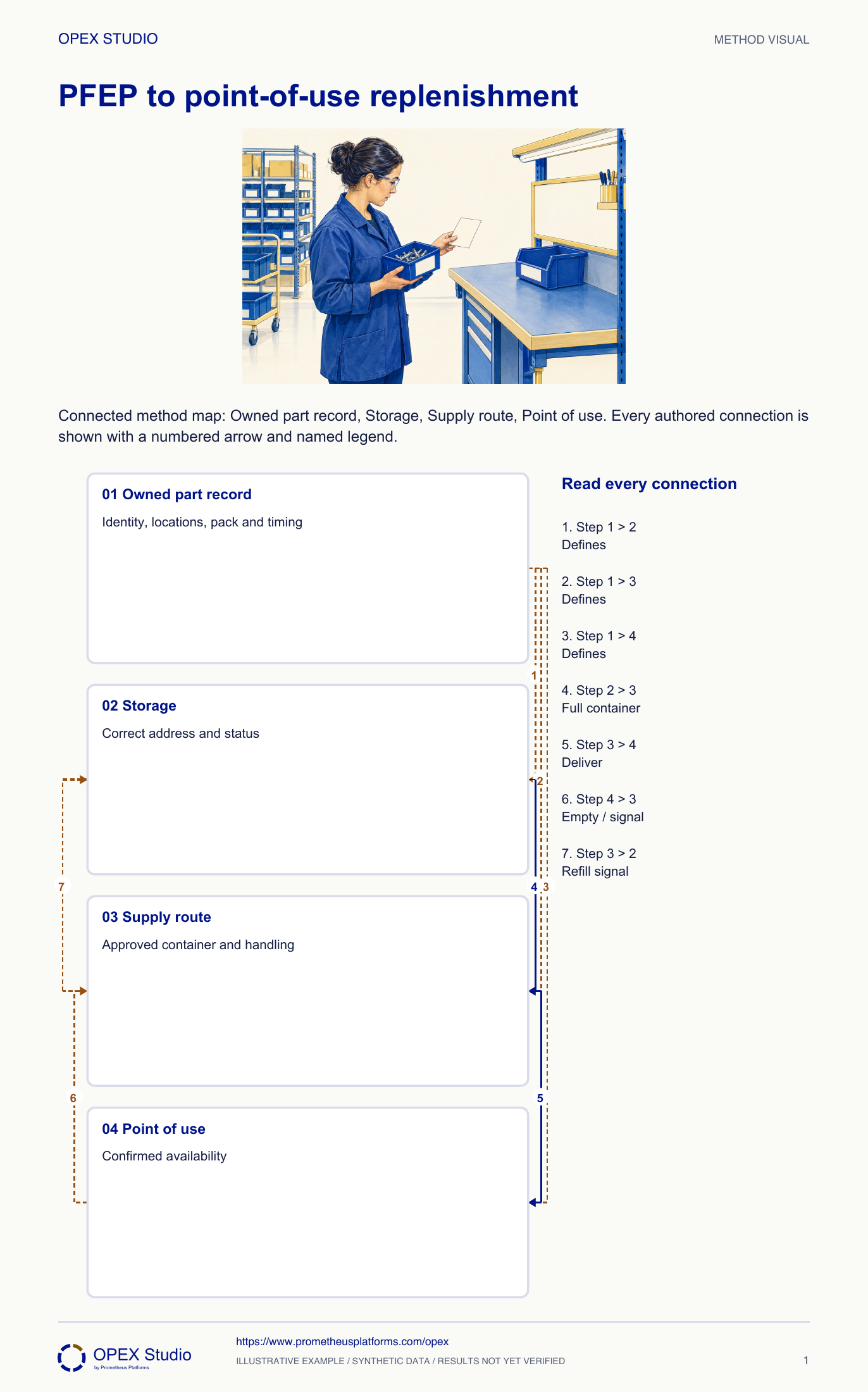
A reliable material route depends on reliable item information. Record the part identity, point of use, storage address, consumption, pack size and replenishment timing in fields that have clear owners. Walk one item from storage to consumption and back through its empty-container or signal return. Resolve discrepancies between the record and the actual route before expanding the system. Keep handling restrictions and quality status visible. A clean spreadsheet can still be wrong; the team needs a routine for maintaining it after changes. The aim is dependable supply at the point of use, not transport activity for its own sake.
A spreadsheet without ownership becomes stale.
Fast transport alone does not create pull.
Feeds kanban parameters; Protects operator standardized work.
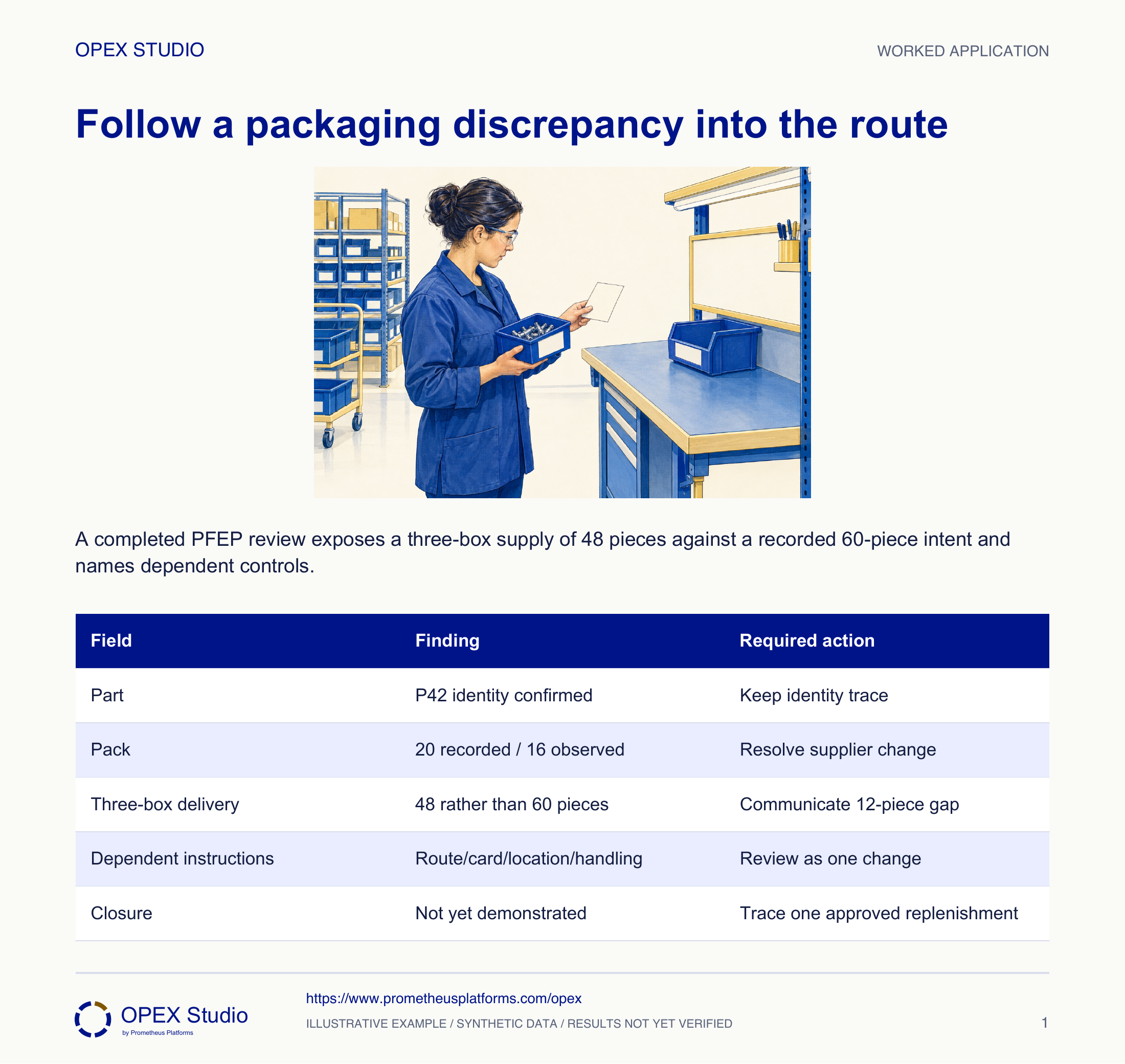
Fictional bracket-supply route: part P42 is consumed at bench B in packs defined as 20 pieces in its part record. Handler Eva finds supplier boxes containing 16. The route replenishes by box count, so the discrepancy changes what the bench receives.
Use the shortage/nonconformance process and retain the approved 20-piece master record until an authorized packaging change exists.
The same initial observation can lead to a different correction when its cause is known.
Reconcile part identity and packaging data with a real replenishment route, then control the impact of a pack-size change before using it in supply instructions.
Fictional bracket-supply route: part P42 is consumed at bench B in packs defined as 20 pieces in its part record. Handler Eva finds supplier boxes containing 16. The route replenishes by box count, so the discrepancy changes what the bench receives.
Role: Material-flow owner with handler, purchasing and the point-of-use operator.
Part identity, packaging quantity, location and handling data agree with the actual route and approved supply method.
The route card asks for three boxes, assumed to be 60 pieces, while the new boxes supply only 48.
| PFEP / route field | Record versus observation |
|---|---|
| Part identity | P42 bracket; identity agrees |
| Pack quantity | Record 20 pieces; observed box 16 |
| Route instruction | 3 boxes per replenishment |
| Source / destination | Store S → bench B |
| Handling data | Weight and container dimensions require confirmation |
| Change status | Supplier packaging change not yet approved in master data |
Eva checks the part identity and counts a controlled sample with the supplier/receiving owner. She retains the packaging revision and delivery identity.
Why: A count mismatch could represent a packaging change, a short shipment or a wrong item. Updating a number without understanding the cause could normalize an error.
Evidence: Confirmed teaching observation: same P42 identity, 16 pieces in the observed package.
Three recorded 20-piece boxes imply 60 pieces. Three observed 16-piece boxes contain 48, a 12-piece difference. Eva communicates the discrepancy to the consuming bench.
Why: Box counts are meaningful only with the matching pack quantity. The route may look complete while under-supplying its intended piece quantity.
Evidence: 3 × 20 = 60; 3 × 16 = 48; difference 12 pieces.
Check pack dimensions, weight, source and destination addresses, consumption basis, replenishment trigger, route frequency and any containers/card quantities tied to packaging.
Why: A PFEP connects item data to physical supply. Changing one quantity can leave other records and handling assumptions inconsistent.
Evidence: Affected-field review names each dependent instruction and its owner.
Follow the approved discrepancy response while purchasing and the flow owner decide the valid packaging basis. If 16-piece packs are approved, revise the route’s unit definition and quantity logic rather than silently calling a box 20 pieces.
Why: Neither the handler nor the software display should invent stock or authority. Rounding a replacement box count also requires review of stock and handling consequences.
Evidence: Interim supply instruction is explicit; approved revision is traceable to the packaging decision.
Trace an authorized replenishment from its signal through pick, conveyance and receipt. Reconcile actual pieces and update the record only through the controlled owner.
Why: A corrected database row is insufficient if the old route card, labels or point-of-use expectations remain in use.
Evidence: Record and physical receipt agree for item, packaging, count, location and handling method.
| Field | Finding | Required action |
|---|---|---|
| Part | P42 identity confirmed | Keep identity trace |
| Pack | 20 recorded / 16 observed | Resolve supplier change |
| Three-box delivery | 48 rather than 60 pieces | Communicate 12-piece gap |
| Dependent instructions | Route/card/location/handling | Review as one change |
| Closure | Not yet demonstrated | Trace one approved replenishment |
Investigation finds the approved package is still 20 pieces; the observed 16-piece boxes were short.
Use the shortage/nonconformance process and retain the approved 20-piece master record until an authorized packaging change exists.
The same initial observation can lead to a different correction when its cause is known.
Supplier response and receipt discrepancy support the decision not to rewrite the pack definition.
Separate fictional route: part F9 has a recorded 25 fasteners per bag. Approved new packaging contains 30. A replenishment instruction still says four bags, intended as 100 pieces.
| Input | Value |
|---|---|
| Old pack | 25 pieces/bag |
| Approved new pack | 30 pieces/bag |
| Old route quantity | 4 bags; intended 100 pieces |
Four new bags deliver 120 pieces, 20 more than the old 100-piece intent.
Review the pack basis, replenishment trigger, point-of-use capacity, handling data and any signal quantity dependent on the old pack.
Three bags deliver 90 and four deliver 120. Neither automatically preserves the intended 100; the owner must approve an appropriate supply rule and practical constraints.
| Option / control | Calculation / evidence | Conclusion |
|---|---|---|
| Four bags | 4 × 30 | 120 pieces; 20 extra |
| Three bags | 3 × 30 | 90 pieces; 10 short |
| Decision | Review stock and supply intent | No silent rounding |
Could this be a wrong part instead of a pack change?
What does the bench actually receive?
What does each rounding choice imply?
Which physical event proves the records agree?
Translate every package quantity into pieces, then audit the dependent instructions.
Owner: PFEP/master-data owner with purchasing and material-flow owner
Record: Controlled packaging change, dependent-field review and receipt trace
Review: At the packaging change and first representative replenishments
Evidence: Correct item/count/location and consistent approved handling instructions
Keep the discrepancy visible and use the approved interim supply response until all affected records and actions agree.
Part-specific usage, locations, pack size, transit and handling data
Method reference; original OPEX scenario and diagram are synthetic teaching content, not source case results.Read the lessons online or use these PDFs to prepare, practise and review with your team. No sign-in needed.
Case objectives, demonstration plans, debriefs, common mistakes and application checks across all 81 workplace cases and method lessons.
Download Facilitator guide PDF · 166 pages · 65.1 MBPrintable case worksheets, blank observation records and five calculation exercises; answers are separate.
Download Learner workbook PDF · 169 pages · 10.7 MBReasoned sample responses, worked calculations and coaching guidance; fictional examples are clearly labelled.
Download Answer key and coaching notes PDF · 105 pages · 8.5 MBThe native method mechanisms and worked applications for all 68 detailed lessons, in a separate bookmarked portrait reference.
Download Method and application reference PDF · 141 pages · 10.2 MBFive illustrated system chapters: 15 Flare concept maps and 26 original workplace teaching cards, with links to all 81 supporting cases and method lessons.
Download Illustrated systems atlas PDF · 69 pages · 55.8 MBExplore this connected method and its separate application conditions.
Explore the connected method →Explore this connected method and its separate application conditions.
Explore the connected method →Explore this connected method and its separate application conditions.
Explore the connected method →