Facilitator guide
Case objectives, demonstration plans, debriefs, common mistakes and application checks across all 81 workplace cases and method lessons.
Download Facilitator guide PDF · 166 pages · 65.1 MB OPEXSTUDIO
Agree ready/done. Follow the visual, practise a decision, then check your thinking.
Fictional teaching examples and AI-generated illustrations. Proposed changes and goals are not achieved results. Use the written instructions and check local conditions before applying a method.
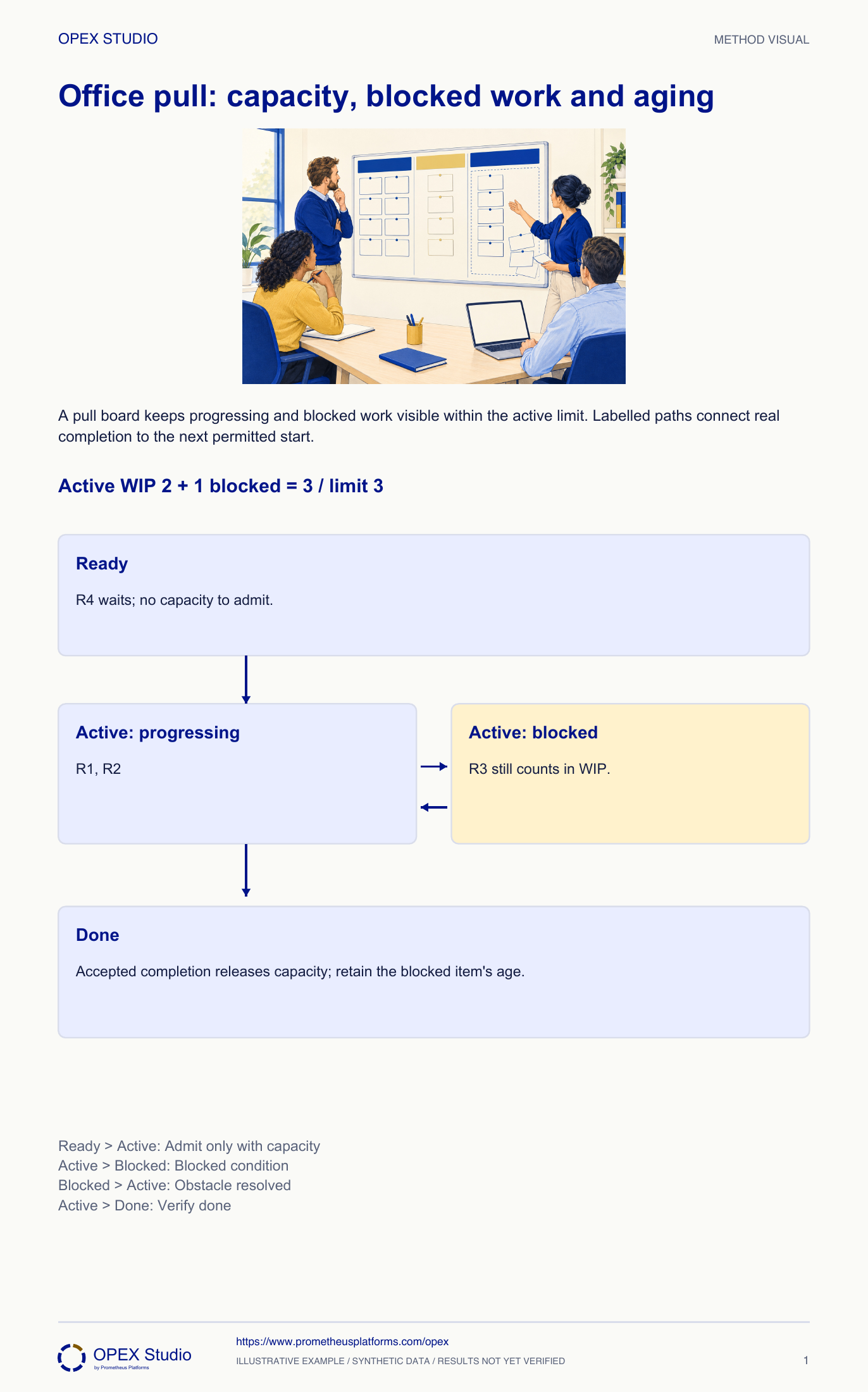
A request board becomes useful when the team agrees what may enter active work, what completion means and what to do when progress stops. Begin with a provisional capacity limit, not a supposedly universal number. Keep blocked requests visible and counted so that the limit reflects real commitments. Review old work and remove obstacles before admitting more. A limit can expose a dependency that another team must help resolve. Judge the experiment by completed service, elapsed time and rework, not by how many tickets moved between columns. Urgent work needs an explicit exception policy.
Moving blocked work off-board does not reduce WIP.
A universal WIP number is not prescribed.
FIFO where appropriate; Escalation handles exceptions transparently.
Fictional administrative team: the agreed active-work limit is three requests, including blocked work. R1 and R2 are progressing, R3 awaits a required approval, and complete request R4 is ready to start. Coordinator Devon is asked to move R3 off the board so R4 can be admitted.
Use the documented exception: name its approver, identify which commitment changes, record the temporary count and set a review/exit condition.
Urgency may justify a controlled exception; hiding an extra start prevents the team from seeing its cost or restoring the normal limit.
Count blocked work inside the declared active limit, choose the next action from capacity and age evidence, and retain explicit control of urgent exceptions.
Fictional administrative team: the agreed active-work limit is three requests, including blocked work. R1 and R2 are progressing, R3 awaits a required approval, and complete request R4 is ready to start. Coordinator Devon is asked to move R3 off the board so R4 can be admitted.
Role: Office team coordinator with the approval owner.
Ready work is pulled when capacity is available; the team sees all accepted active work, its age and its blockers.
Moving the blocked card to an uncounted list would make the board appear to have capacity that the agreed rule does not provide.
| Request | Status | Age / next evidence |
|---|---|---|
| R1 | Progressing | 1 working day; review due today |
| R2 | Progressing | 2 working days; calculation in progress |
| R3 | Blocked | 4 working days; approval owner contacted |
| R4 | Ready, not active | Complete inputs; waiting for a slot |
| Policy | Active limit 3 | Blocked work counts |
Devon counts two progressing requests plus one blocked request. He records three active items against a limit of three and leaves R4 in Ready.
Why: A WIP limit is meaningful only when its entry, exit and blocked-work rules remain consistent. Relabeling work does not release capacity.
Evidence: 2 progressing + 1 blocked = 3 active; no ordinary slot for R4.
The team checks why R3 has waited four working days, whether the approval request was complete, and who can provide a decision. It records a next contact time rather than simply coloring the card red.
Why: Aging prompts a response to accepted work. The oldest item is not automatically the most urgent, but its wait needs an explanation.
Evidence: R3 has an approval owner, missing decision and next review time.
Devon asks whether available colleagues can help R1 complete its review or assemble the missing approval evidence for R3. They retain each request’s acceptance criteria.
Why: Starting more work can increase context switching while leaving completion unchanged. Helping finish must not bypass required checks.
Evidence: One named support action, with the request still counted until genuine completion.
When R1 is actually completed and its acceptance evidence recorded, the active count falls to two. The team then pulls R4 using its agreed ready-queue ordering rule.
Why: The release is linked to a real exit event, not to optimism that someone will finish later.
Evidence: R1 completed; R2 and R3 remain active; R4 admitted; count returns to three.
Record blocked age, completion rate and any exceptions over a representative period. If approval delays repeatedly occupy the limit, address that dependency with its owner.
Why: A board alone cannot remove a cross-team response failure. Changing the limit needs an explicit learning decision, not a hidden workaround.
Evidence: A review record names the recurring approval cause and a test of response reliability.
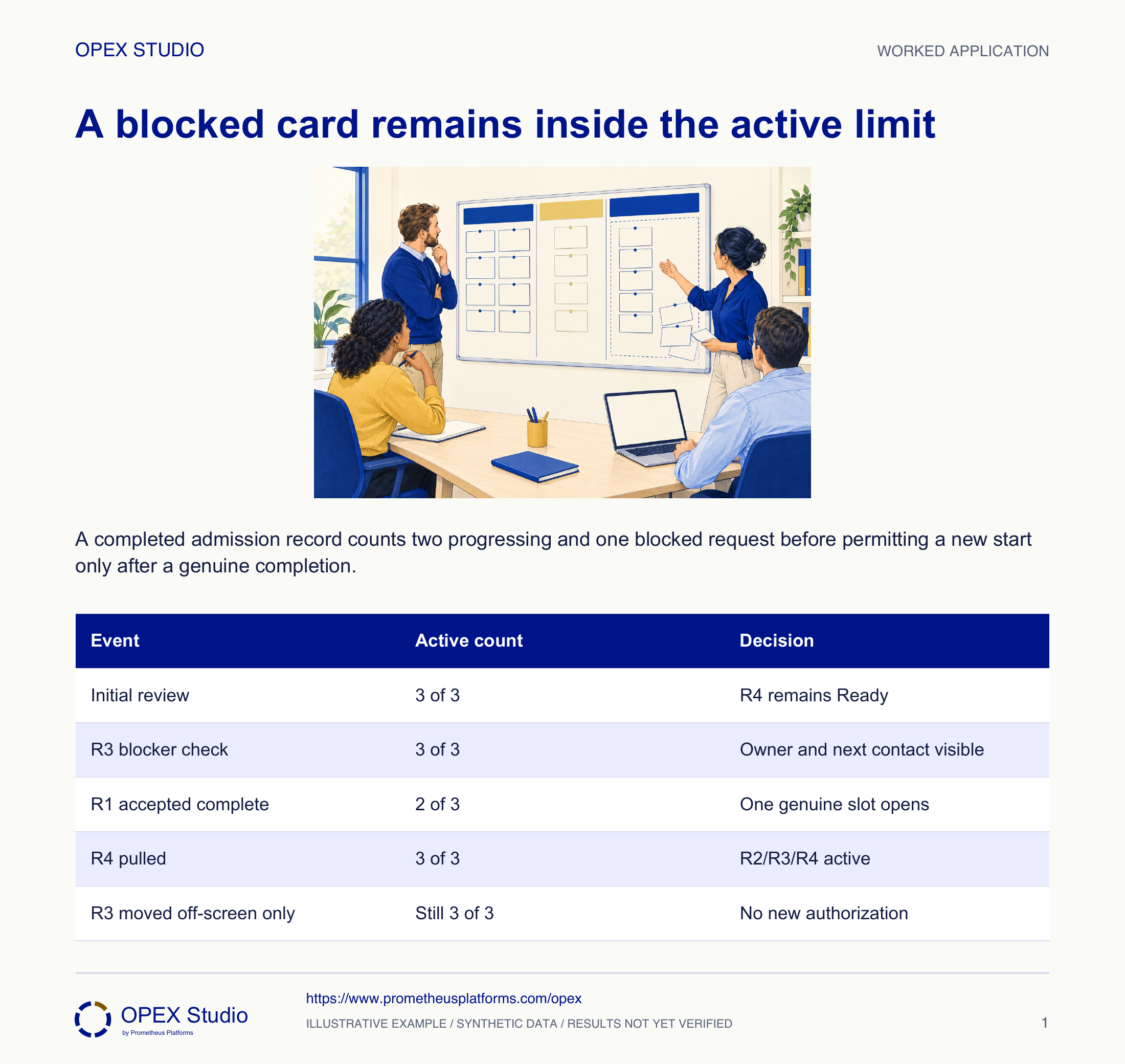
| Event | Active count | Decision |
|---|---|---|
| Initial review | 3 of 3 | R4 remains Ready |
| R3 blocker check | 3 of 3 | Owner and next contact visible |
| R1 accepted complete | 2 of 3 | One genuine slot opens |
| R4 pulled | 3 of 3 | R2/R3/R4 active |
| R3 moved off-screen only | Still 3 of 3 | No new authorization |
An authorized service owner declares R5 urgent under the existing exception policy while all three slots remain occupied.
Use the documented exception: name its approver, identify which commitment changes, record the temporary count and set a review/exit condition.
Urgency may justify a controlled exception; hiding an extra start prevents the team from seeing its cost or restoring the normal limit.
Exception record identifies R5, approval, temporary WIP and displaced work.
Separate fictional case: active limit four, with S1 and S2 progressing and S3/S4 blocked. S5 is ready. S2 later completes with accepted output.
| State | Evidence |
|---|---|
| Initial active work | 2 progressing + 2 blocked |
| Limit | 4, including blocked |
| Ready | S5 |
| Later event | S2 accepted complete |
Initially 2 + 2 = 4, so S5 does not enter under the ordinary rule.
S2 completion reduces WIP to 3; admitting S5 restores 4. Neither blocked item disappears from the count.
A useful response checks the missing input with its owner. Moving a blocked card to a private list or marking it done without acceptance evidence does not create legitimate capacity.
| Event | Counted requests | Count / decision |
|---|---|---|
| Initial | S1/S2/S3/S4 | 4; do not start S5 |
| S2 complete | S1/S3/S4 | 3; one slot |
| S5 admitted | S1/S3/S4/S5 | 4; limit restored |
Does changing a card’s location change its commitment?
What can the team do before starting R4?
Which evidence legitimately creates a slot?
Who owns a blocker outside this team?
Count every accepted request on paper, then narrate the admission event and the unresolved blocker.
Owner: Service team owner with cross-team approval counterpart
Record: Active-work history, blocker age, completion evidence and exception log
Review: At the daily work review and the agreed policy-learning review
Evidence: Honest WIP, improving completion/age and fulfilled acceptance criteria
Escalate repeated external waits; revise readiness, response or WIP policy with a visible hypothesis.
FIFO work release and bounded queues in service workflows
Method reference; original OPEX scenario and diagram are synthetic teaching content, not source case results.Read the lessons online or use these PDFs to prepare, practise and review with your team. No sign-in needed.
Case objectives, demonstration plans, debriefs, common mistakes and application checks across all 81 workplace cases and method lessons.
Download Facilitator guide PDF · 166 pages · 65.1 MBPrintable case worksheets, blank observation records and five calculation exercises; answers are separate.
Download Learner workbook PDF · 169 pages · 10.7 MBReasoned sample responses, worked calculations and coaching guidance; fictional examples are clearly labelled.
Download Answer key and coaching notes PDF · 105 pages · 8.5 MBThe native method mechanisms and worked applications for all 68 detailed lessons, in a separate bookmarked portrait reference.
Download Method and application reference PDF · 141 pages · 10.2 MBFive illustrated system chapters: 15 Flare concept maps and 26 original workplace teaching cards, with links to all 81 supporting cases and method lessons.
Download Illustrated systems atlas PDF · 69 pages · 55.8 MBExplore this connected method and its separate application conditions.
Explore the connected method →Explore this connected method and its separate application conditions.
Explore the connected method →Explore this connected method and its separate application conditions.
Explore the connected method →Explore this connected method and its separate application conditions.
Explore the connected method →