Facilitator guide
Case objectives, demonstration plans, debriefs, common mistakes and application checks across all 81 workplace cases and method lessons.
Download Facilitator guide PDF · 166 pages · 65.1 MB OPEXSTUDIO
Establish the reference classifications and difficult items.. Follow the visual, practise a decision, then check your thinking.
Fictional teaching examples and AI-generated illustrations. Proposed changes and goals are not achieved results. Use the written instructions and check local conditions before applying a method.
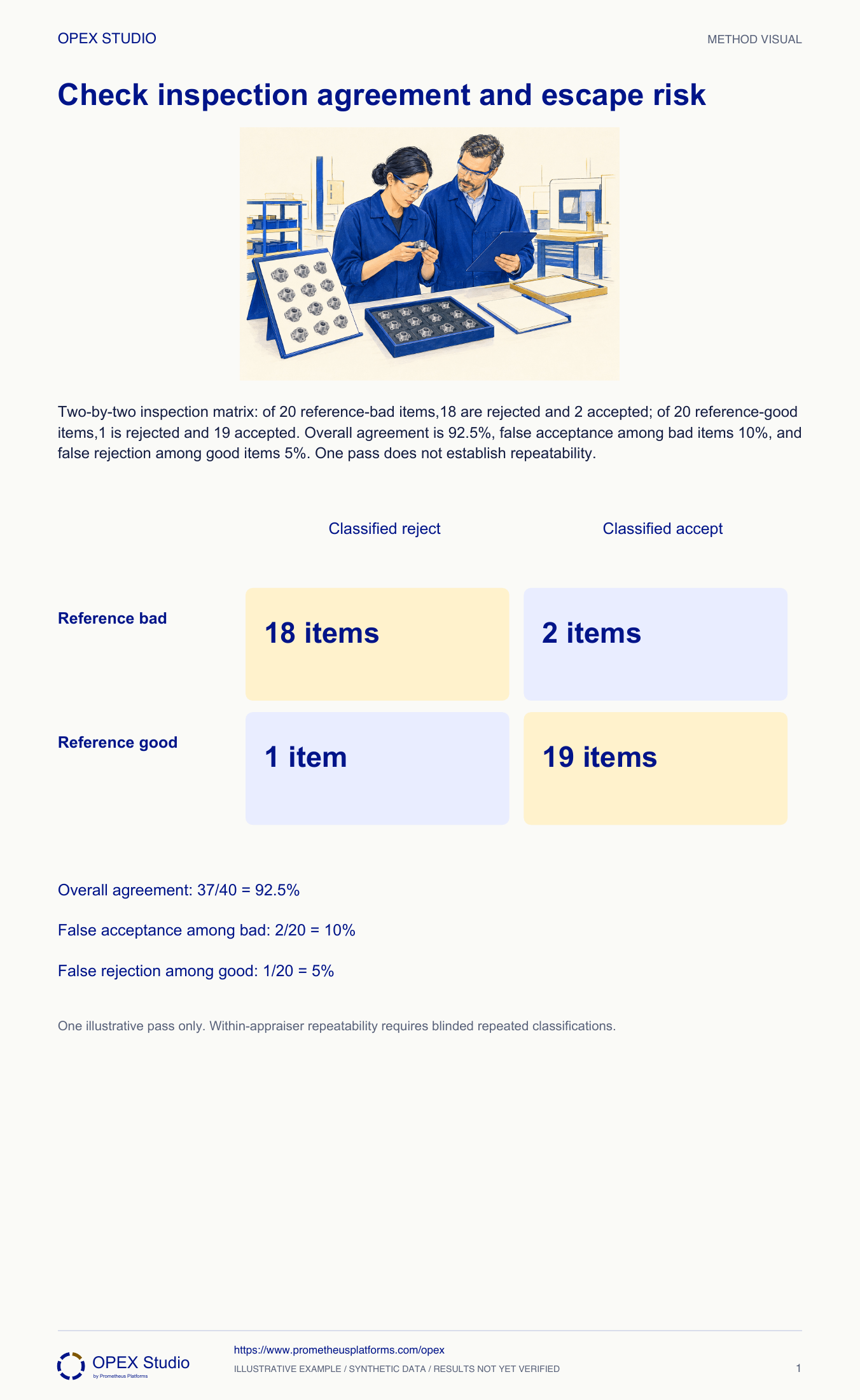
Overall agreement can conceal the error that matters most. Establish a defensible reference classification and include representative, difficult items. A full attribute study uses blinded repeats and multiple appraisers to examine consistency within people, between people and against the reference. The single matrix here illustrates denominator choices only. False acceptance asks what fraction of reference-bad items escaped; false rejection asks what fraction of reference-good items were rejected. Both differ from overall agreement. Report the counts and uncertainty rather than declaring success from one percentage. A reference itself can be uncertain, so unresolved classifications need an explicit adjudication method.
Reference bad20:18reject,2accept; reference good20:1reject,19accept.
Agreement37/40=92.5%; false acceptance2/20=10%; false rejection1/20=5%.
A single matrix does not establish within-appraiser repeatability.
Fictional case: inspector Leo assesses 40 reference items. Of 20 reference-bad items,18 are rejected and 2 accepted. Of 20 reference-good items,19 are accepted and 1 rejected. The core matrix retains these exact counts. The team calls 92.5% agreement proof that inspection is repeatable.
Resolve or explicitly classify the reference uncertainty before using that item to score an appraiser’s correctness. Preserve the disagreement as useful method evidence.
A forced reference label could turn legitimate ambiguity into an apparent operator failure. This is a method-definition issue as well as a training question.
Read a reference-classification matrix, distinguish overall agreement from the two error directions, and recognize the limits of a single pass.
Fictional case: inspector Leo assesses 40 reference items. Of 20 reference-bad items,18 are rejected and 2 accepted. Of 20 reference-good items,19 are accepted and 1 rejected. The core matrix retains these exact counts. The team calls 92.5% agreement proof that inspection is repeatable.
Role: Inspection-method owner and appraiser coach
Reference status is trustworthy for the defined characteristic; item identity and decision are retained; repeated and between-appraiser comparisons are designed separately.
One aggregate percentage hides false acceptance and false rejection, and one pass has no repeated classifications from which to judge repeatability.
| Reference class | Rejected | Accepted |
|---|---|---|
| Bad | 18 | 2 |
| Good | 1 | 19 |
Leo’s coach confirms the definition of good/bad and how the reference decisions were established. Each item keeps one identity linked to Leo’s classification.
Why: Agreement against a questionable reference does not establish correctness. The comparison must concern the same characteristic and decision rule.
Evidence: Forty item records reconcile to the two reference groups.
Correct classifications are 18 bad rejected plus 19 good accepted, totaling 37. Overall agreement is 37/40=92.5%.
Why: Agreement counts matches to the reference across both classes. It says nothing yet about consistency on a repeated blind pass.
Evidence: The reported numerator is 37, not merely the count of accepted items.
Two of the 20 reference-bad items were accepted, giving 10% false acceptance among bad items in this study.
Why: The denominator is the reference-bad group. Dividing by all 40 would answer a different question and conceal the conditional risk direction.
Evidence: The record identifies the two item IDs for review without claiming a production escape rate.
One of 20 reference-good items was rejected, giving 5% false rejection among good items. The coach preserves this distinction from false acceptance.
Why: Both errors matter but can have different consequences. A single combined error percentage can obscure what instruction or decision boundary needs attention.
Evidence: The review retains separate error directions and their respective denominators.
The coach plans blinded repeat classifications and, where appropriate, other appraisers using representative cases including difficult boundaries. Prior answers are not shown during repeat assessment.
Why: Within-appraiser consistency, between-appraiser agreement and reference agreement are different questions. Repetition must be designed to measure them rather than rehearse remembered labels.
Evidence: The next study plan states the comparison and keeps its results blank until performed.
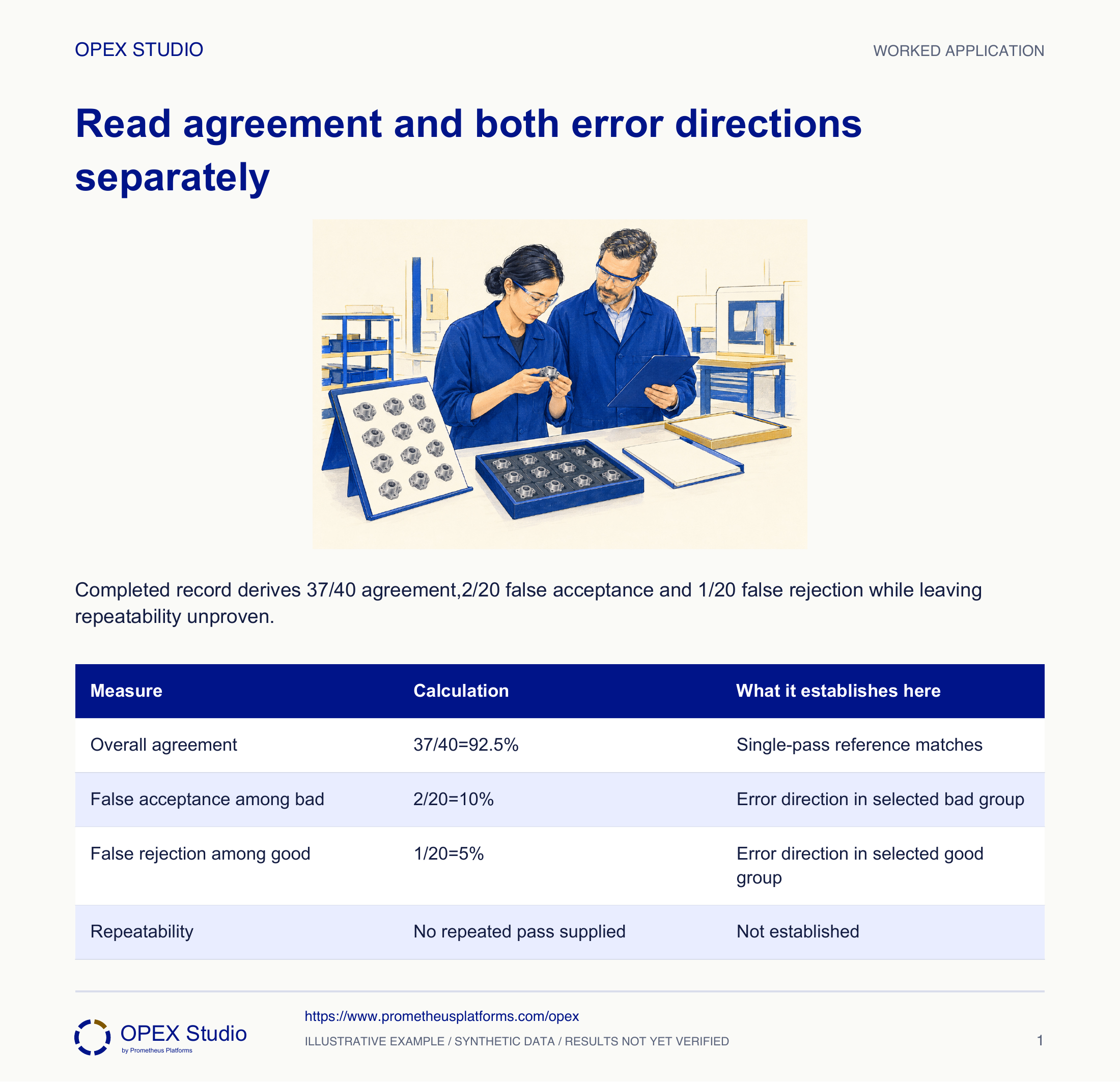
| Measure | Calculation | What it establishes here |
|---|---|---|
| Overall agreement | 37/40=92.5% | Single-pass reference matches |
| False acceptance among bad | 2/20=10% | Error direction in selected bad group |
| False rejection among good | 1/20=5% | Error direction in selected good group |
| Repeatability | No repeated pass supplied | Not established |
One item marked reference-bad has conflicting expert assessments and no resolved decision rule.
Resolve or explicitly classify the reference uncertainty before using that item to score an appraiser’s correctness. Preserve the disagreement as useful method evidence.
A forced reference label could turn legitimate ambiguity into an apparent operator failure. This is a method-definition issue as well as a training question.
The study record states reference uncertainty and the responsible adjudication process.
New fictional pass:30 reference-bad items yield 27 rejected and 3 accepted;10 reference-good items yield 8 accepted and 2 rejected.
| Reference class | Rejected | Accepted |
|---|---|---|
| Bad | 27 | 3 |
| Good | 2 | 8 |
Overall agreement=(27+8)/40=87.5%. False acceptance among bad is 3/30=10%; false rejection among good is 2/10=20%.
The unequal reference groups weight the overall result differently. A single pass still cannot establish within-appraiser repeatability; blinded repeated classifications are needed for that question.
| Metric | Numerator / denominator | Result |
|---|---|---|
| Agreement | 35/40 | 87.5% |
| False acceptance | 3/30 | 10% |
| False rejection | 2/10 | 20% |
Which items belong in false acceptance?
What denominator changes?
Which error is hidden by one total?
How would a repeat be kept blind?
Color the two matching cells, then calculate each conditional rate from its own reference row.
Owner: Inspection-method owner
Record: Reference basis, item-level classifications, agreement/error summaries and action record
Review: After instruction changes and during planned measurement review
Evidence: Representative blind comparisons and resolved decision criteria
Clarify references or method, coach targeted errors and verify with new blinded opportunities.
Attribute agreement examines within-appraiser, between-appraiser and reference-standard agreement.
Only the public scope is used; no ISO/TR14468 tables or examples are copied and current standard adoption is not inferred.Read the lessons online or use these PDFs to prepare, practise and review with your team. No sign-in needed.
Case objectives, demonstration plans, debriefs, common mistakes and application checks across all 81 workplace cases and method lessons.
Download Facilitator guide PDF · 166 pages · 65.1 MBPrintable case worksheets, blank observation records and five calculation exercises; answers are separate.
Download Learner workbook PDF · 169 pages · 10.7 MBReasoned sample responses, worked calculations and coaching guidance; fictional examples are clearly labelled.
Download Answer key and coaching notes PDF · 105 pages · 8.5 MBThe native method mechanisms and worked applications for all 68 detailed lessons, in a separate bookmarked portrait reference.
Download Method and application reference PDF · 141 pages · 10.2 MBFive illustrated system chapters: 15 Flare concept maps and 26 original workplace teaching cards, with links to all 81 supporting cases and method lessons.
Download Illustrated systems atlas PDF · 69 pages · 55.8 MBExplore this connected method and its separate application conditions.
Explore the connected method →Explore this connected method and its separate application conditions.
Explore the connected method →