Facilitator guide
Case objectives, demonstration plans, debriefs, common mistakes and application checks across all 81 workplace cases and method lessons.
Download Facilitator guide PDF · 166 pages · 65.1 MB OPEXSTUDIO
Define expected condition. Follow the visual, practise a decision, then check your thinking.
Fictional teaching examples and AI-generated illustrations. Proposed changes and goals are not achieved results. Use the written instructions and check local conditions before applying a method.
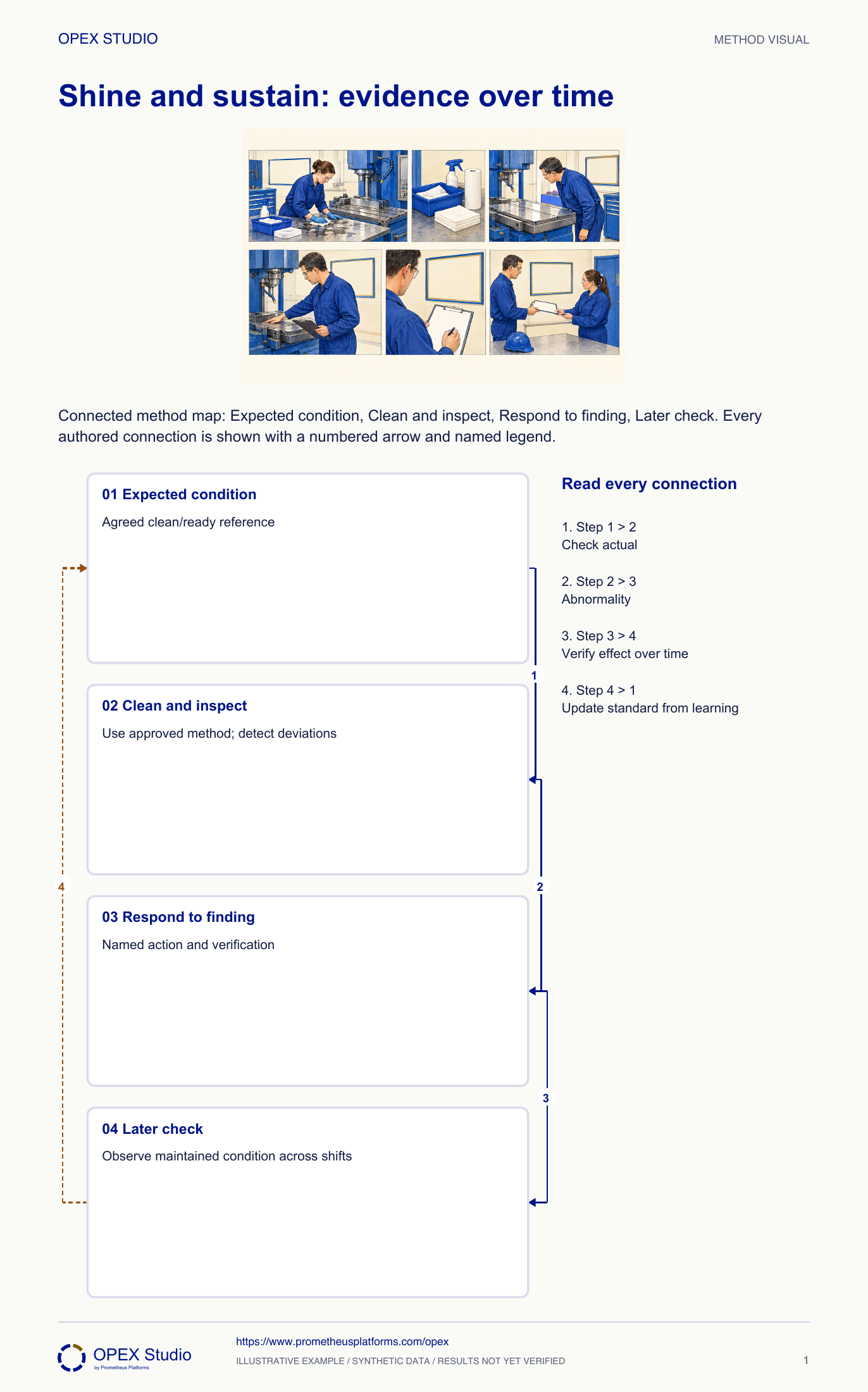
A clean condition is useful because it makes abnormalities easier to see and work easier to perform. Define the expected condition and the approved cleaning or inspection method. Record what is found, respond to recurring problems and verify the condition later, including another shift when relevant. An after photograph captures one moment; sustain needs evidence over time. A glossy surface or completed checklist cannot show that a leak was resolved. Use dated observations and response records to tell that story. Keep cleanup materials and disposal within local controls, and do not depict a tidy area as a completed safety assessment.
Glossy floors do not prove sustain.
A signed checklist alone does not establish maintained condition.
Supports TPM condition checks; Leader routines verify effectiveness.
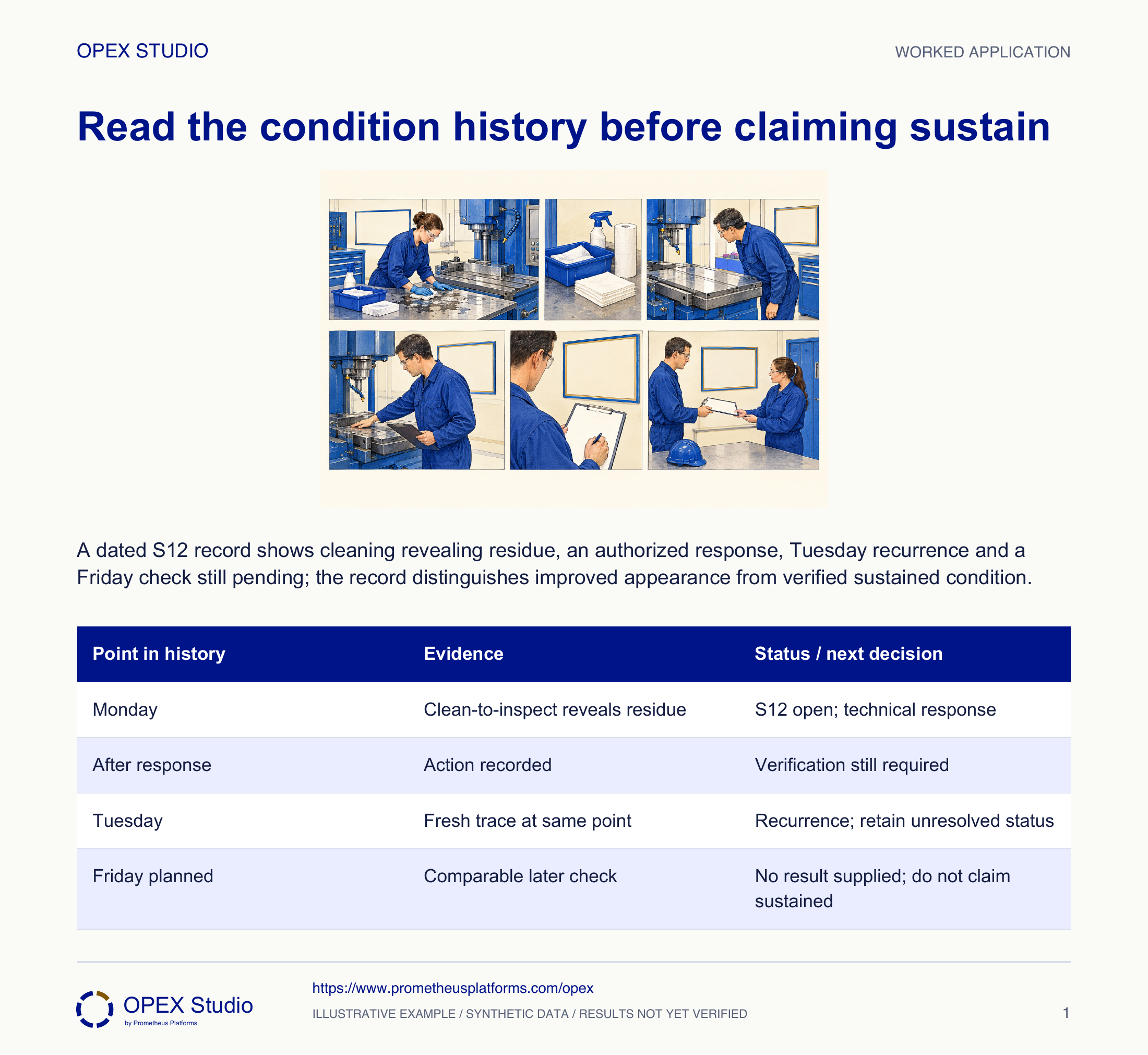
Fictional workshop: the team photographs a cleaned saw-support area on Monday. A clean-to-inspect check reveals residue at the base. Tuesday’s shift sees a new trace after the authorized response, and Friday’s planned review must decide what the evidence actually supports. The photographs are training illustrations, not a completed workplace audit.
Label the condition difference and obtain an appropriate comparable check. The image can document cleaning, but not absence of recurrence under the relevant condition.
Changing observation conditions can create a misleading before/after claim.
Distinguish a clean appearance from sustained condition control using dated observations, owned responses and a comparable later check.
Fictional workshop: the team photographs a cleaned saw-support area on Monday. A clean-to-inspect check reveals residue at the base. Tuesday’s shift sees a new trace after the authorized response, and Friday’s planned review must decide what the evidence actually supports. The photographs are training illustrations, not a completed workplace audit.
Role: Area owner, shift colleagues and the technical owner for any equipment-related finding.
The agreed clean/ready reference is visible; routine checks expose deviations and assign response rather than hide them.
A glossy Monday after-photo is being used to claim the condition is permanently sustained.
| Illustrative record | Condition / status |
|---|---|
| Monday clean-to-inspect | Base residue revealed; finding S12 opened |
| Authorized response | Technical owner assigned; verification required |
| Tuesday other shift | Fresh trace noted under comparable approved condition |
| Friday review | Later observation planned; result not supplied |
| Reference | Same identified point and clean/ready definition |
The area owner identifies the inspection point, clean/ready reference and approved check. The team distinguishes cosmetic reflections from the visible condition it must maintain.
Why: Without a common reference, different shifts can give the same condition different ratings.
Evidence: Reference, location and operating context accompany the photograph.
Monday’s clean-to-inspect activity records the revealed residue and opens S12 rather than removing every trace from the evidence record.
Why: Shine supports inspection. Erasing the finding while improving the photograph defeats that purpose.
Evidence: S12 links the observation, response owner and required verification.
Tuesday’s colleague records a fresh trace under comparable conditions and links it to S12. The owner revisits the response instead of closing it because cleaning was completed.
Why: Cross-shift recurrence is contrary evidence to sustained control.
Evidence: The history separates completed cleaning from unresolved condition.
Friday’s reviewer checks the actual later observation, response evidence and shift use of the reference. Any standard change is approved and explained to the team.
Why: Sustain is a repeated management routine with feedback, not the passage of a date on a calendar.
Evidence: The planned review stays pending until observed evidence exists; no Friday result is invented.
| Point in history | Evidence | Status / next decision |
|---|---|---|
| Monday | Clean-to-inspect reveals residue | S12 open; technical response |
| After response | Action recorded | Verification still required |
| Tuesday | Fresh trace at same point | Recurrence; retain unresolved status |
| Friday planned | Comparable later check | No result supplied; do not claim sustained |
Friday’s image shows a dry floor immediately after cleaning while the machine has not operated in the condition used for Tuesday’s check.
Label the condition difference and obtain an appropriate comparable check. The image can document cleaning, but not absence of recurrence under the relevant condition.
Changing observation conditions can create a misleading before/after claim.
Record timing, operating context and the exact condition being compared.
New fictional tool station: the reference requires identified tools in ready locations and held tools segregated. A morning photo meets the reference. At shift end one tool is unlabelled in ready stock and the next shift cannot identify its status.
| Observation | Fact |
|---|---|
| Morning | Reference met at handover |
| Shift end | One unlabelled tool in ready stock |
| Next shift | Status unknown |
| Proposed claim | Sustained because morning photo passed |
The morning record shows one acceptable moment; later evidence shows the status routine did not reliably maintain the reference.
Use the approved status/hold response and assign the tool-status owner; do not assume ready from shelf location.
Verify identity/status at representative handovers and check that return/hold roles work across shifts. Record failures honestly; one later pass does not prove permanence.
| History / decision | Suggested entry |
|---|---|
| Morning | Reference met at that observation |
| Later | Unknown-status tool in ready stock |
| Response | Control status under approved route; owner assigned |
| Sustain check | Observe subsequent handovers and role use |
What does this one image establish?
What does Tuesday change?
Which response protects status clarity?
What would you need from another shift?
Write a caption for each observation stating what it does and does not support, then complete the transfer record.
Owner: Area owner with representatives from every relevant shift
Record: Dated condition history, finding response and approved reference
Review: At handovers and agreed recurring condition reviews
Evidence: Comparable observations, actual response use and recurring-finding status
Keep findings open, adjust support/standard through its owner and route equipment mechanisms to qualified investigation.
Systematic workplace standards and sustaining routines, not cosmetic tidiness
Method reference; original OPEX scenario and diagram are synthetic teaching content, not source case results.Read the lessons online or use these PDFs to prepare, practise and review with your team. No sign-in needed.
Case objectives, demonstration plans, debriefs, common mistakes and application checks across all 81 workplace cases and method lessons.
Download Facilitator guide PDF · 166 pages · 65.1 MBPrintable case worksheets, blank observation records and five calculation exercises; answers are separate.
Download Learner workbook PDF · 169 pages · 10.7 MBReasoned sample responses, worked calculations and coaching guidance; fictional examples are clearly labelled.
Download Answer key and coaching notes PDF · 105 pages · 8.5 MBThe native method mechanisms and worked applications for all 68 detailed lessons, in a separate bookmarked portrait reference.
Download Method and application reference PDF · 141 pages · 10.2 MBFive illustrated system chapters: 15 Flare concept maps and 26 original workplace teaching cards, with links to all 81 supporting cases and method lessons.
Download Illustrated systems atlas PDF · 69 pages · 55.8 MBExplore this connected method and its separate application conditions.
Explore the connected method →Explore this connected method and its separate application conditions.
Explore the connected method →Explore this connected method and its separate application conditions.
Explore the connected method →Explore this connected method and its separate application conditions.
Explore the connected method →Explore this connected method and its separate application conditions.
Explore the connected method →