Facilitator guide
Case objectives, demonstration plans, debriefs, common mistakes and application checks across all 81 workplace cases and method lessons.
Download Facilitator guide PDF · 166 pages · 65.1 MB OPEXSTUDIO
Identify organization, customer and certification scope.. Follow the visual, practise a decision, then check your thinking.
Fictional teaching examples and AI-generated illustrations. Proposed changes and goals are not achieved results. Use the written instructions and check local conditions before applying a method.
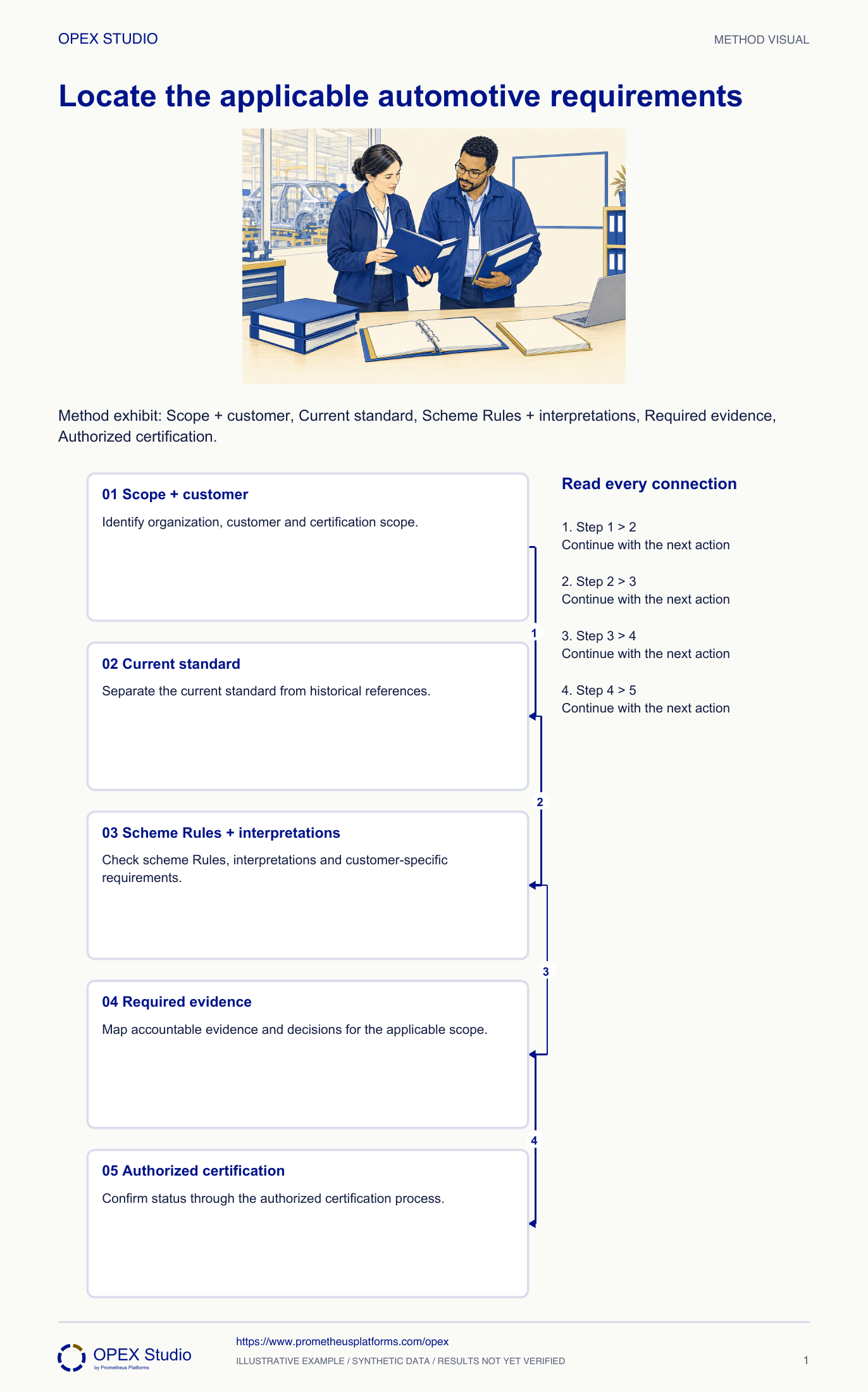
Begin by identifying the organization, product, customer and certification scope. IATF16949:2016 replaced the historical ISO/TS16949:2009 reference; certification Rules sixth edition are a separate document effective January2025. A July2026 IATF communiqué plans the second standard edition for mid2027 and explicitly treats timing as indicative. Do not treat that future edition as already published. Check current interpretations and customer-specific requirements alongside the applicable standard. Map responsibilities and evidence without claiming that a lesson, internal checklist or completed template establishes conformity. Certification status and scope depend on the authorized process; they cannot be inferred from familiarity with the terminology.
Checked2026-09-19: IATF16949:2016 remains published first edition.
Rules6 effective2025-01-01 is separate; ISO/TS16949:2009 is historical.
July2026 communiqué plans second edition mid2027, explicitly indicative.
Fictional case: an automotive supplier receives a purchasing note saying “ISO/TS 16949 certified” and an internal slide titled “IATF sixth edition”. Quality lead Ren must correct the references and identify the actual requirements applicable to a defined site/customer scope. Primary IATF pages were checked on 20 September 2026 for this lesson.
Clarify the required authority and scope through the customer interface, provide the verified current references and avoid promising certification evidence that has not been checked.
Ambiguity should be resolved before turning a phrase into a compliance claim or internal requirement.
Identify the current automotive requirement authorities and distinguish the standard edition, certification Rules, interpretations, customer requirements and historical references.
Fictional case: an automotive supplier receives a purchasing note saying “ISO/TS 16949 certified” and an internal slide titled “IATF sixth edition”. Quality lead Ren must correct the references and identify the actual requirements applicable to a defined site/customer scope. Primary IATF pages were checked on 20 September 2026 for this lesson.
Role: Automotive quality-system lead and customer interface
The requirement register identifies source, edition/revision, applicability, owner and review date. Certification status is confirmed through authorized evidence, not inferred from training.
Historical ISO/TS wording and scheme Rules numbering are being treated as interchangeable current standard names.
| Authority | Status checked 20 September 2026 |
|---|---|
| Standard | IATF 16949:2016 first edition |
| Historical reference | ISO/TS 16949:2009 replaced |
| Certification scheme Rules | 6th edition effective 1 January 2025 |
| Planned standard revision | Second edition planned mid-2027; timing indicative |
| Additional applicable sources | Current SIs/FAQs and customer-specific requirements to verify for scope |
Ren identifies the site, activities, customer relationship and decision being made. He distinguishes a requirement lookup from a claim that the organization is certified.
Why: Applicability depends on scope and the relevant contractual/certification framework. A generic training title cannot establish those facts.
Evidence: The register names the scope and the person responsible for confirmation.
He marks ISO/TS 16949:2009 as historical and points to IATF 16949:2016 as the published first-edition standard at the check date. He retains the old reference as a traceable source of the question.
Why: Historical wording may appear in old records or informal requests. Correcting the reference should not silently alter the meaning of a retained historical document.
Evidence: The current register distinguishes historical and current authorities.
Ren records Rules 6 as the certification-scheme Rules effective 1 January 2025, not a sixth edition of IATF 16949. He identifies applicable scheme responsibilities through the official authority.
Why: Edition numbers belong to different documents. Combining them produces a nonexistent standard label and can send the team to the wrong requirements.
Evidence: The register has separate rows for standard and scheme Rules.
He reviews current official interpretations/FAQs and applicable customer-specific requirements, recording revision and relevance rather than copying protected clauses into the training pack.
Why: The base standard title alone may not capture applicable current obligations. The organization needs access to the authorized documents and a controlled applicability process.
Evidence: Each additional requirement has a source, applicability decision and accountable owner.
Ren records the July 2026 communiqué’s mid-2027 publication plan as indicative and schedules source monitoring. He does not claim the second edition is published or invent a transition deadline.
Why: A planned date is not an effective requirement. Current work follows applicable published authorities while preparing for verified future changes.
Evidence: The register separates published status, planned change and next review date.
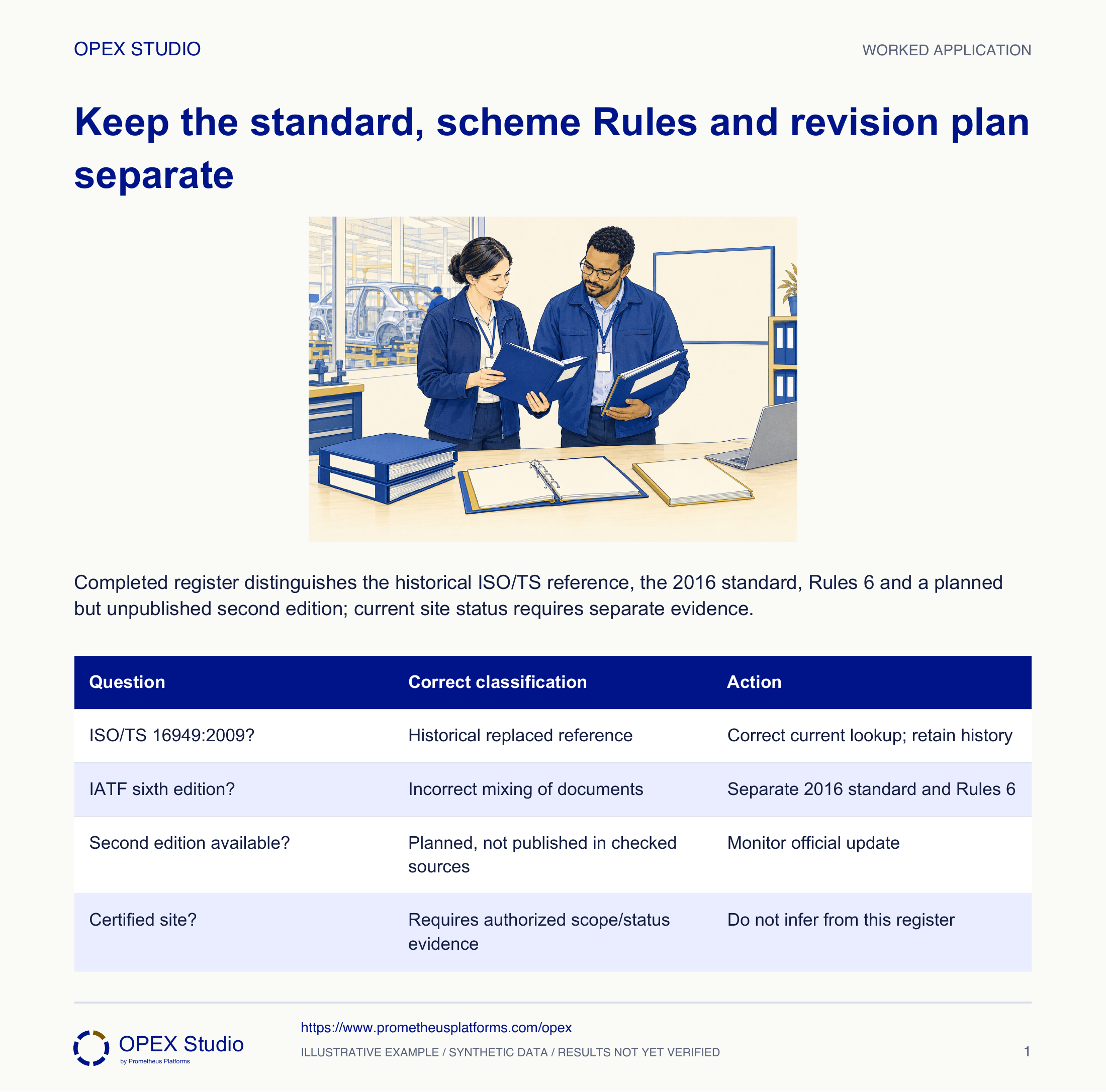
| Question | Correct classification | Action |
|---|---|---|
| ISO/TS 16949:2009? | Historical replaced reference | Correct current lookup; retain history |
| IATF sixth edition? | Incorrect mixing of documents | Separate 2016 standard and Rules 6 |
| Second edition available? | Planned, not published in checked sources | Monitor official update |
| Certified site? | Requires authorized scope/status evidence | Do not infer from this register |
The customer asks for “latest automotive certification rules” without specifying the intended deliverable.
Clarify the required authority and scope through the customer interface, provide the verified current references and avoid promising certification evidence that has not been checked.
Ambiguity should be resolved before turning a phrase into a compliance claim or internal requirement.
The clarification record identifies the customer’s actual requirement and retained decision.
New fictional slide says “Certified to IATF 16949 sixth edition; ISO/TS remains current; new standard effective mid-2027.” No certification record is supplied.
| Slide claim | Evidence available |
|---|---|
| Sixth edition standard | Rules 6 publication only |
| ISO/TS current | Official replacement history |
| Mid 2027 effective | Indicative publication plan |
| Certified | No scoped status evidence |
Separate IATF 16949:2016 first edition from certification Rules 6, effective 1 January 2025. ISO/TS 16949:2009 is historical and replaced. The second edition’s mid-2027 publication timing is indicative, not an established effective date.
Remove the unsupported certified claim until the applicable authorized site/scope/status evidence is verified. Assign an owner to monitor official updates and assess published transition requirements when available.
| Incorrect claim | Corrected statement | Boundary |
|---|---|---|
| Sixth edition standard | Rules 6 is a separate document | Do not rename the standard |
| ISO/TS current | Historical replaced reference | Preserve historical records |
| Effective mid-2027 | Indicative planned publication | No invented deadline |
| Certified | Status not established here | Require scoped evidence |
Which edition number belongs to which document?
What is published and what is planned?
Which claim requires evidence beyond a source lookup?
Who monitors a change and what triggers review?
Create separate rows for standard, Rules, supplements and customer requirements before writing a status summary.
Owner: Automotive QMS owner and customer interface
Record: Controlled authority/applicability register and scoped status evidence
Review: At official updates, customer changes and planned periodic review
Evidence: Current authoritative references with documented applicability
Clarify ambiguous requirements and assess published changes before updating operational commitments.
IATF 16949:2016 first edition replaced ISO/TS 16949:2009.
Historical ISO/TS terms are retrieval aliases with a correction, not current certification labels.Rules 6 became effective 2025-01-01; it is separate from the IATF 16949 standard edition.
Public primary-source summary; underlying paid standards/forms are not reproduced.The July 2026 communiqué plans second-edition publication for mid-2027; timing is indicative.
A planned revision is not a published standard; recheck before authoring or release.Official sanctioned interpretations supplement the published standard; verify the currently applicable official revision and scope.
Use current applicable SIs, FAQs, customer requirements and licensed standard; this catalog is not a requirements repository.Read the lessons online or use these PDFs to prepare, practise and review with your team. No sign-in needed.
Case objectives, demonstration plans, debriefs, common mistakes and application checks across all 81 workplace cases and method lessons.
Download Facilitator guide PDF · 166 pages · 65.1 MBPrintable case worksheets, blank observation records and five calculation exercises; answers are separate.
Download Learner workbook PDF · 169 pages · 10.7 MBReasoned sample responses, worked calculations and coaching guidance; fictional examples are clearly labelled.
Download Answer key and coaching notes PDF · 105 pages · 8.5 MBThe native method mechanisms and worked applications for all 68 detailed lessons, in a separate bookmarked portrait reference.
Download Method and application reference PDF · 141 pages · 10.2 MBFive illustrated system chapters: 15 Flare concept maps and 26 original workplace teaching cards, with links to all 81 supporting cases and method lessons.
Download Illustrated systems atlas PDF · 69 pages · 55.8 MBExplore this connected method and its separate application conditions.
Explore the connected method →Explore this connected method and its separate application conditions.
Explore the connected method →Explore this connected method and its separate application conditions.
Explore the connected method →