Facilitator guide
Case objectives, demonstration plans, debriefs, common mistakes and application checks across all 81 workplace cases and method lessons.
Download Facilitator guide PDF · 166 pages · 65.1 MB OPEXSTUDIO
8D + cause verification. Follow the visual, practise a decision, then check your thinking.
Fictional teaching examples and AI-generated illustrations. Proposed changes and goals are not achieved results. Use the written instructions and check local conditions before applying a method.
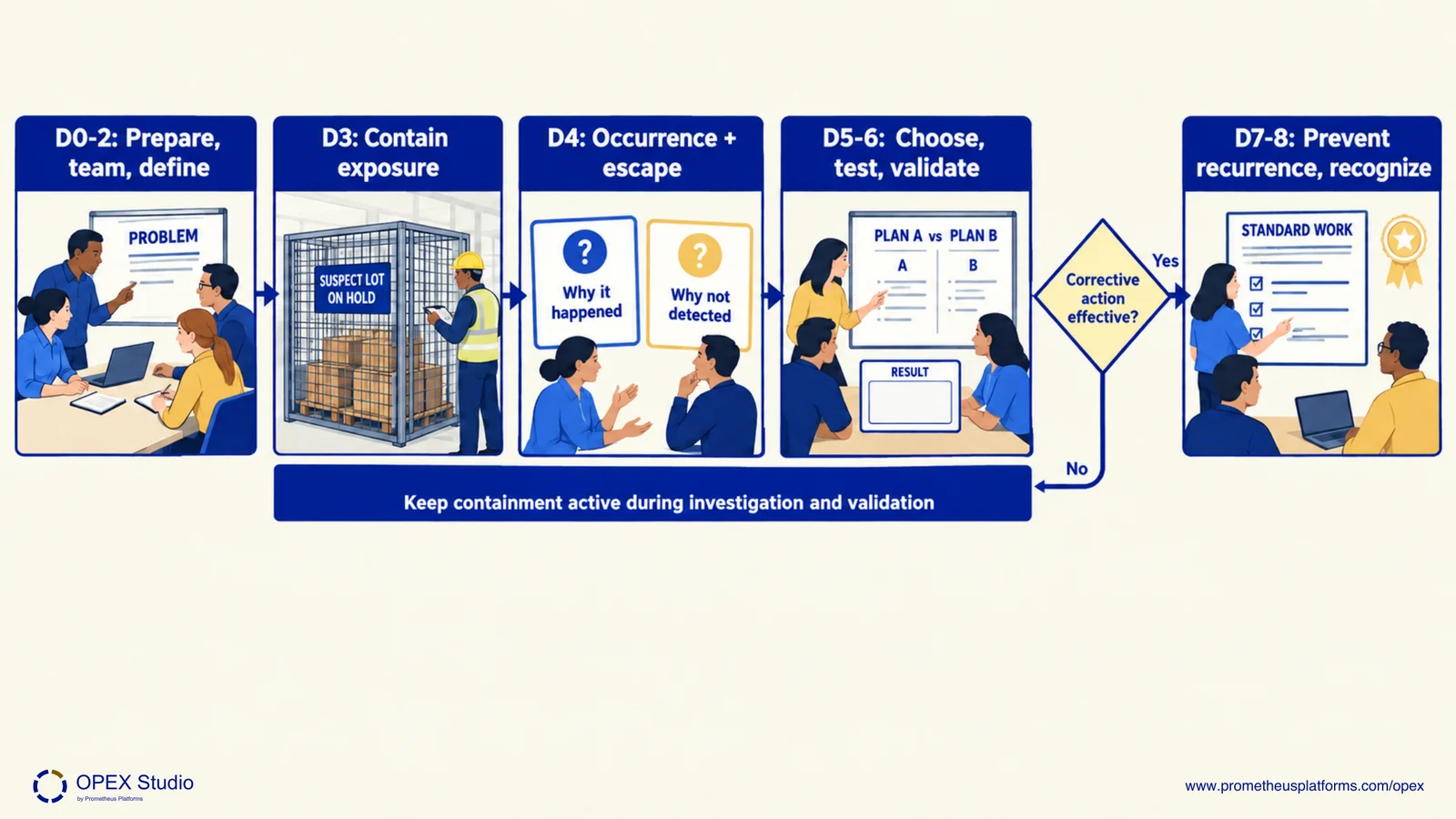
The existing sample has 144 first-test failures in 2400 valves. Begin by defining the affected product, defect and observation period. Temporary containment limits exposure while the team investigates both why the leak occurred and why the process failed to prevent or detect it earlier. Keep possible causes separate from confirmed causes. The proposed 1.5% goal is not a result. Carry a verified corrective action into normal work and review recurrence before retiring containment.
D0 prepares the work where used. D1 forms the team; D2 defines the problem; D3 contains exposure; D4 verifies occurrence and escape causes; D5 selects and tests permanent action; D6 implements and validates; D7 prevents recurrence; D8 recognizes the team.
Containment protects while investigation continues. Correcting affected units and removing a verified cause are different actions.
A fixture association is visible. Is that enough to select permanent corrective action?
No. Use it to select a discriminating test; preserve containment while checking the cause and the detection gap.
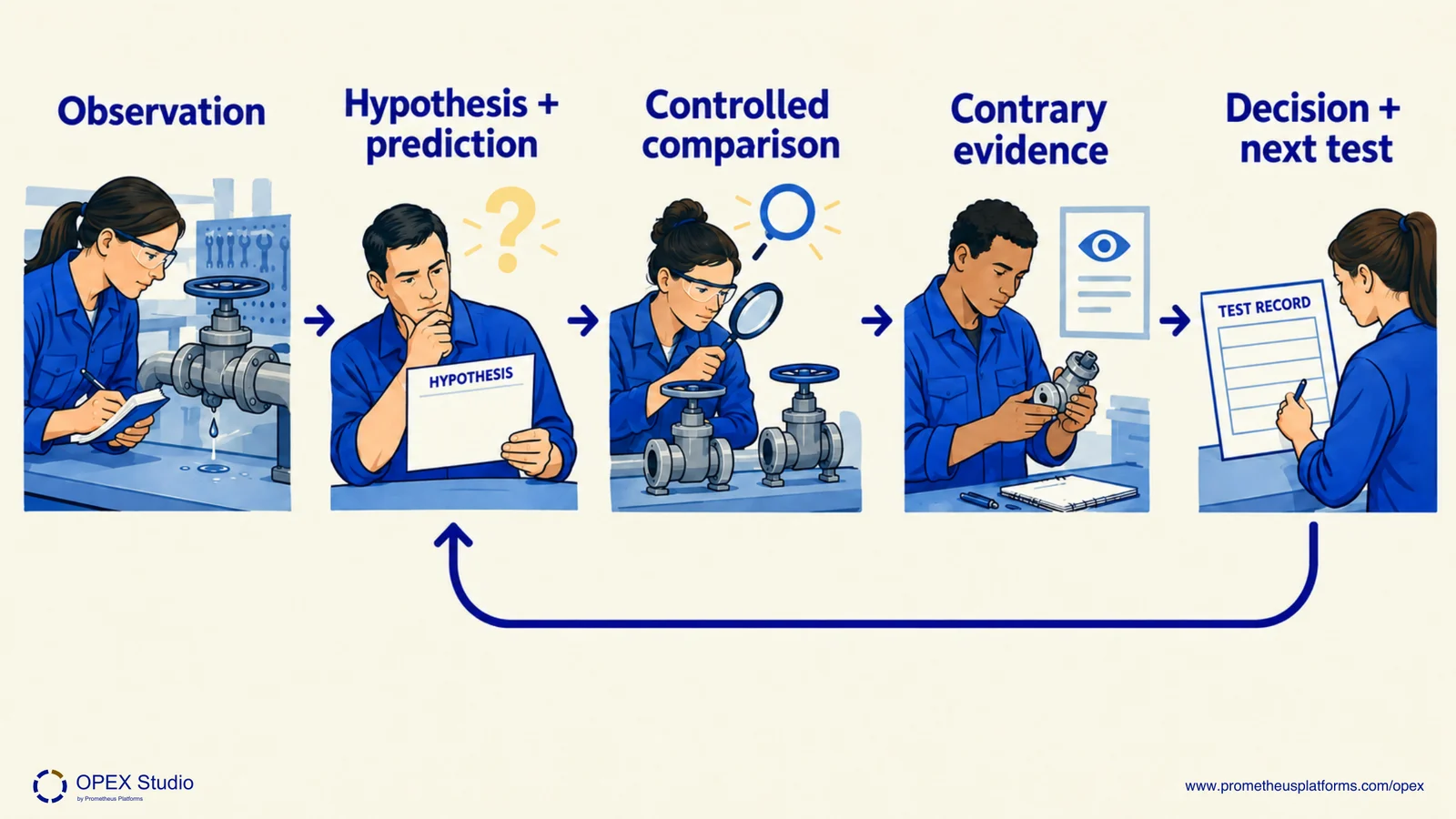
Write the predicted result before running a controlled comparison. Specify what stays comparable, how failures will be measured, and what result would challenge the explanation. The retained pilot gate of no more than 4 first-test failures in 300 and later validation gate of no more than 36 in 2400 are separate planned checks, not proof already obtained. A small pass alone does not establish long-term performance.
Fixture A: 110 failures / 1,200 tested = 9.17%; fixture B: 34 / 1,200 = 2.83% (rounded). Material, operator and time differences may confound this association.
Teardown categories: rolled seal 82; low torque indication 34; other or undetermined 28. Total 144. Categories and rates guide investigation, not a causal conclusion.
The planned pilot gate is ≤4 / 300; the later validation gate is ≤36 / 2,400. No future results have been supplied.
What is the difference between relabelling or repairing affected units and changing the cause?
The first corrects those units; corrective action changes a verified cause and requires an effectiveness check.
8D progresses through team formation, problem definition, containment, verified occurrence and escape causes, permanent correction selection, effectiveness validation, recurrence prevention and team recognition; some organizations add D0 preparation.
Brainstorming does not verify a cause; interim containment is distinct from permanent corrective action.Fishbone diagrams organize possible explanations into categories to support exploration and further analysis.
A diagram branch is a candidate explanation, not automatically a verified cause.Correction resolves a detected nonconformity, such as through repair or rework; corrective action addresses its causes to prevent recurrence.
The handbook sometimes groups correction and containment; a three-way teaching distinction should be identified as an explicit convention.Read the lessons online or use these PDFs to prepare, practise and review with your team. No sign-in needed.
Case objectives, demonstration plans, debriefs, common mistakes and application checks across all 81 workplace cases and method lessons.
Download Facilitator guide PDF · 166 pages · 65.1 MBPrintable case worksheets, blank observation records and five calculation exercises; answers are separate.
Download Learner workbook PDF · 169 pages · 10.7 MBReasoned sample responses, worked calculations and coaching guidance; fictional examples are clearly labelled.
Download Answer key and coaching notes PDF · 105 pages · 8.5 MBThe native method mechanisms and worked applications for all 68 detailed lessons, in a separate bookmarked portrait reference.
Download Method and application reference PDF · 141 pages · 10.2 MBFive illustrated system chapters: 15 Flare concept maps and 26 original workplace teaching cards, with links to all 81 supporting cases and method lessons.
Download Illustrated systems atlas PDF · 69 pages · 55.8 MBA verified occurrence or escape cause can lead to a prevention or detection change at the work station.
Explore the connected method →Daily follow-up keeps containment, response owners and effectiveness checks visible after the investigation.
Explore the connected method →