Facilitator guide
Case objectives, demonstration plans, debriefs, common mistakes and application checks across all 81 workplace cases and method lessons.
Download Facilitator guide PDF · 166 pages · 65.1 MB OPEXSTUDIO
State shared objective. Follow the visual, practise a decision, then check your thinking.
Fictional teaching examples and AI-generated illustrations. Proposed changes and goals are not achieved results. Use the written instructions and check local conditions before applying a method.
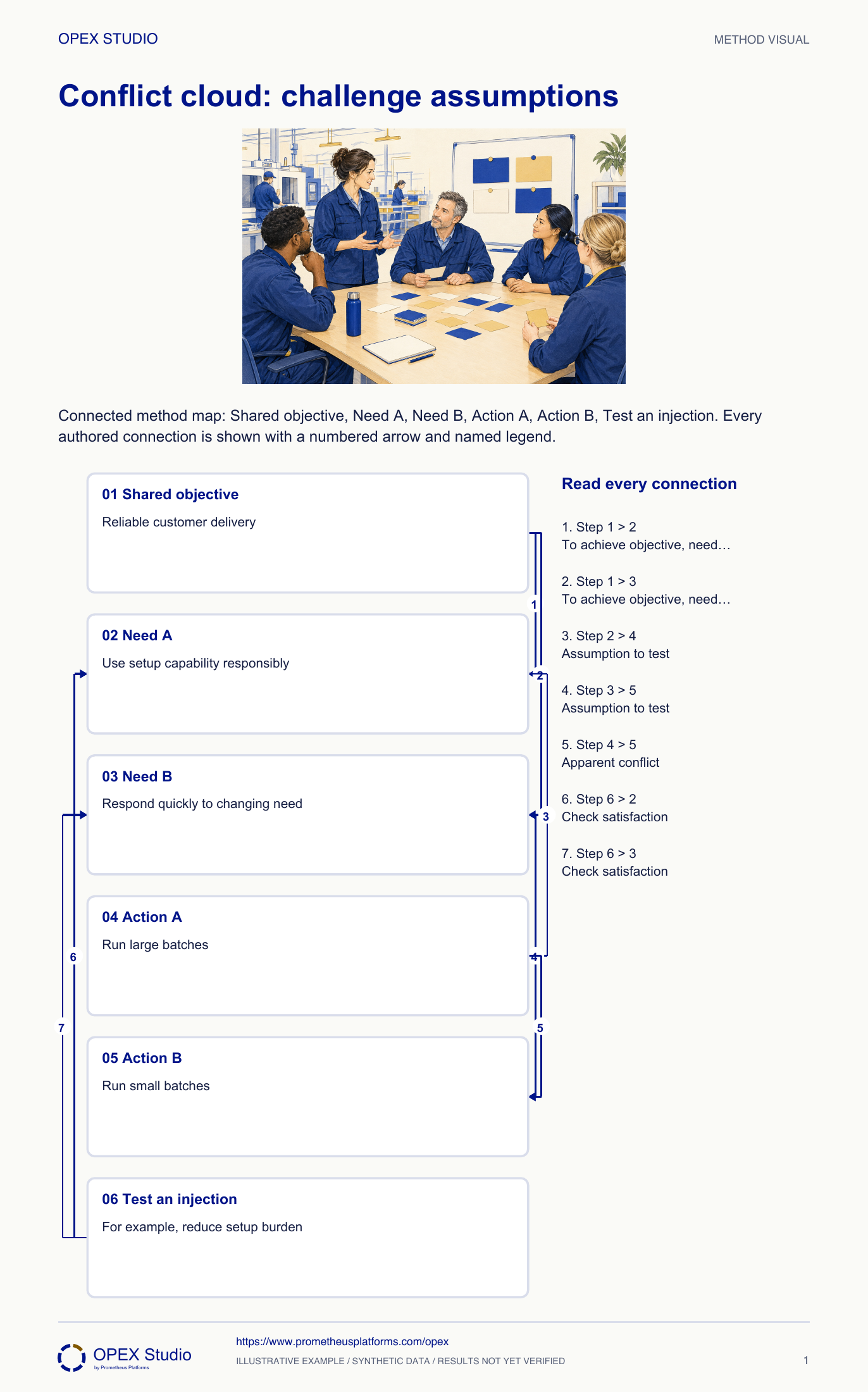
Begin by stating an objective both sides can support. Describe each legitimate need and the action each side believes is required to satisfy it. Put the conflicting actions beside each other, then examine the assumptions connecting the boxes. Look for a change that can satisfy both needs without preserving the conflict. That proposed injection remains a hypothesis: test its practical consequences and look for unwanted effects. Do not disguise a preferred solution as neutral logic or assume compromise is the only option. The drawing supports a respectful discussion of policies and beliefs, not a verdict about which person is wrong.
A compromise is not necessarily resolution.
A plausible injection still needs testing.
Connects policy constraints to action; A3/PDCA can test proposed change.
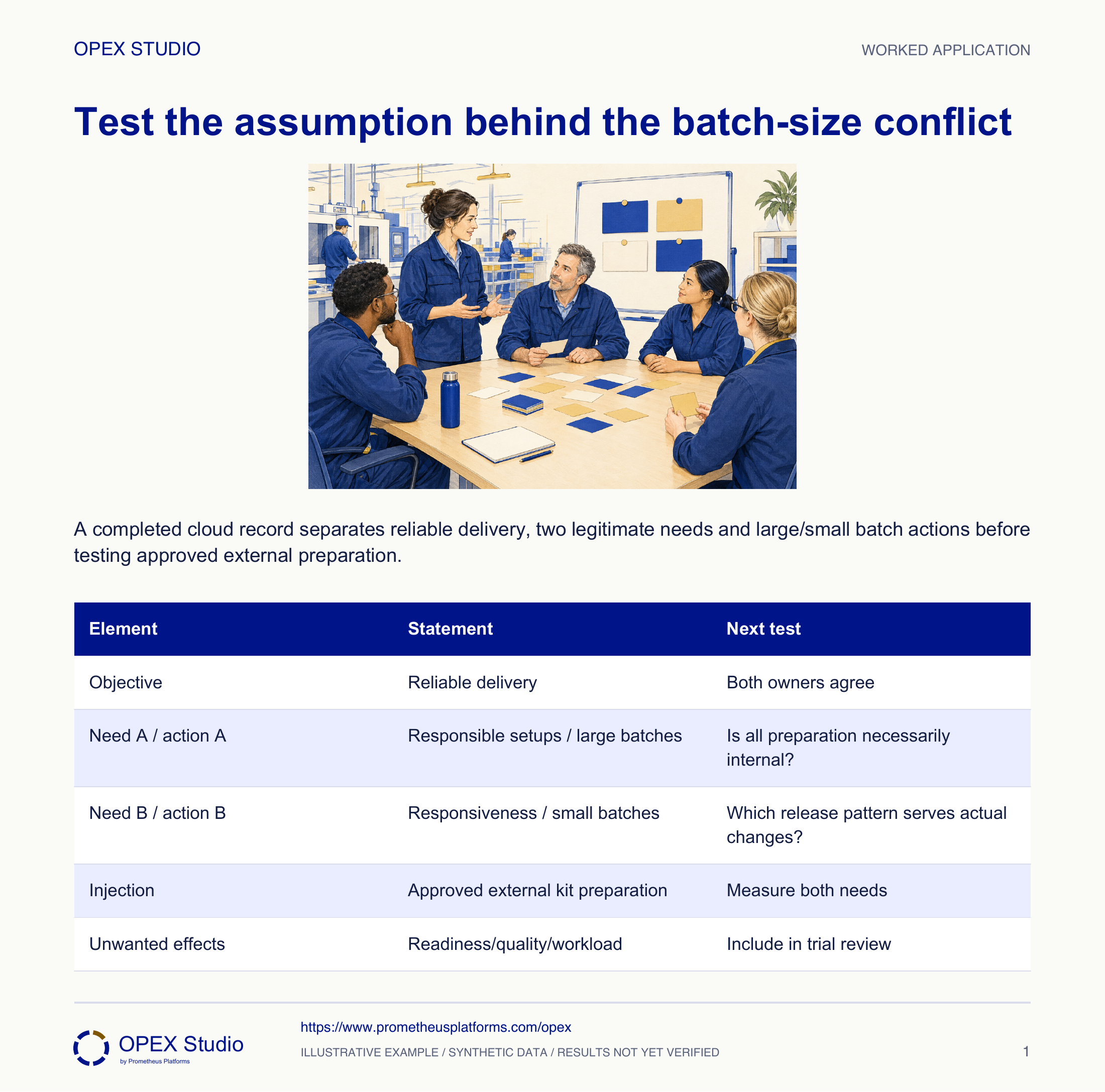
Fictional workshop: production manager Arun wants large batches to use scarce setup capability responsibly. Customer-service manager Mei wants small batches to respond to changing demand. Both want reliable delivery. Facilitator Sol helps them investigate the apparent conflict without treating either person as the problem.
Retain that requirement and explore other assumptions, such as transfer batching or preparation delay, with the responsible owner.
Challenging an assumption does not grant authority to ignore a verified process constraint.
State a shared objective, represent both legitimate needs fairly, expose the assumptions behind incompatible actions and design a test that checks both needs and unwanted effects.
Fictional workshop: production manager Arun wants large batches to use scarce setup capability responsibly. Customer-service manager Mei wants small batches to respond to changing demand. Both want reliable delivery. Facilitator Sol helps them investigate the apparent conflict without treating either person as the problem.
Role: Neutral facilitator with both decision owners and affected operators.
An improvement should meet the legitimate needs behind both positions and preserve necessary quality and safety conditions.
A proposed compromise batch size has been chosen before anyone tests why each action is believed necessary.
| Cloud element | Case statement |
|---|---|
| Shared objective | Reliable customer delivery |
| Need A | Use setup capability responsibly |
| Need B | Respond quickly to changing need |
| Action A | Run large batches |
| Action B | Run small batches |
| Candidate assumption | Frequent changes must consume excessive stopped time |
Sol asks Arun and Mei to restate the goal in terms both accept: reliable customer delivery under the required operating conditions. She checks that neither side’s private target has been substituted.
Why: Without a genuinely shared objective, the diagram can force agreement that does not exist.
Evidence: Both owners confirm the objective and the necessary conditions.
Record setup capability and responsiveness as legitimate needs. Place large and small batches as the conflicting proposed actions, using each person’s own explanation.
Why: Treating a chosen action as a need can make the conflict look unavoidable. Fair representation allows alternative actions to emerge.
Evidence: Two needs and two distinct actions are visible; neither person is blamed.
Ask why responsible setup use is believed to require large batches and why responsiveness is believed to require small batches. Investigate actual setup work, mix changes and delivery effects.
Why: An arrow is a claim about necessity. Evidence may show that a specific assumption, such as unavoidable preparation during stopped time, is not always valid.
Evidence: Assumption log distinguishes observed facts, beliefs and missing evidence.
The team considers preparing verified changeover kits externally where approved, reducing avoidable stopped preparation while retaining required internal controls. It predicts whether smaller releases could then serve demand without unacceptable setup burden.
Why: The injection addresses an assumption; it is not simply the midpoint between two batch sizes. It remains a proposal until both needs are tested.
Evidence: Trial checks setup burden and customer responsiveness, with quality and operator workload retained.
Review missing kits, wrong configurations, extra preparation workload and delivery results during a bounded trial. Accept, adapt or reject the injection with both owners.
Why: A solution that satisfies one need while shifting hidden cost or risk onto another person has not resolved the stated conflict.
Evidence: Decision cites evidence for both needs and the necessary conditions.
| Element | Statement | Next test |
|---|---|---|
| Objective | Reliable delivery | Both owners agree |
| Need A / action A | Responsible setups / large batches | Is all preparation necessarily internal? |
| Need B / action B | Responsiveness / small batches | Which release pattern serves actual changes? |
| Injection | Approved external kit preparation | Measure both needs |
| Unwanted effects | Readiness/quality/workload | Include in trial review |
Evidence shows an approved process requires a specific processing batch, and no alternative is yet qualified.
Retain that requirement and explore other assumptions, such as transfer batching or preparation delay, with the responsible owner.
Challenging an assumption does not grant authority to ignore a verified process constraint.
The revised cloud distinguishes a validated condition from an untested belief.
Separate fictional office: one manager wants all approval reviews on Friday to use specialist time efficiently; another wants daily decisions to meet customer response promises. Both seek correct, timely commitments. A proposal schedules a short daily review of complete cases, with preparation handled separately.
| Element | Case evidence |
|---|---|
| Need A | Use limited approval expertise responsibly |
| Need B | Respond within agreed customer window |
| Actions | Weekly batch / daily review |
| Candidate injection | Ready cases; short protected daily decision slot |
The shared objective is correct, timely customer commitments. Efficient use of expertise and timely response are needs; weekly batching and daily reviewing are proposed actions.
One testable assumption is that daily review necessarily wastes more specialist time. Ready-case preparation and a protected slot might alter that relationship.
Measure specialist review/preparation burden, decision timeliness and correctness. Check interruptions, incomplete cases and shifted workload; do not declare success from daily meetings alone.
| Cloud / test element | Statement | Evidence to collect |
|---|---|---|
| Need A | Responsible use of expertise | Review/preparation burden |
| Need B | Timely correct response | Decision timeliness and quality |
| Assumption | Daily review necessarily inefficient | Test with ready cases |
| Unwanted effect | Preparation shifted elsewhere | Observe workload and rework |
Would both owners sign this wording?
Why is batch size an action rather than the underlying need?
Which necessity assumption might the daily slot change?
How could the proposal help one side but harm the other?
Write both sides in respectful first-person language, then test one arrow rather than arguing for a favored action.
Owner: Both decision owners with a neutral facilitator
Record: Agreed cloud, assumption evidence and bounded injection test
Review: At trial agreement and after evidence from the defined test period
Evidence: Both legitimate needs met with necessary conditions and unwanted effects examined
Revise the assumptions or injection jointly; do not report a plausible diagram as a validated resolution.
Conflict, assumptions and win-win injections; public synopsis only
Public course synopsis only; no claim to have viewed restricted course content.Read the lessons online or use these PDFs to prepare, practise and review with your team. No sign-in needed.
Case objectives, demonstration plans, debriefs, common mistakes and application checks across all 81 workplace cases and method lessons.
Download Facilitator guide PDF · 166 pages · 65.1 MBPrintable case worksheets, blank observation records and five calculation exercises; answers are separate.
Download Learner workbook PDF · 169 pages · 10.7 MBReasoned sample responses, worked calculations and coaching guidance; fictional examples are clearly labelled.
Download Answer key and coaching notes PDF · 105 pages · 8.5 MBThe native method mechanisms and worked applications for all 68 detailed lessons, in a separate bookmarked portrait reference.
Download Method and application reference PDF · 141 pages · 10.2 MBFive illustrated system chapters: 15 Flare concept maps and 26 original workplace teaching cards, with links to all 81 supporting cases and method lessons.
Download Illustrated systems atlas PDF · 69 pages · 55.8 MBExplore this connected method and its separate application conditions.
Explore the connected method →Explore this connected method and its separate application conditions.
Explore the connected method →Explore this connected method and its separate application conditions.
Explore the connected method →