Facilitator guide
Case objectives, demonstration plans, debriefs, common mistakes and application checks across all 81 workplace cases and method lessons.
Download Facilitator guide PDF · 166 pages · 65.1 MB OPEXSTUDIO
Understand how the methods relate before selecting a detailed lesson.. Follow the visual, practise a decision, then check your thinking.
Fictional teaching examples and AI-generated illustrations. Proposed changes and goals are not achieved results. Use the written instructions and check local conditions before applying a method.
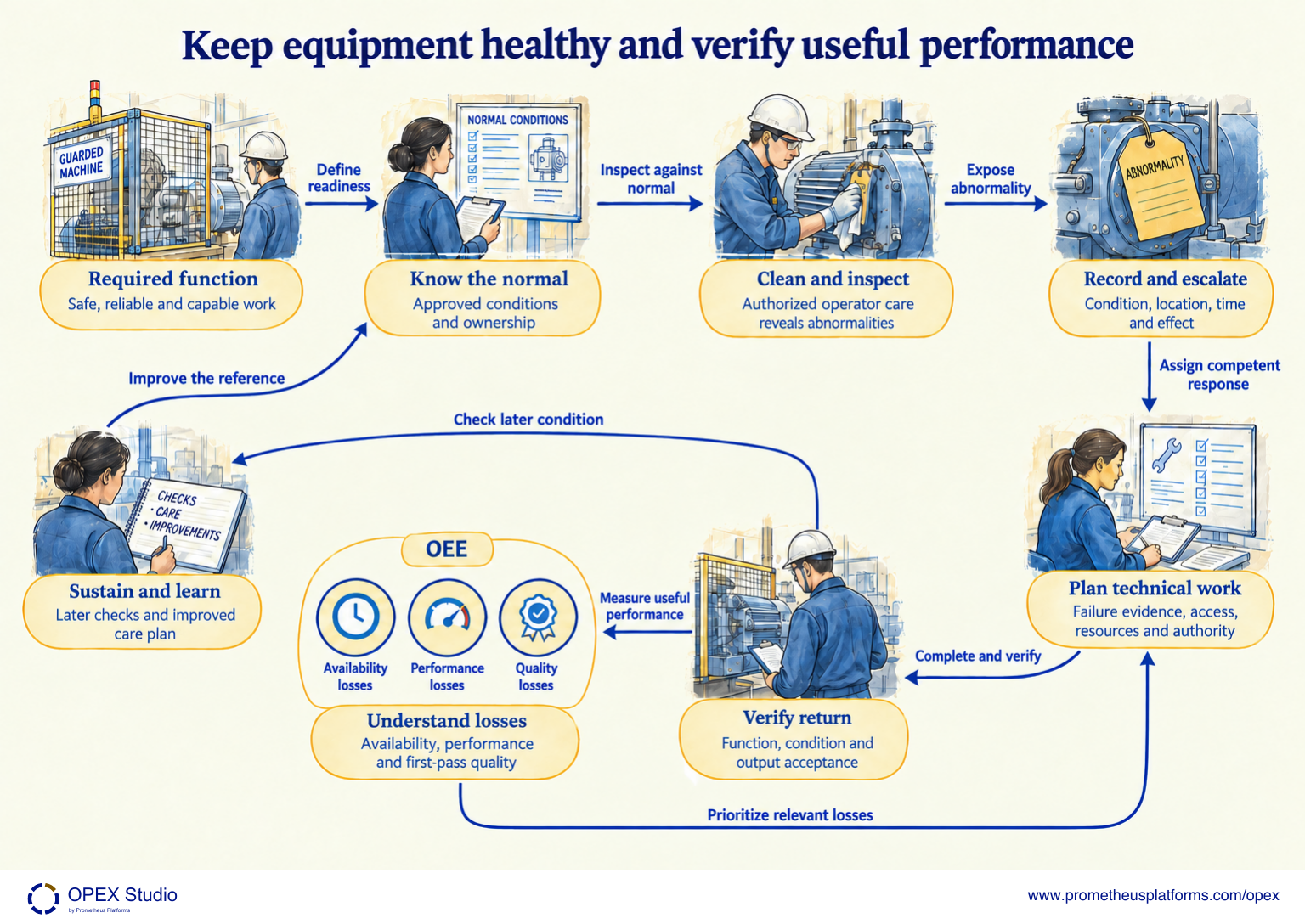
Equipment wellness starts with the function the equipment must perform and a clear reference for normal condition. Approved operator care can expose leaks, looseness or contamination, but technical intervention remains with competent authorized people. Record the condition and route it to the appropriate response. Planned work should address supported failure mechanisms and include verification of return, not only a completion tick. OEE helps reconcile categories of lost planned time with first-pass good output; it should guide useful investigation rather than encourage excess production. Later checks establish whether the condition is maintained and whether the care or maintenance plan needs revision.
Cleaning is an opportunity to inspect, not proof that a defect has been repaired.
Operator care does not authorize specialist adjustment or bypass of controls.
OEE combines availability, performance and first-pass quality; it is not a universal target or demand measure.
A machine is clean and the maintenance task is signed off, but the same residue returns on the next shift. Is the issue sustained?
No. Record recurrence, retain unresolved status and review the technical response and verification. Appearance and task completion do not establish maintained condition.
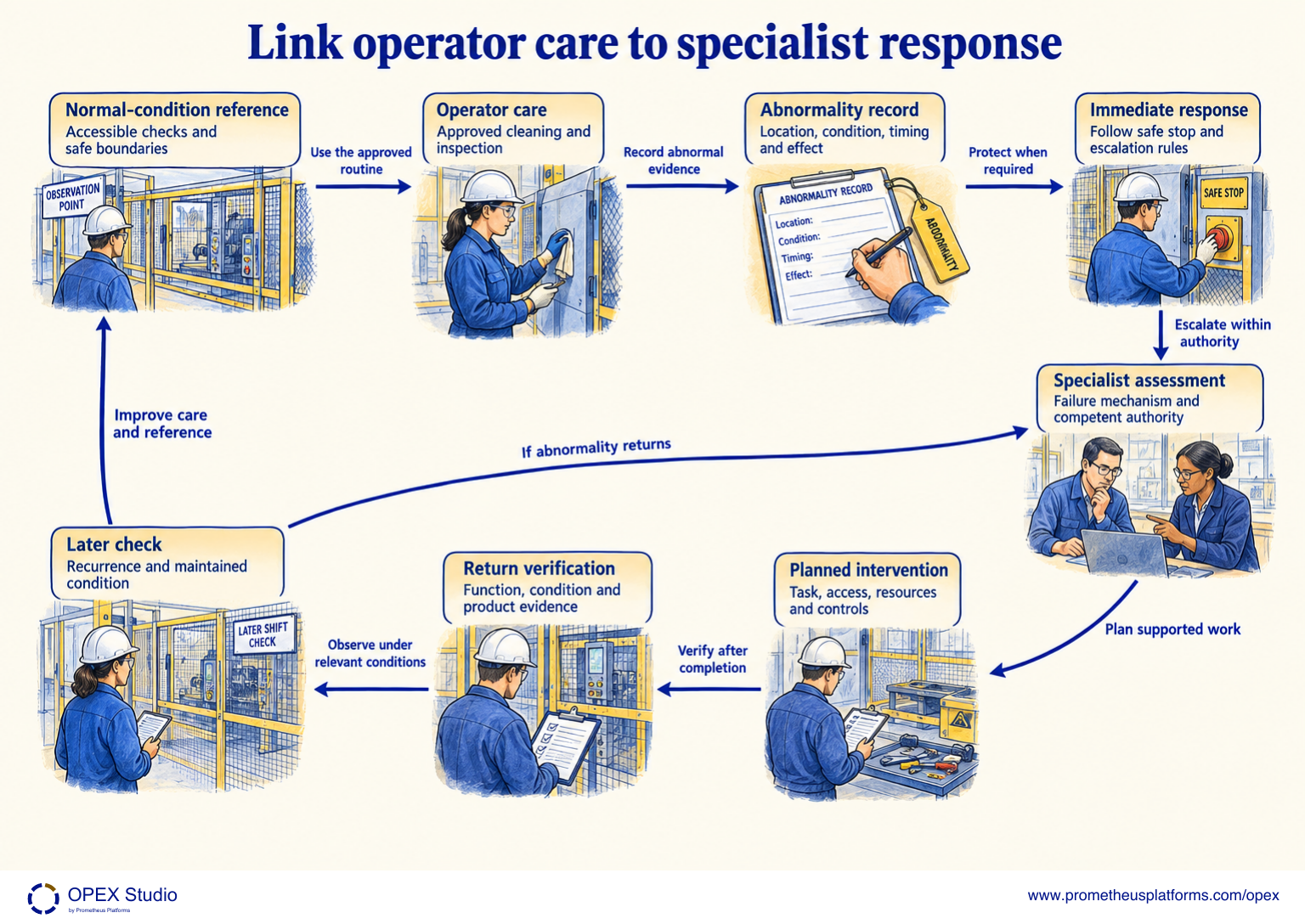
An operator’s approved cleaning and inspection routine helps discover changes from normal condition. Record what was observed and follow the defined immediate response and escalation boundaries. Discovery does not authorize technical adjustment, guard bypass or unplanned work. A competent specialist assesses the failure evidence and plans the appropriate intervention, access and controls. Return verification should check the required function, the maintained condition and relevant product evidence. Later observation under comparable conditions is needed to distinguish a completed task from sustained improvement. If the abnormality returns, retain it as unresolved and revisit the technical explanation rather than simply adding another cleaning tick.
Clean-to-inspect makes abnormalities visible; it is not a substitute for repair.
Operator care and specialist maintenance have different authority boundaries.
A later check must observe relevant operating conditions; a fresh clean photograph is insufficient.
An operator repeatedly wipes oil from the same external point, and each shift signs the cleaning sheet. What should change in the response?
Record the repeated condition, follow local safe response rules and escalate for competent assessment. Keep the recurrence visible and plan verification after an authorized intervention. More signatures do not establish that the leak mechanism is controlled.
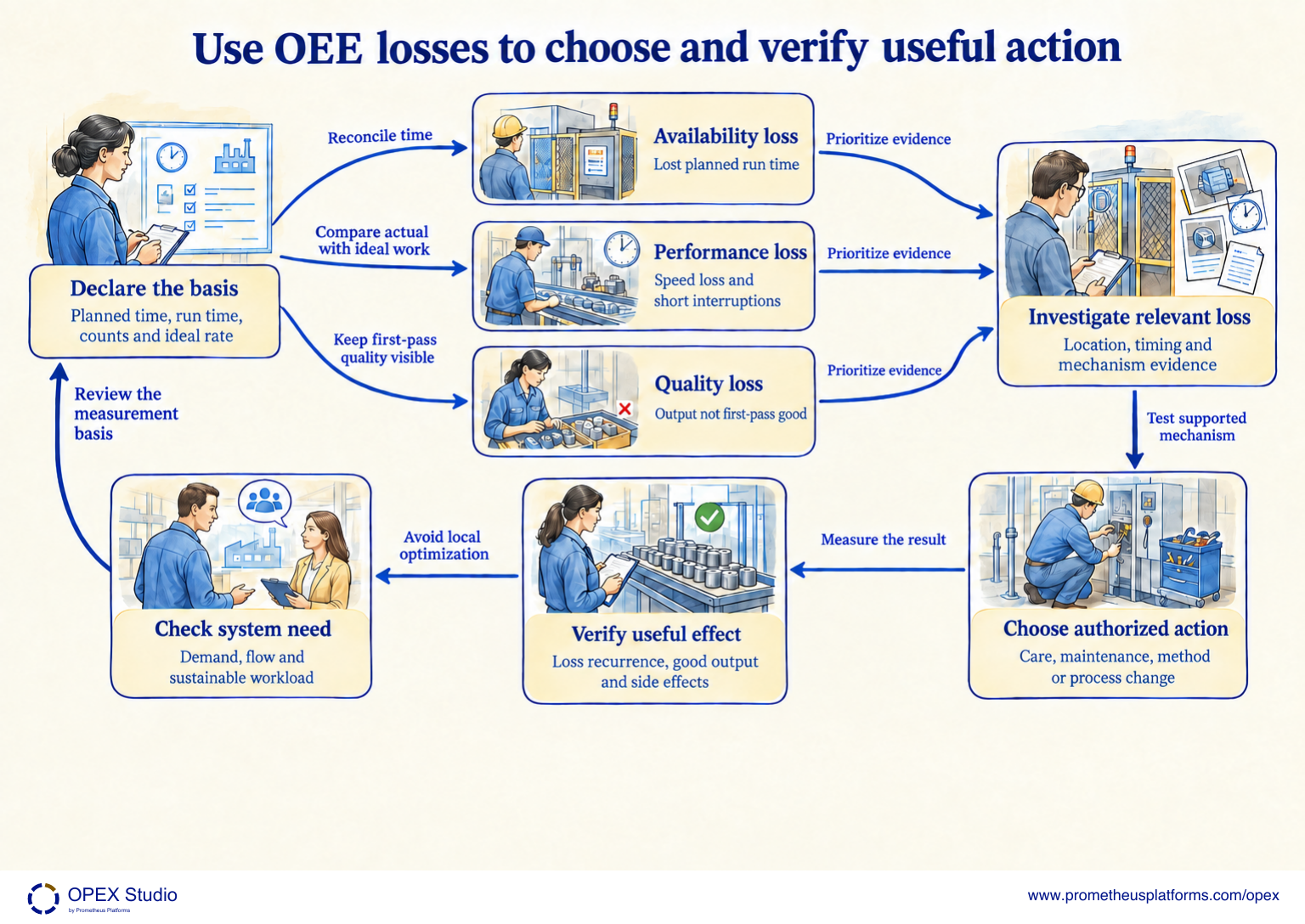
OEE is useful when its measurement basis is clear. Declare planned time, run time, total output, first-pass good output and the ideal rate before calculating the factors. Availability, performance and quality represent different loss lenses and should lead to evidence about where and how loss occurs. The largest category is a starting question, not a proven cause. Choose an authorized intervention supported by the mechanism, then verify recurrence, good output and unintended effects. Finally check the system need: higher local output can create inventory or workload without improving customer delivery. Use the detailed OEE lesson for the exact numerical reconciliation.
OEE equals availability multiplied by performance multiplied by first-pass quality.
Keep planned-time and ideal-rate assumptions visible; do not improve the score by silently changing the denominator.
OEE is not a command to produce beyond demand or maximize every machine’s utilization.
A team increases reported OEE by excluding recurring stoppages from planned time while the customer receives no more good output. What should the review question?
Check whether the measurement basis changed legitimately and transparently. Reconcile the omitted time, examine actual losses and compare useful good output with customer need. A higher percentage alone is not evidence of operational improvement.
Cross-functional loss prevention; autonomous and planned maintenance differ
Method reference; original OPEX scenario and diagram are synthetic teaching content, not source case results.Role sharing, maintenance information, MTBF/MTTR, diagnosis and repeat-failure analysis; historical methodology, not current award eligibility
Method reference; original OPEX scenario and diagram are synthetic teaching content, not source case results.Quality-maintenance conditions, deterioration and recurring-breakdown prevention; historical assessment source
Method reference; original OPEX scenario and diagram are synthetic teaching content, not source case results.Availability × performance × quality and loss categories
Method reference; original OPEX scenario and diagram are synthetic teaching content, not source case results.Systematic workplace standards and sustaining routines, not cosmetic tidiness
Method reference; original OPEX scenario and diagram are synthetic teaching content, not source case results.Five focusing steps connect applications and complement other improvement approaches; public synopsis only
Public course synopsis only; no claim to have viewed restricted course content.Read the lessons online or use these PDFs to prepare, practise and review with your team. No sign-in needed.
Case objectives, demonstration plans, debriefs, common mistakes and application checks across all 81 workplace cases and method lessons.
Download Facilitator guide PDF · 166 pages · 65.1 MBPrintable case worksheets, blank observation records and five calculation exercises; answers are separate.
Download Learner workbook PDF · 169 pages · 10.7 MBReasoned sample responses, worked calculations and coaching guidance; fictional examples are clearly labelled.
Download Answer key and coaching notes PDF · 105 pages · 8.5 MBThe native method mechanisms and worked applications for all 68 detailed lessons, in a separate bookmarked portrait reference.
Download Method and application reference PDF · 141 pages · 10.2 MBFive illustrated system chapters: 15 Flare concept maps and 26 original workplace teaching cards, with links to all 81 supporting cases and method lessons.
Download Illustrated systems atlas PDF · 69 pages · 55.8 MBPrimary teaching mechanism belongs to equipment wellness and oee. Supporting links identify application dependencies; they do not make the methods interchangeable.
Explore the connected method →Primary teaching mechanism belongs to equipment wellness and oee. Supporting links identify application dependencies; they do not make the methods interchangeable.
Explore the connected method →Primary teaching mechanism belongs to equipment wellness and oee. Supporting links identify application dependencies; they do not make the methods interchangeable.
Explore the connected method →Primary teaching mechanism belongs to equipment wellness and oee. Supporting links identify application dependencies; they do not make the methods interchangeable.
Explore the connected method →Primary teaching mechanism belongs to equipment wellness and oee. Supporting links identify application dependencies; they do not make the methods interchangeable.
Explore the connected method →Primary teaching mechanism belongs to equipment wellness and oee. Supporting links identify application dependencies; they do not make the methods interchangeable.
Explore the connected method →Primary teaching mechanism belongs to equipment wellness and oee. Supporting links identify application dependencies; they do not make the methods interchangeable.
Explore the connected method →Primary teaching mechanism belongs to equipment wellness and oee. Supporting links identify application dependencies; they do not make the methods interchangeable.
Explore the connected method →