Facilitator guide
Case objectives, demonstration plans, debriefs, common mistakes and application checks across all 81 workplace cases and method lessons.
Download Facilitator guide PDF · 166 pages · 65.1 MB OPEXSTUDIO
Understand how the methods relate before selecting a detailed lesson.. Follow the visual, practise a decision, then check your thinking.
Fictional teaching examples and AI-generated illustrations. Proposed changes and goals are not achieved results. Use the written instructions and check local conditions before applying a method.
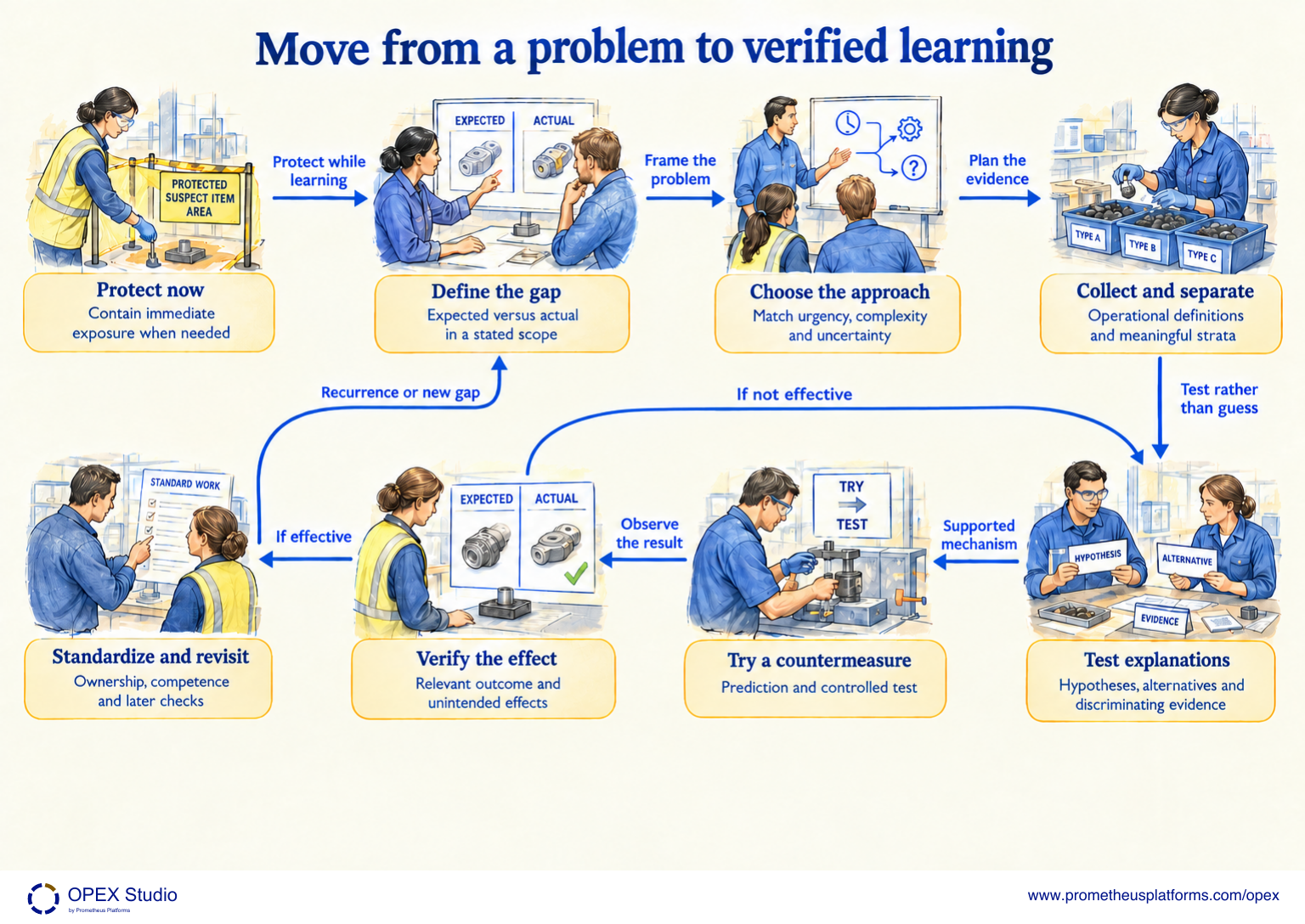
Protect people and customers when exposure requires an immediate response, while keeping containment distinct from permanent correction. Define the expected and actual condition before selecting a method. Different problems need different depth: an urgent restoration, a recurring gap, a target-condition experiment and open-ended innovation are not the same. Collect evidence using stable definitions and meaningful strata. Fishbone branches and why-chains organize hypotheses; they do not prove causes. Test alternatives, predict the effect of a countermeasure and verify relevant outcomes and unintended effects. Effective changes need ownership, learning and later review. An ineffective test should return the team to the evidence.
A hypothesis map is not proof of root cause.
Containment may continue while causal investigation and validation proceed.
The method choice depends on the problem; the map does not require every problem to use every tool.
A team’s fishbone contains many plausible causes. What makes it ready to choose a permanent action?
It is not ready from the diagram alone. Choose discriminating observations or tests, examine alternatives and connect any proposed action to supported causal evidence.
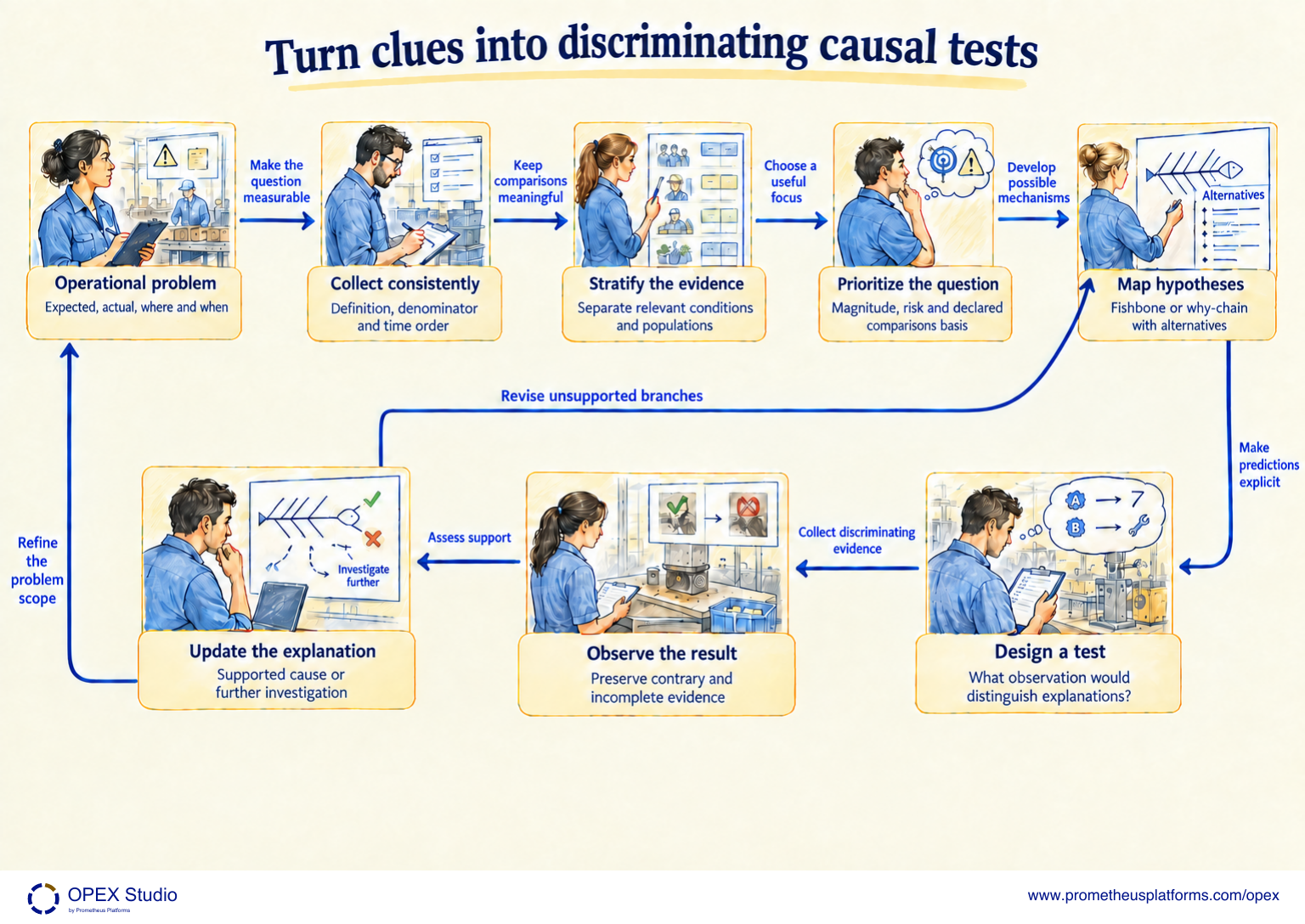
Useful evidence begins with a clear problem and stable operational definitions. Preserve denominators and time order, and stratify where populations or conditions differ. A Pareto comparison can prioritize a question on a declared basis; it does not prove a cause. Fishbone diagrams and why-chains help organize possible mechanisms and alternative explanations. A scatter relationship is another clue, not proof of causation. Choose an observation or test that would distinguish the alternatives. Retain contrary and incomplete evidence instead of forcing a neat story. Update the explanation only to the strength supported, and refine the problem scope when the evidence requires it.
Raw counts can mislead when exposure denominators differ.
A ranked category, correlation or fishbone branch does not establish causation.
A why-chain may branch; stop where evidence stops instead of inventing a fifth answer.
One shift has more defects but produces ten times as many units. What should be checked before blaming that shift?
Compare compatible defect definitions, exposure denominators, product mix, timing and measurement conditions. A higher count may coexist with a lower rate. Use the stratified evidence to choose a causal test, not a blame statement.
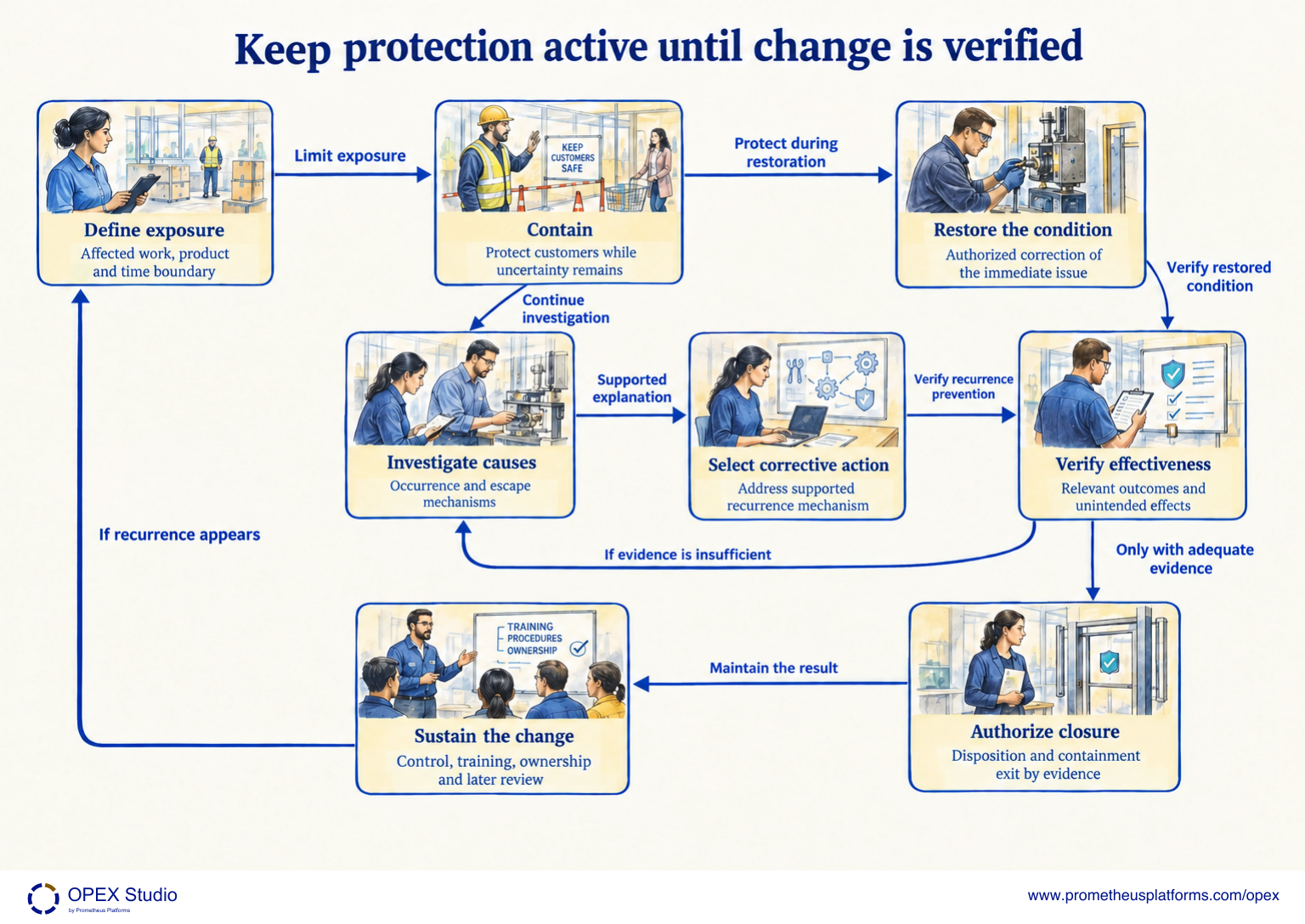
Containment protects against current exposure; correction restores the immediate condition; corrective action addresses a supported cause of recurrence. These decisions can overlap in time but should not be confused. Investigate both occurrence and escape where relevant. A restored machine or a relabelled record does not alone establish that affected output is acceptable or that recurrence is prevented. Verify the appropriate condition and outcomes, keep containment active while evidence is inadequate, and use the designated authority for disposition and exit. Carry effective learning into controls, training and later review. This relationship map complements 8D and NCR routines without claiming that their formal gates are identical.
Containment does not prove a permanent cause has been removed.
Correction must restore the actual required condition, not merely change a label.
Containment exit and closure require defined authority and effectiveness evidence.
An overdue gauge has received a new label, but no authorized calibration or verification record exists. Can the NCR be closed?
No. Remove the overdue gauge from service as required, complete authorized calibration or verification and restore correct status records. Assess suspect measurement/output exposure and verify the scheduling-system corrective action before closure.
Troubleshooting, gap from standard, target condition and open-ended innovation
Method reference; original OPEX scenario and diagram are synthetic teaching content, not source case results.Analysis method must fit problem; model must not default blindly to 5 Whys
Method reference; original OPEX scenario and diagram are synthetic teaching content, not source case results.Cause chain, not exactly five repetitions; gap-from-standard focus
Method reference; original OPEX scenario and diagram are synthetic teaching content, not source case results.Organize possible causes of a defined effect for investigation; the diagram structures ideas rather than proving them.
Public primary-source summary; underlying paid standards/forms are not reproduced.RCCA investigates causes, implements and verifies corrective actions, and supports appropriate Nadcap NCR responses.
This teaching workflow is not the official NCR response form or an accreditation decision.Define the observed event, collection period and recording fields; pilot the form before repeated use.
Public primary-source summary; underlying paid standards/forms are not reproduced.Rank category totals on one stated measurement basis; cumulative percentages are optional and end at100%.
Public primary-source summary; underlying paid standards/forms are not reproduced.Separate observations by relevant source categories so aggregated data do not conceal patterns.
Public primary-source summary; underlying paid standards/forms are not reproduced.Plot paired numerical observations to examine association; an apparent relationship alone does not establish causation.
Public primary-source summary; underlying paid standards/forms are not reproduced.Andon response, stopping on abnormality, mistake prevention
Method reference; original OPEX scenario and diagram are synthetic teaching content, not source case results.Abnormality signal summons response; fixed-position process stop differs from emergency stop
Method reference; original OPEX scenario and diagram are synthetic teaching content, not source case results.Control plans link process risks and controls, with explicit reaction ownership, containment and return-to-control actions.
Public overview only. Do not reproduce licensed forms or infer a universal sampling frequency or safe-launch exit period.Read the lessons online or use these PDFs to prepare, practise and review with your team. No sign-in needed.
Case objectives, demonstration plans, debriefs, common mistakes and application checks across all 81 workplace cases and method lessons.
Download Facilitator guide PDF · 166 pages · 65.1 MBPrintable case worksheets, blank observation records and five calculation exercises; answers are separate.
Download Learner workbook PDF · 169 pages · 10.7 MBReasoned sample responses, worked calculations and coaching guidance; fictional examples are clearly labelled.
Download Answer key and coaching notes PDF · 105 pages · 8.5 MBThe native method mechanisms and worked applications for all 68 detailed lessons, in a separate bookmarked portrait reference.
Download Method and application reference PDF · 141 pages · 10.2 MBFive illustrated system chapters: 15 Flare concept maps and 26 original workplace teaching cards, with links to all 81 supporting cases and method lessons.
Download Illustrated systems atlas PDF · 69 pages · 55.8 MBPrimary teaching mechanism belongs to problem solving and verified change. Supporting links identify application dependencies; they do not make the methods interchangeable.
Explore the connected method →Primary teaching mechanism belongs to problem solving and verified change. Supporting links identify application dependencies; they do not make the methods interchangeable.
Explore the connected method →Primary teaching mechanism belongs to problem solving and verified change. Supporting links identify application dependencies; they do not make the methods interchangeable.
Explore the connected method →Primary teaching mechanism belongs to problem solving and verified change. Supporting links identify application dependencies; they do not make the methods interchangeable.
Explore the connected method →Primary teaching mechanism belongs to problem solving and verified change. Supporting links identify application dependencies; they do not make the methods interchangeable.
Explore the connected method →Primary teaching mechanism belongs to problem solving and verified change. Supporting links identify application dependencies; they do not make the methods interchangeable.
Explore the connected method →Primary teaching mechanism belongs to problem solving and verified change. Supporting links identify application dependencies; they do not make the methods interchangeable.
Explore the connected method →Primary teaching mechanism belongs to problem solving and verified change. Supporting links identify application dependencies; they do not make the methods interchangeable.
Explore the connected method →Primary teaching mechanism belongs to problem solving and verified change. Supporting links identify application dependencies; they do not make the methods interchangeable.
Explore the connected method →Primary teaching mechanism belongs to problem solving and verified change. Supporting links identify application dependencies; they do not make the methods interchangeable.
Explore the connected method →Primary teaching mechanism belongs to problem solving and verified change. Supporting links identify application dependencies; they do not make the methods interchangeable.
Explore the connected method →Primary teaching mechanism belongs to problem solving and verified change. Supporting links identify application dependencies; they do not make the methods interchangeable.
Explore the connected method →Primary teaching mechanism belongs to problem solving and verified change. Supporting links identify application dependencies; they do not make the methods interchangeable.
Explore the connected method →Primary teaching mechanism belongs to problem solving and verified change. Supporting links identify application dependencies; they do not make the methods interchangeable.
Explore the connected method →Primary teaching mechanism belongs to problem solving and verified change. Supporting links identify application dependencies; they do not make the methods interchangeable.
Explore the connected method →Primary teaching mechanism belongs to problem solving and verified change. Supporting links identify application dependencies; they do not make the methods interchangeable.
Explore the connected method →Primary teaching mechanism belongs to quality control and dependable evidence. Supporting links identify application dependencies; they do not make the methods interchangeable.
Explore the connected method →Primary teaching mechanism belongs to quality control and dependable evidence. Supporting links identify application dependencies; they do not make the methods interchangeable.
Explore the connected method →Primary teaching mechanism belongs to quality control and dependable evidence. Supporting links identify application dependencies; they do not make the methods interchangeable.
Explore the connected method →Primary teaching mechanism belongs to quality control and dependable evidence. Supporting links identify application dependencies; they do not make the methods interchangeable.
Explore the connected method →Primary teaching mechanism belongs to quality control and dependable evidence. Supporting links identify application dependencies; they do not make the methods interchangeable.
Explore the connected method →Primary teaching mechanism belongs to quality control and dependable evidence. Supporting links identify application dependencies; they do not make the methods interchangeable.
Explore the connected method →Primary teaching mechanism belongs to quality control and dependable evidence. Supporting links identify application dependencies; they do not make the methods interchangeable.
Explore the connected method →Primary teaching mechanism belongs to quality control and dependable evidence. Supporting links identify application dependencies; they do not make the methods interchangeable.
Explore the connected method →Primary teaching mechanism belongs to quality control and dependable evidence. Supporting links identify application dependencies; they do not make the methods interchangeable.
Explore the connected method →Primary teaching mechanism belongs to quality control and dependable evidence. Supporting links identify application dependencies; they do not make the methods interchangeable.
Explore the connected method →Primary teaching mechanism belongs to quality control and dependable evidence. Supporting links identify application dependencies; they do not make the methods interchangeable.
Explore the connected method →Primary teaching mechanism belongs to quality control and dependable evidence. Supporting links identify application dependencies; they do not make the methods interchangeable.
Explore the connected method →Primary teaching mechanism belongs to quality control and dependable evidence. Supporting links identify application dependencies; they do not make the methods interchangeable.
Explore the connected method →Primary teaching mechanism belongs to quality control and dependable evidence. Supporting links identify application dependencies; they do not make the methods interchangeable.
Explore the connected method →Primary teaching mechanism belongs to quality control and dependable evidence. Supporting links identify application dependencies; they do not make the methods interchangeable.
Explore the connected method →Primary teaching mechanism belongs to quality control and dependable evidence. Supporting links identify application dependencies; they do not make the methods interchangeable.
Explore the connected method →Primary teaching mechanism belongs to quality control and dependable evidence. Supporting links identify application dependencies; they do not make the methods interchangeable.
Explore the connected method →Primary teaching mechanism belongs to quality control and dependable evidence. Supporting links identify application dependencies; they do not make the methods interchangeable.
Explore the connected method →Primary teaching mechanism belongs to quality control and dependable evidence. Supporting links identify application dependencies; they do not make the methods interchangeable.
Explore the connected method →Primary teaching mechanism belongs to quality control and dependable evidence. Supporting links identify application dependencies; they do not make the methods interchangeable.
Explore the connected method →Primary teaching mechanism belongs to quality control and dependable evidence. Supporting links identify application dependencies; they do not make the methods interchangeable.
Explore the connected method →Primary teaching mechanism belongs to quality control and dependable evidence. Supporting links identify application dependencies; they do not make the methods interchangeable.
Explore the connected method →Primary teaching mechanism belongs to quality control and dependable evidence. Supporting links identify application dependencies; they do not make the methods interchangeable.
Explore the connected method →Primary teaching mechanism belongs to quality control and dependable evidence. Supporting links identify application dependencies; they do not make the methods interchangeable.
Explore the connected method →Primary teaching mechanism belongs to leadership and daily learning. Supporting links identify application dependencies; they do not make the methods interchangeable.
Explore the connected method →Primary teaching mechanism belongs to leadership and daily learning. Supporting links identify application dependencies; they do not make the methods interchangeable.
Explore the connected method →Primary teaching mechanism belongs to leadership and daily learning. Supporting links identify application dependencies; they do not make the methods interchangeable.
Explore the connected method →Primary teaching mechanism belongs to leadership and daily learning. Supporting links identify application dependencies; they do not make the methods interchangeable.
Explore the connected method →Primary teaching mechanism belongs to leadership and daily learning. Supporting links identify application dependencies; they do not make the methods interchangeable.
Explore the connected method →Primary teaching mechanism belongs to leadership and daily learning. Supporting links identify application dependencies; they do not make the methods interchangeable.
Explore the connected method →Primary teaching mechanism belongs to leadership and daily learning. Supporting links identify application dependencies; they do not make the methods interchangeable.
Explore the connected method →