Facilitator guide
Case objectives, demonstration plans, debriefs, common mistakes and application checks across all 81 workplace cases and method lessons.
Download Facilitator guide PDF · 166 pages · 65.1 MB OPEXSTUDIO
Translate customer needs into a connected launch plan.. Follow the visual, practise a decision, then check your thinking.
Fictional teaching examples and AI-generated illustrations. Proposed changes and goals are not achieved results. Use the written instructions and check local conditions before applying a method.
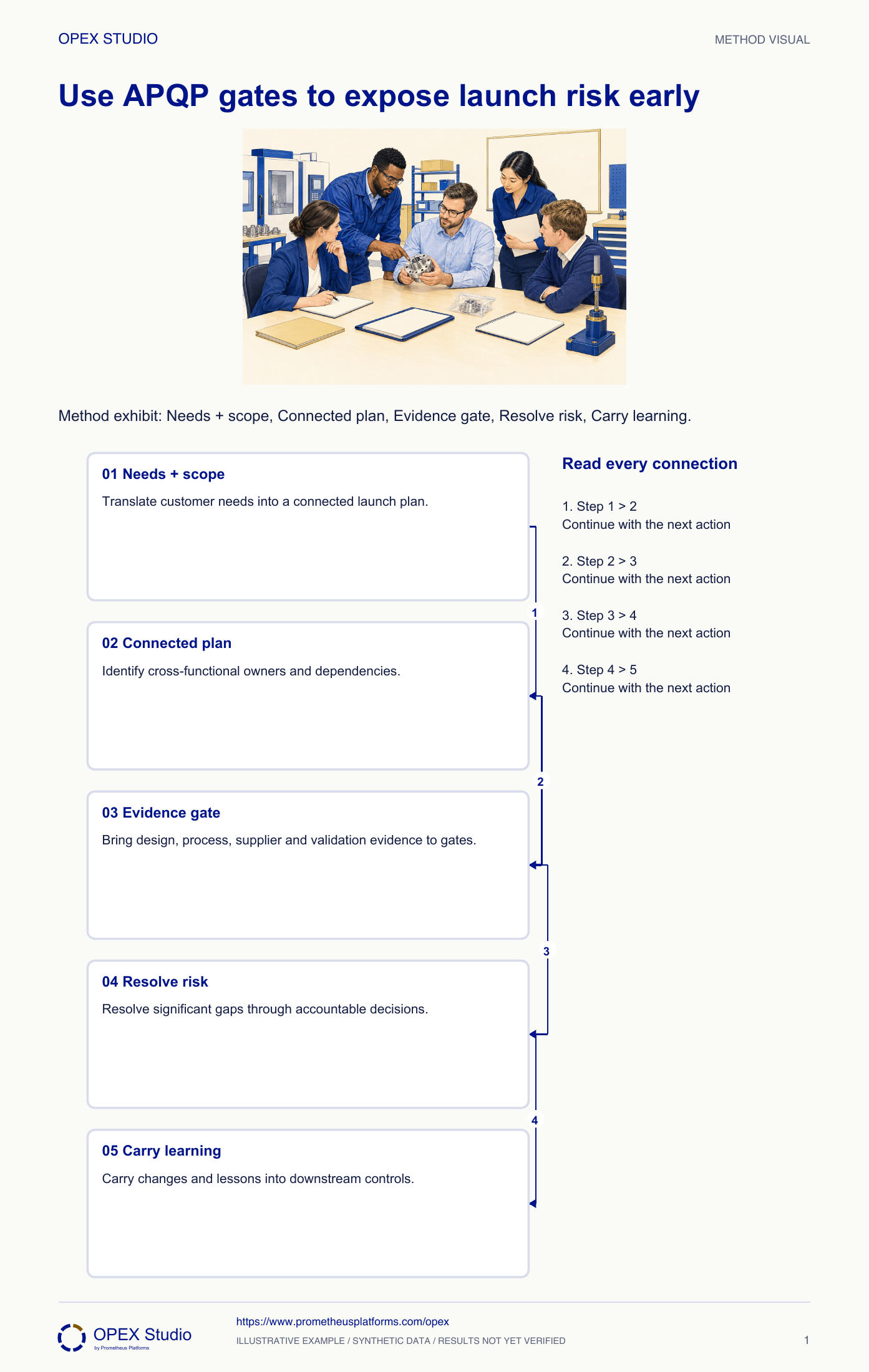
APQP links product and process development to evidence-based launch decisions. Translate customer needs into a plan with connected responsibilities, timing and deliverables. Use gates to expose unresolved risks, dependencies and changes rather than to celebrate document completion. Evidence from design, process development, suppliers and validation must fit the actual scope. Carry decisions and lessons forward so an approved change does not leave downstream records obsolete. The current public AIAG materials distinguish APQP third edition from the standalone Control Plan first edition. Customer adoption and requirements still need checking. This teaching map demonstrates decision discipline, not a complete mandated gate list or automatic launch authorization.
APQP3 and standalone Control Plan1 were published in2024.
Three open actions are an example, not a standard gate requirement.
Customer adoption and authorization remain separate checks.
Fictional case: a new component launch has three open actions: measurement validation, supplier validation and a station reaction drill. Planner Tessa has a green schedule because most tasks are complete. The core lesson retains these three gaps. The team must decide what evidence is missing and who can authorize the next step.
Assess which evidence and controls the revision affects, reopen those dependencies and obtain the required review before using the old acceptance for the new scope.
Prior evidence may remain useful, but applicability must be justified. Relabelling an old report with the new revision would break provenance.
Use a launch evidence gate to expose dependencies and unresolved risk, with accountable decisions instead of a task-completion percentage.
Fictional case: a new component launch has three open actions: measurement validation, supplier validation and a station reaction drill. Planner Tessa has a green schedule because most tasks are complete. The core lesson retains these three gaps. The team must decide what evidence is missing and who can authorize the next step.
Role: Cross-functional launch leader with engineering, supplier quality and operations
Customer needs, design/process development, validation and operational controls are connected through clear deliverables and evidence-based decisions.
The team treats a high completion percentage as approval to launch, despite unresolved evidence needed to interpret product results and respond to abnormalities.
| Open action | Why it matters | Owner |
|---|---|---|
| Measurement validation | Can the measured result support the decision? | Metrology lead |
| Supplier validation | Does supplied input meet the agreed conditions? | Supplier quality |
| Reaction drill | Can the station contain and escalate an abnormality? | Operations and quality |
Tessa names the product/revision, intended production conditions and the specific decision the gate must support. She confirms customer requirements and the applicable planning method.
Why: A gate without scope can be passed using evidence from a different revision or trial condition. A date is not an acceptance criterion.
Evidence: The gate agenda states the decision, scope and approval roles.
She links measurement validation to interpretation of process trials, supplier validation to representative inputs, and reaction-drill results to the control plan and work instructions.
Why: Open tasks differ in consequence. Dependencies reveal why an apparently small incomplete action can undermine several downstream conclusions.
Evidence: The evidence map identifies which claims depend on each unresolved action.
Each owner brings traceable records, their limitations and outstanding findings. Tessa distinguishes a scheduled study from a completed reviewed result and a document upload from accepted evidence.
Why: Administrative completion can hide a missing technical result. The gate must examine what the evidence establishes, not whether a file exists.
Evidence: Three action rows contain evidence status and remaining questions.
The authorized team determines whether the applicable criteria are met, what restrictions or additional work are required, and who owns closure. Tessa does not invent a customer deviation or presume silence means approval.
Why: A conditional decision must have actual authority and explicit conditions. It cannot be manufactured from an optimistic progress score.
Evidence: The record names decision owner, scope, conditions and next review.
Validated changes flow into PFMEA, control plan, instructions, supplier controls and handover as applicable. The team verifies that the receiving operation can use them.
Why: A launch gate is connected to continuing control, not a ceremony that ends at shipment. Lessons and unresolved risks must reach the people doing the work.
Evidence: The handover identifies controlled revisions and receiving owners.
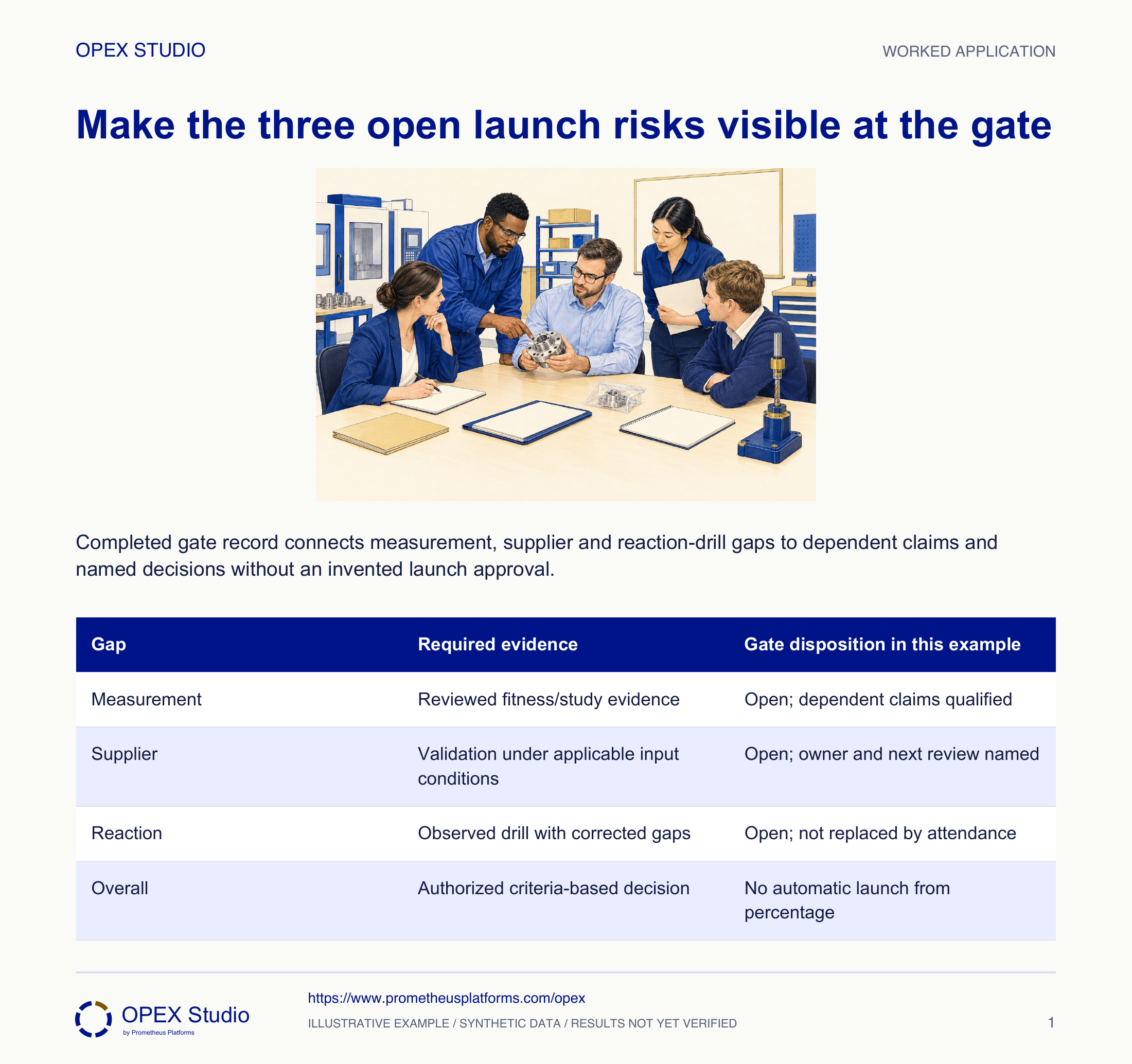
| Gap | Required evidence | Gate disposition in this example |
|---|---|---|
| Measurement | Reviewed fitness/study evidence | Open; dependent claims qualified |
| Supplier | Validation under applicable input conditions | Open; owner and next review named |
| Reaction | Observed drill with corrected gaps | Open; not replaced by attendance |
| Overall | Authorized criteria-based decision | No automatic launch from percentage |
A late revision changes a controlled characteristic after the trial evidence was accepted.
Assess which evidence and controls the revision affects, reopen those dependencies and obtain the required review before using the old acceptance for the new scope.
Prior evidence may remain useful, but applicability must be justified. Relabelling an old report with the new revision would break provenance.
A change-impact record identifies reused evidence, necessary revalidation and authority.
New fictional launch has closed packaging review and operator training, but the measurement method for a critical characteristic remains unresolved. The dashboard says 2 of 3 actions complete.
| Action | Status |
|---|---|
| Packaging review | Closed with evidence |
| Training | Delivered and recorded |
| Measurement method | Fitness unresolved |
2/3=66.7% administrative completion. That fraction does not establish readiness or the significance of the open measurement issue.
The method gap may undermine interpretation of validation results for the characteristic. Record the affected claims, required evidence, accountable decision and follow-up; do not declare launch approved from the count.
| Item | Result | Meaning |
|---|---|---|
| Completion | 2 of 3=66.7% | Task count only |
| Measurement | Unresolved | Dependent validation qualified |
| Gate decision | Authorized review required | No invented approval |
What exactly would this gate authorize?
Which claims rely on the measurement action?
Why can one gap matter more than two closures?
Who receives the controlled changes?
Write a one-paragraph gate recommendation with scope, evidence, remaining risk and decision owner.
Owner: Launch leader and receiving process owners
Record: Gate evidence, decision conditions and controlled handover
Review: At defined gates and material changes
Evidence: Applicable evidence and verified operational readiness
Reopen affected dependencies and escalate unresolved authority rather than using completion percentage as release permission.
The 2024 release separates Control Plan 1 from APQP 3 and adds emphasis on launch, change/risk management, traceability and gated planning.
Customer applicability and effective dates differ; this announcement is not a complete requirement set.Read the lessons online or use these PDFs to prepare, practise and review with your team. No sign-in needed.
Case objectives, demonstration plans, debriefs, common mistakes and application checks across all 81 workplace cases and method lessons.
Download Facilitator guide PDF · 166 pages · 65.1 MBPrintable case worksheets, blank observation records and five calculation exercises; answers are separate.
Download Learner workbook PDF · 169 pages · 10.7 MBReasoned sample responses, worked calculations and coaching guidance; fictional examples are clearly labelled.
Download Answer key and coaching notes PDF · 105 pages · 8.5 MBThe native method mechanisms and worked applications for all 68 detailed lessons, in a separate bookmarked portrait reference.
Download Method and application reference PDF · 141 pages · 10.2 MBFive illustrated system chapters: 15 Flare concept maps and 26 original workplace teaching cards, with links to all 81 supporting cases and method lessons.
Download Illustrated systems atlas PDF · 69 pages · 55.8 MBExplore this connected method and its separate application conditions.
Explore the connected method →Explore this connected method and its separate application conditions.
Explore the connected method →Explore this connected method and its separate application conditions.
Explore the connected method →