Facilitator guide
Case objectives, demonstration plans, debriefs, common mistakes and application checks across all 81 workplace cases and method lessons.
Download Facilitator guide PDF · 166 pages · 65.1 MB OPEXSTUDIO
Choose specific questions tied to critical process controls.. Follow the visual, practise a decision, then check your thinking.
Fictional teaching examples and AI-generated illustrations. Proposed changes and goals are not achieved results. Use the written instructions and check local conditions before applying a method.
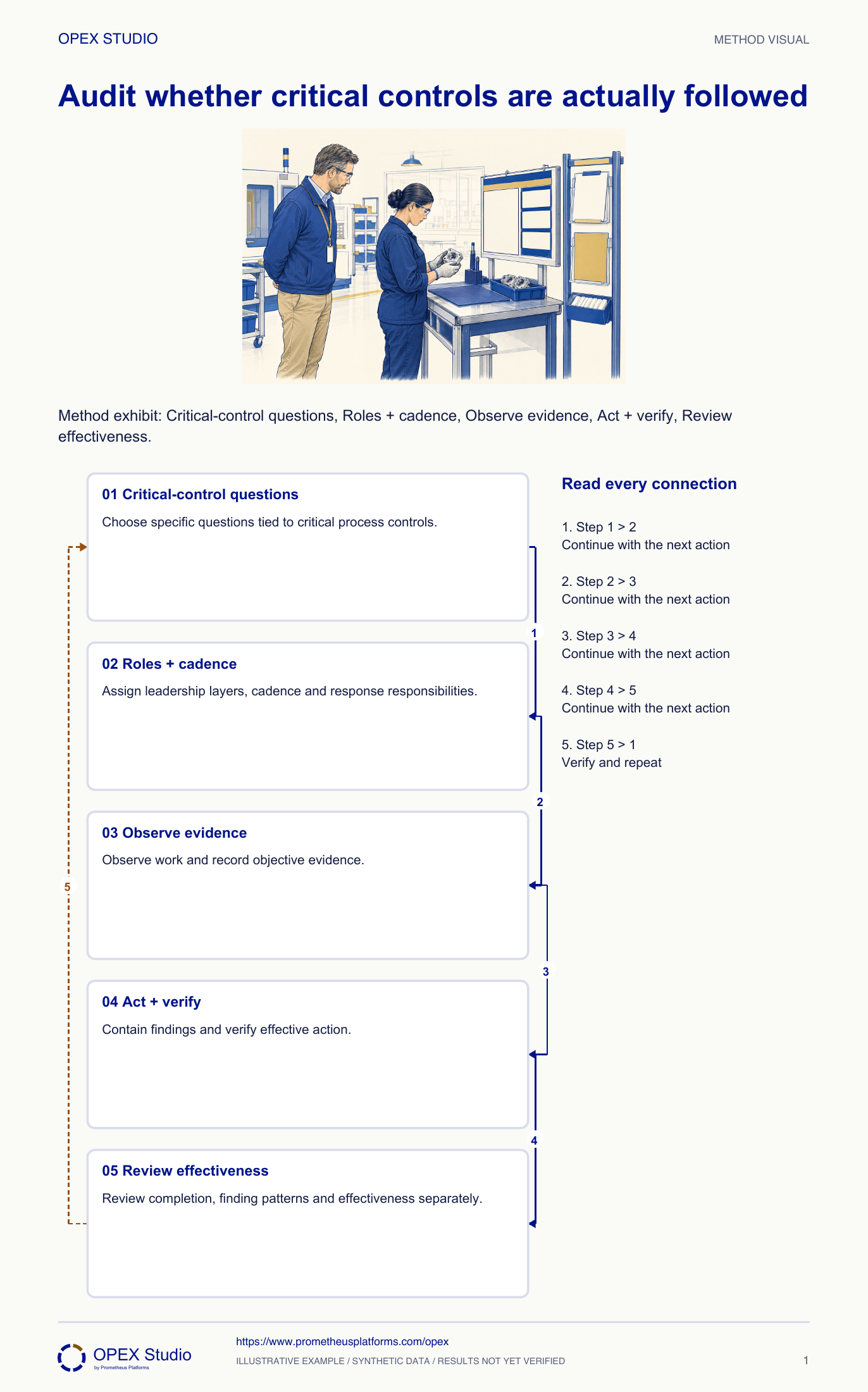
A layered process audit checks execution of important controls through planned observation by defined roles. Choose specific questions tied to process risks, then decide how evidence is recorded and what happens when a control is absent or ineffective. The purpose is to detect and correct weaknesses in routine execution, not to substitute for product inspection or a full management-system audit. Review completion, findings, action effectiveness and recurring patterns as different measures. A high completion percentage can coexist with poor observations, and a low finding count can reflect superficial checks. Use learning to improve both the process and the audit questions without turning the routine into blame.
8/10checks=80%completion.
2/8findings=25%finding rate among completed checks.
Neither metric measures percentage conforming product.
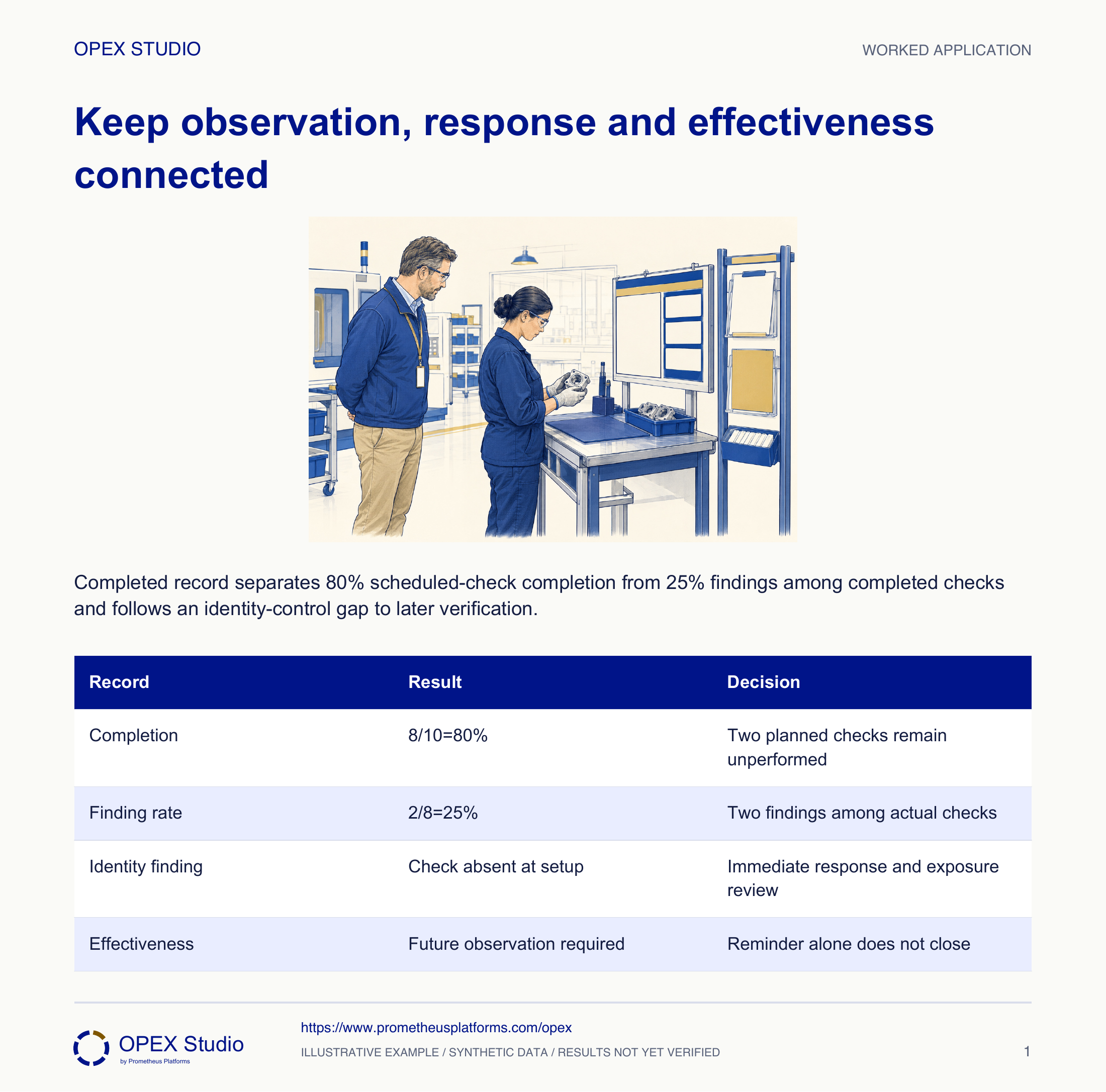
Fictional case: ten process checks were scheduled across leadership layers at Vale Assembly. Eight were completed and two findings recorded. These values remain unchanged in the core diagram. Supervisor Priya must report the results and follow an absent identity check through containment, action and a later observation.
Review whether the planned operating opportunities were actually covered and correct the observation plan. Preserve the true timing rather than backdating entries.
A perfect completion count can miss the conditions where a control is most likely to fail. The schedule should support representative observation.
Observe a critical control at the work, record objective evidence and verify the response while keeping audit-completion metrics distinct from product quality.
Fictional case: ten process checks were scheduled across leadership layers at Vale Assembly. Eight were completed and two findings recorded. These values remain unchanged in the core diagram. Supervisor Priya must report the results and follow an absent identity check through containment, action and a later observation.
Role: Layered-audit coordinator and process leaders
Questions target specific critical controls, observers inspect actual work/records and findings reach an accountable response with verification.
The dashboard labels 80% completion as 80% quality and closes findings when a reminder email is sent.
| Measure or finding | Fictional evidence |
|---|---|
| Scheduled / completed checks | 10 /8 |
| Findings among completed checks | 2 |
| Example finding | Current product identity not checked before setup |
| Initial action | Leader restores required check and reviews exposure |
| Effectiveness | Later observation still needed |
Priya replaces “Does the team care about quality?” with a question about whether the current product identity is checked against the setup instruction. The observer must see the work or its required record.
Why: A specific question can produce objective evidence. An opinion question encourages easy yes answers without testing the control.
Evidence: The question names the control, evidence and relevant operating moment.
Different leadership roles observe the critical control at planned opportunities. Priya identifies who responds to an abnormality and who removes a system obstacle.
Why: Layers provide different perspectives and authority; repeatedly collecting signatures without an action path does not strengthen the control.
Evidence: The schedule names observers, opportunity and receiving owner.
One observer records that setup proceeded without the required product-identity check, with time and relevant record reference. Another finding remains a separate evidence item.
Why: The finding should be reproducible and bounded. “Operator careless” is a causal judgment that the observation alone does not establish.
Evidence: Two objective findings are retained rather than merged into a general score.
Completion is 8/10=80%. Finding rate among completed checks is 2/8=25%. Priya labels both denominators and avoids interpreting either as percentage conforming product.
Why: The measures concern the audit activity and its observations. They do not estimate product quality or prove that the underlying control is effective.
Evidence: The dashboard names scheduled-check completion and findings per completed check.
The owner handles immediate exposure, investigates why the identity step was missed and corrects the relevant process. A later observed opportunity checks whether the intended control now works.
Why: Sending a reminder is an action, not effectiveness evidence. The review must distinguish restoration now from prevention of the recurring gap.
Evidence: Closure references the later observation and any remaining system issue.
| Record | Result | Decision |
|---|---|---|
| Completion | 8/10=80% | Two planned checks remain unperformed |
| Finding rate | 2/8=25% | Two findings among actual checks |
| Identity finding | Check absent at setup | Immediate response and exposure review |
| Effectiveness | Future observation required | Reminder alone does not close |
The log shows every leader completed the week’s planned observations at the same quiet moment.
Review whether the planned operating opportunities were actually covered and correct the observation plan. Preserve the true timing rather than backdating entries.
A perfect completion count can miss the conditions where a control is most likely to fail. The schedule should support representative observation.
The review records actual opportunities and gaps in coverage.
New fictional week has 12 planned checks,9 completed and 3 findings. One finding was marked closed after an email, with no later observation.
| Item | Count/status |
|---|---|
| Planned | 12 |
| Completed | 9 |
| Findings | 3 |
| Closed-by-email item | No effectiveness evidence |
Completion 9/12=75%; findings 3/9=33.3% of completed checks. Neither is a product-conformance rate.
Reopen or qualify the email-only closure under the local process; identify the actual control, response and later observation needed to verify effectiveness. Preserve the action already taken without overstating what it proves.
| Metric | Calculation | Meaning |
|---|---|---|
| Completion | 9/12=75% | Scheduled activity |
| Finding rate | 3/9=33.3% | Findings among checks |
| Closure | Email only | Effectiveness not established |
What could you actually observe?
Which population is each about?
What evidence would demonstrate the control?
Which operating condition might a convenient visit miss?
Write one audit question with its expected evidence and reaction owner.
Owner: Layered-audit coordinator and process owner
Record: Observation schedule, objective findings and effectiveness record
Review: At planned leadership reviews and follow-up observations
Evidence: Relevant coverage and verified control response
Improve questions, access or process conditions when repeated findings or superficial checks persist.
Process-specific checks, cross-functional ownership and management review connect audits to meaningful performance outcomes.
Public primary-source summary; underlying paid standards/forms are not reproduced.Read the lessons online or use these PDFs to prepare, practise and review with your team. No sign-in needed.
Case objectives, demonstration plans, debriefs, common mistakes and application checks across all 81 workplace cases and method lessons.
Download Facilitator guide PDF · 166 pages · 65.1 MBPrintable case worksheets, blank observation records and five calculation exercises; answers are separate.
Download Learner workbook PDF · 169 pages · 10.7 MBReasoned sample responses, worked calculations and coaching guidance; fictional examples are clearly labelled.
Download Answer key and coaching notes PDF · 105 pages · 8.5 MBThe native method mechanisms and worked applications for all 68 detailed lessons, in a separate bookmarked portrait reference.
Download Method and application reference PDF · 141 pages · 10.2 MBFive illustrated system chapters: 15 Flare concept maps and 26 original workplace teaching cards, with links to all 81 supporting cases and method lessons.
Download Illustrated systems atlas PDF · 69 pages · 55.8 MBExplore this connected method and its separate application conditions.
Explore the connected method →Explore this connected method and its separate application conditions.
Explore the connected method →Explore this connected method and its separate application conditions.
Explore the connected method →Explore this connected method and its separate application conditions.
Explore the connected method →