Facilitator guide
Case objectives, demonstration plans, debriefs, common mistakes and application checks across all 81 workplace cases and method lessons.
Download Facilitator guide PDF · 166 pages · 65.1 MB OPEXSTUDIO
Agree purpose. Follow the visual, practise a decision, then check your thinking.
Fictional teaching examples and AI-generated illustrations. Proposed changes and goals are not achieved results. Use the written instructions and check local conditions before applying a method.
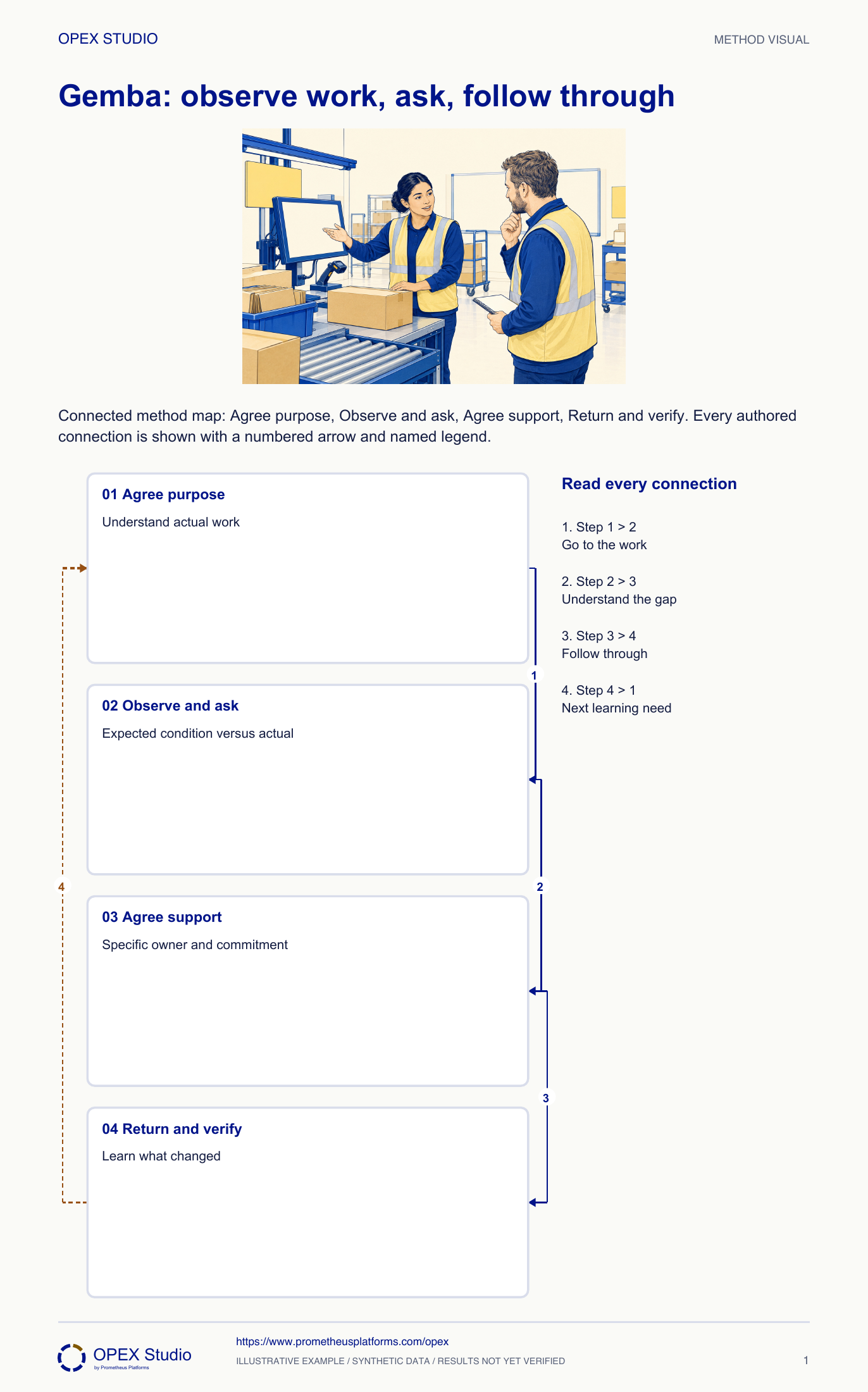
Visit the work to understand how the process actually functions and what makes it difficult for the people doing it. Agree the purpose, observe a real sequence and ask about the difference between expected and actual conditions. Avoid turning every answer into an immediate instruction. Clarify what support is needed, make a specific commitment and return to check what happened. The quality of the visit is shown by learning and follow-through, not distance walked or boxes checked. Respect privacy and safe observation boundaries. A worker who exposes a problem should receive help, not punishment for making it visible.
Gemba is not a checklist patrol.
Observation does not authorize technical intervention.
Feeds leader standard work; Develops A3 evidence.
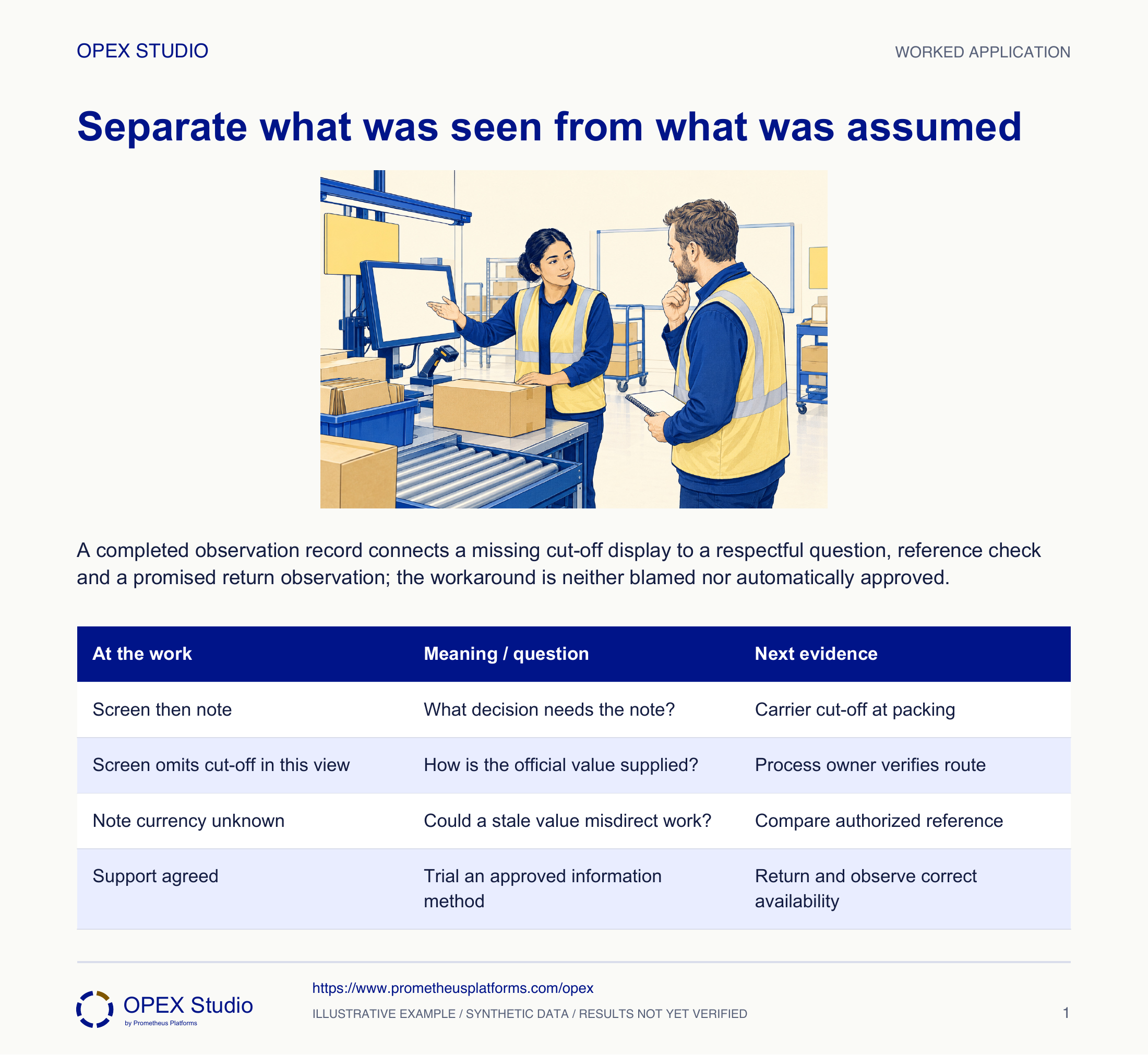
Fictional packing area: leader Ben sees operator Asha using a handwritten note beside the approved order screen. Earlier visits criticized unofficial paper, so colleagues are reluctant to describe workarounds. Ben wants to understand the handoff before deciding whether the note is a problem.
Use the local response for affected work and establish the approved reference immediately. Continue investigating why the work depended on the note.
Respectful learning does not ignore a real error; correcting the current risk does not erase the underlying information gap.
Distinguish an observed work condition from an interpretation, ask a respectful question that improves understanding and close a support commitment at the work.
Fictional packing area: leader Ben sees operator Asha using a handwritten note beside the approved order screen. Earlier visits criticized unofficial paper, so colleagues are reluctant to describe workarounds. Ben wants to understand the handoff before deciding whether the note is a problem.
Role: Leader visiting with the colleague who performs the work.
The approved process supplies the information needed to identify the order and complete the handoff correctly.
The note appears to supply information missing at the moment of work, but its purpose and accuracy are not yet known.
| Recorded item | Evidence status |
|---|---|
| Asha reads screen, then note, before packing | Observed sequence |
| Note includes carrier cut-off | Visible fact in fictional scene |
| Asha dislikes the system | Leader’s interpretation; unsupported |
| Approved screen | Cut-off not visible in the presented view |
| Accuracy / currency of note | Unknown |
Ben explains that he is learning how the next order is made ready and asks Asha to show the normal sequence without speeding up for the visit.
Why: A clear purpose reduces the pressure to perform for inspection and reveals the work as it happens.
Evidence: The visit question concerns information at the handoff, not a person’s compliance score.
He records screen, note and packing in order, separating what he sees from his inference about resistance to change.
Why: An interpretation can be tested only after the underlying observations are clear.
Evidence: The observation sheet marks dislikes the system as unsupported.
Ben asks what decision the cut-off supports and what would happen without it. Asha explains that the screen lacks the needed timing at this point; they check the reference with the process owner.
Why: The note may reveal a design gap while also creating a currency risk. Understanding both is better than instant removal or blanket approval.
Evidence: Needed information, its source and the unanswered currency question are recorded.
The owner agrees to verify an approved information route and a bounded trial. Ben names who will provide support and returns to observe whether the information is available and correct.
Why: Listening without follow-through teaches the team that surfacing problems has no effect.
Evidence: The commitment contains owner, review point and observable handoff evidence; no successful trial is invented.
| At the work | Meaning / question | Next evidence |
|---|---|---|
| Screen then note | What decision needs the note? | Carrier cut-off at packing |
| Screen omits cut-off in this view | How is the official value supplied? | Process owner verifies route |
| Note currency unknown | Could a stale value misdirect work? | Compare authorized reference |
| Support agreed | Trial an approved information method | Return and observe correct availability |
The reference check finds that the handwritten cut-off differs from the current approved value.
Use the local response for affected work and establish the approved reference immediately. Continue investigating why the work depended on the note.
Respectful learning does not ignore a real error; correcting the current risk does not erase the underlying information gap.
Record affected scope, current correction and the separate process-design follow-up.
New fictional office visit: an analyst checks a private-looking spreadsheet before assigning requests. It contains skill availability absent from the queue screen. Its access permissions and update ownership are unknown.
| Observed / known | Unknown |
|---|---|
| Spreadsheet consulted before assignment | Who maintains it? |
| Queue screen omits skill availability | What approved source should provide it? |
| Assignment needs a qualified receiver | Is the spreadsheet accurate and appropriately accessible? |
Consulting a spreadsheet and missing skill data are facts; laziness or dislike of the queue are unsupported interpretations.
Ask how a receiver is selected and what information would be missing without the sheet. Check current authority and access with the owner.
Agree a controlled information route and revisit an assignment to verify accuracy, access and usability. Do not copy private data into the exercise or close on a promise.
| Record field | Suggested reasoning |
|---|---|
| Observation | Spreadsheet used to identify available skill |
| Question | What assignment decision needs this information? |
| Support | Verify approved source, access and update owner |
| Return | Observe a correct assignment using approved information |
What can you actually see?
What purpose does the note serve?
What remains unknown about the spreadsheet?
What evidence would make support complete?
Write an observation and a competing interpretation in different columns before drafting the conversation.
Owner: Process owner and visiting leader with the colleague doing the work
Record: Observation/support commitment linked to the actual handoff
Review: At the agreed return observation, then through daily follow-up if unresolved
Evidence: Accurate approved information available at the work and colleague feedback
Address the design/support barrier and retain current risk controls; do not blame the person who exposed the workaround.
Leaders observe work and coach capability rather than blame or take over
Method reference; original OPEX scenario and diagram are synthetic teaching content, not source case results.Read the lessons online or use these PDFs to prepare, practise and review with your team. No sign-in needed.
Case objectives, demonstration plans, debriefs, common mistakes and application checks across all 81 workplace cases and method lessons.
Download Facilitator guide PDF · 166 pages · 65.1 MBPrintable case worksheets, blank observation records and five calculation exercises; answers are separate.
Download Learner workbook PDF · 169 pages · 10.7 MBReasoned sample responses, worked calculations and coaching guidance; fictional examples are clearly labelled.
Download Answer key and coaching notes PDF · 105 pages · 8.5 MBThe native method mechanisms and worked applications for all 68 detailed lessons, in a separate bookmarked portrait reference.
Download Method and application reference PDF · 141 pages · 10.2 MBFive illustrated system chapters: 15 Flare concept maps and 26 original workplace teaching cards, with links to all 81 supporting cases and method lessons.
Download Illustrated systems atlas PDF · 69 pages · 55.8 MBExplore this connected method and its separate application conditions.
Explore the connected method →Explore this connected method and its separate application conditions.
Explore the connected method →Explore this connected method and its separate application conditions.
Explore the connected method →Explore this connected method and its separate application conditions.
Explore the connected method →