Facilitator guide
Case objectives, demonstration plans, debriefs, common mistakes and application checks across all 81 workplace cases and method lessons.
Download Facilitator guide PDF · 166 pages · 65.1 MB OPEXSTUDIO
Plan scope and map structure and intended functions.. Follow the visual, practise a decision, then check your thinking.
Fictional teaching examples and AI-generated illustrations. Proposed changes and goals are not achieved results. Use the written instructions and check local conditions before applying a method.
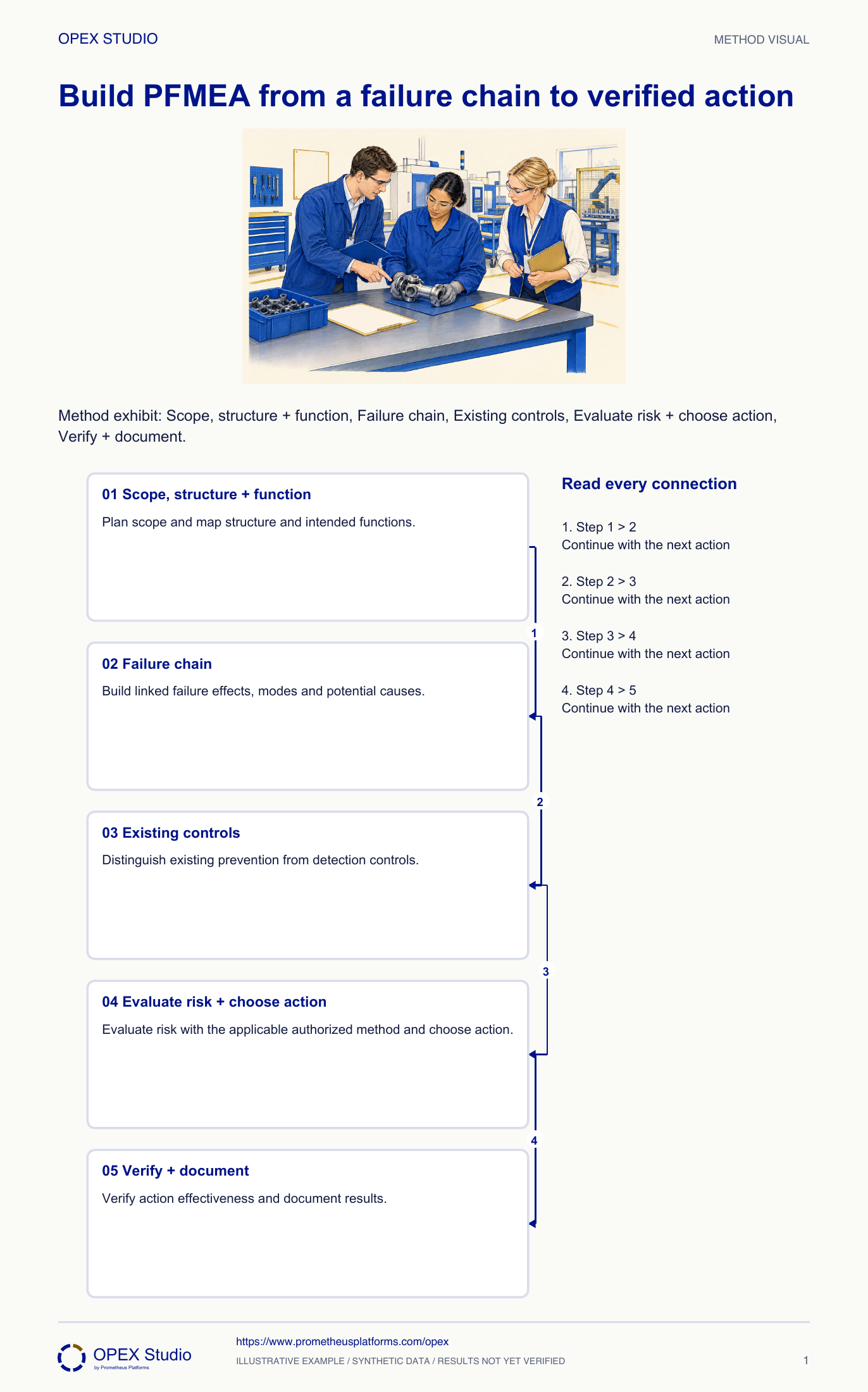
Process FMEA considers how a process could fail before relying on failures to teach the lesson. Start with scope, structure and intended functions. Connect the failure effect, failure mode and potential cause at the appropriate levels. Keep prevention controls separate from detection controls: stopping the wrong selection differs from finding an under-tightened joint afterwards. Evaluate risk with the applicable authorized method, choose actions, verify their implementation and effectiveness, and document the results. The seven-step approach organizes that work; it is not a reason to invent ratings or reproduce proprietary tables. A predicted cause in risk analysis is also not proof of the cause of a past incident.
Wrong program cause → under-tightened joint mode → lost joint function effect.
Prevention reduces occurrence; detection finds a condition.
Seven steps are planning/preparation, structure, function, failure, risk, optimization and results documentation; no proprietary tables.
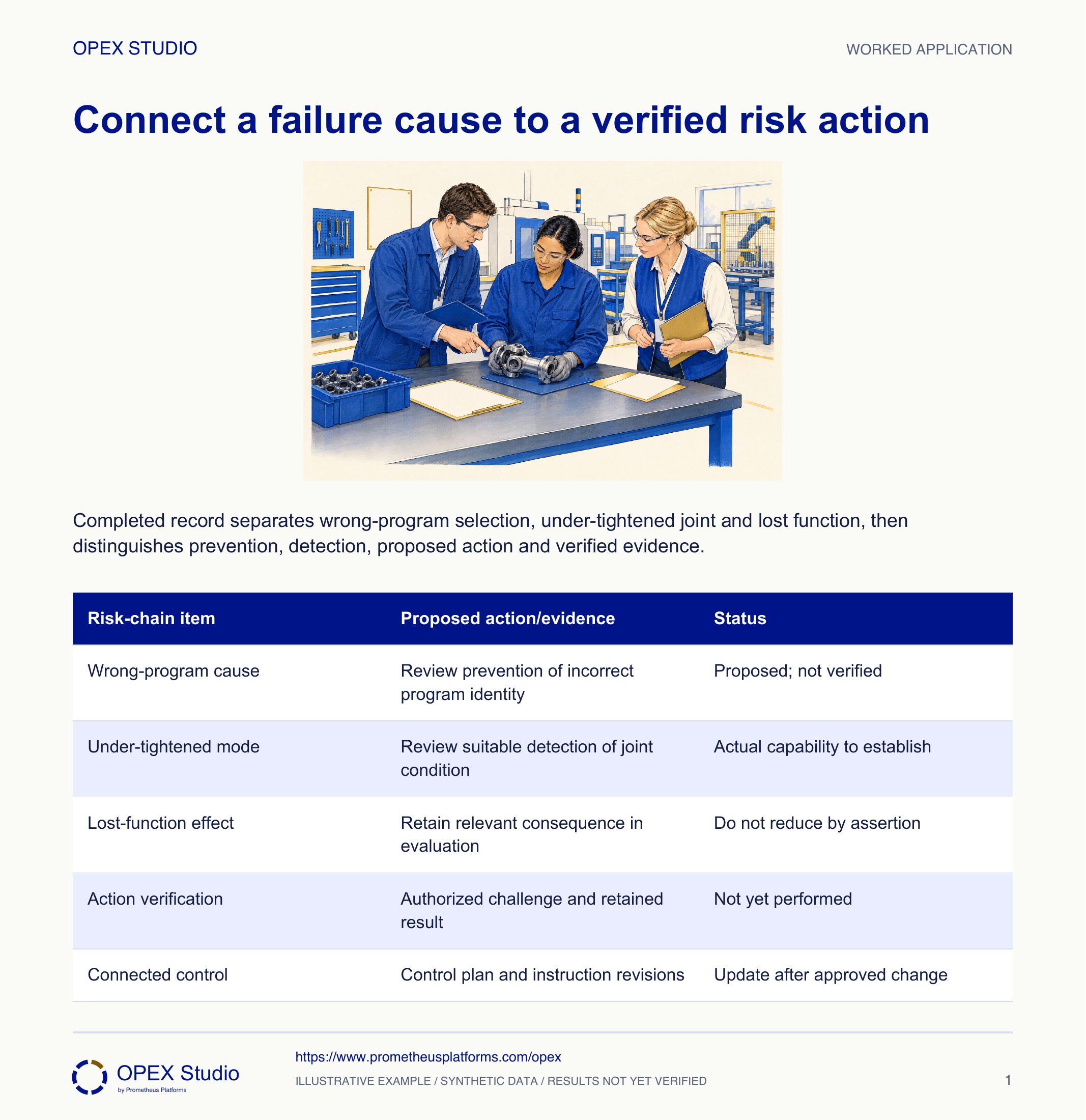
Fictional case: joint assembly can use the wrong program. The potential process failure is an under-tightened joint; the downstream effect is loss of joint function. Those distinctions remain in the core lesson. Facilitator Dev reviews a draft that repeats “wrong torque” in cause, mode and effect, with an invented risk number and a training action marked complete.
Include authorized override conditions, access and return-to-normal verification in the risk/action review before calling prevention effective.
A control that works only in the normal demonstration may leave a relevant failure path open. Do not remove the path from the FMEA because it is inconvenient.
Build a coherent cause–mode–effect chain, distinguish prevention from detection, and connect a proposed risk action to verification and controlled documents.
Fictional case: joint assembly can use the wrong program. The potential process failure is an under-tightened joint; the downstream effect is loss of joint function. Those distinctions remain in the core lesson. Facilitator Dev reviews a draft that repeats “wrong torque” in cause, mode and effect, with an invented risk number and a training action marked complete.
Role: Cross-functional process-risk team with engineering and quality owners
Process structure and intended functions lead to specific failure chains, existing controls, applicable risk evaluation and verified actions.
The worksheet looks populated but cannot explain what fails, why it might happen or how an action would change the risk.
| Chain element | Fictional entry |
|---|---|
| Intended function | Produce the specified joint condition |
| Potential cause | Wrong program selected |
| Failure mode | Under-tightened joint |
| Effect | Joint function lost |
| Current proposal | Train operator; no verification evidence supplied |
Dev identifies the assembly operation, interfaces and required joint function before writing failure statements. He asks who receives the output and what the receiving process depends on.
Why: A failure chain needs a defined function and level of analysis. Without that context, a phrase may be mistaken for cause, mode or effect.
Evidence: The reviewed scope connects operation and receiving function.
The team records wrong-program selection as a potential cause, under-tightening as the mode and loss of joint function as the effect. It checks the causal direction rather than merely filling columns.
Why: The mode describes the process failing its function; cause explains how it could arise; effect describes its consequence at the relevant next level.
Evidence: The three statements differ and form a coherent chain.
A suitable program-selection prevention control would address the cause. A suitable joint-condition inspection would detect a resulting condition. The team records what actually exists, not what it hopes to add.
Why: A proposed control is not an existing control, and detection does not necessarily prevent occurrence. This distinction affects the risk discussion and action choice.
Evidence: Each control is marked existing or proposed and prevention or detection.
Dev uses the authorized evaluation criteria and ownership process. In the AIAG/VDA approach the seven-step structure and Action Priority are not replaced by an invented RPN threshold.
Why: Risk labels must come from the applicable method and evidence, not a convenient score. A public training example cannot supply a customer’s ratings or approval.
Evidence: The record identifies the evaluation authority and keeps unsupported ratings blank.
The team proposes a controlled program-identity check or other engineered solution for specialist review, defines an authorized challenge and records evidence before changing residual-risk status. It aligns the control plan and instruction.
Why: Completing a training session is an activity, not proof of effective prevention. Verification must test the intended failure mechanism and preserve the outcome.
Evidence: The action has an owner, verification criterion and linked-document updates.
| Risk-chain item | Proposed action/evidence | Status |
|---|---|---|
| Wrong-program cause | Review prevention of incorrect program identity | Proposed; not verified |
| Under-tightened mode | Review suitable detection of joint condition | Actual capability to establish |
| Lost-function effect | Retain relevant consequence in evaluation | Do not reduce by assertion |
| Action verification | Authorized challenge and retained result | Not yet performed |
| Connected control | Control plan and instruction revisions | Update after approved change |
During design review, the team finds a maintenance override that can bypass the proposed program check.
Include authorized override conditions, access and return-to-normal verification in the risk/action review before calling prevention effective.
A control that works only in the normal demonstration may leave a relevant failure path open. Do not remove the path from the FMEA because it is inconvenient.
The verification plan includes the permitted override scenario and its responsibility.
New fictional packing process can select the wrong label file, apply a wrong product label and cause a customer to receive misidentified contents. A final scan is proposed but not installed.
| Fact or proposal | State |
|---|---|
| Wrong label file | Potential cause |
| Final scan | Proposed detection/control concept |
| Verification | Not performed |
Cause: wrong label file selected; mode: incorrect label applied; effect: misidentified contents at the customer. A file/product identity control may prevent selection; a suitable scan may detect a mismatch, depending on what it actually checks.
The scan cannot be listed as an effective existing control before installation and verification. Use authorized mismatch challenges and update connected instructions/control-plan records after approved changes.
| Element | Correct statement | Evidence status |
|---|---|---|
| Cause | Wrong file selected | Potential |
| Mode | Incorrect label applied | Potential failure |
| Effect | Customer receives misidentified contents | Relevant consequence |
| Proposed scan | Detection depends on design | Unverified |
Who relies on the output?
Which phrase is the mode?
What does the scan actually detect?
Which path might the demonstration miss?
Draw the chain first, then connect each control to the cause or condition it addresses.
Owner: Process-risk owner and cross-functional team
Record: Failure chain, authorized evaluation, action evidence and controlled revisions
Review: At design/process changes and after relevant failures
Evidence: Verified control performance and aligned operational documents
Reopen the risk/action review when evidence exposes an unaddressed path or ineffective control.
The harmonized method uses seven steps and Action Priority instead of RPN-based prioritization.
Do not copy rating/AP tables or invent AP from RPN. Confirm the method required by the customer.Read the lessons online or use these PDFs to prepare, practise and review with your team. No sign-in needed.
Case objectives, demonstration plans, debriefs, common mistakes and application checks across all 81 workplace cases and method lessons.
Download Facilitator guide PDF · 166 pages · 65.1 MBPrintable case worksheets, blank observation records and five calculation exercises; answers are separate.
Download Learner workbook PDF · 169 pages · 10.7 MBReasoned sample responses, worked calculations and coaching guidance; fictional examples are clearly labelled.
Download Answer key and coaching notes PDF · 105 pages · 8.5 MBThe native method mechanisms and worked applications for all 68 detailed lessons, in a separate bookmarked portrait reference.
Download Method and application reference PDF · 141 pages · 10.2 MBFive illustrated system chapters: 15 Flare concept maps and 26 original workplace teaching cards, with links to all 81 supporting cases and method lessons.
Download Illustrated systems atlas PDF · 69 pages · 55.8 MBExplore this connected method and its separate application conditions.
Explore the connected method →Explore this connected method and its separate application conditions.
Explore the connected method →Explore this connected method and its separate application conditions.
Explore the connected method →Explore this connected method and its separate application conditions.
Explore the connected method →