Facilitator guide
Case objectives, demonstration plans, debriefs, common mistakes and application checks across all 81 workplace cases and method lessons.
Download Facilitator guide PDF · 166 pages · 65.1 MB OPEXSTUDIO
Understand how the methods relate before selecting a detailed lesson.. Follow the visual, practise a decision, then check your thinking.
Fictional teaching examples and AI-generated illustrations. Proposed changes and goals are not achieved results. Use the written instructions and check local conditions before applying a method.
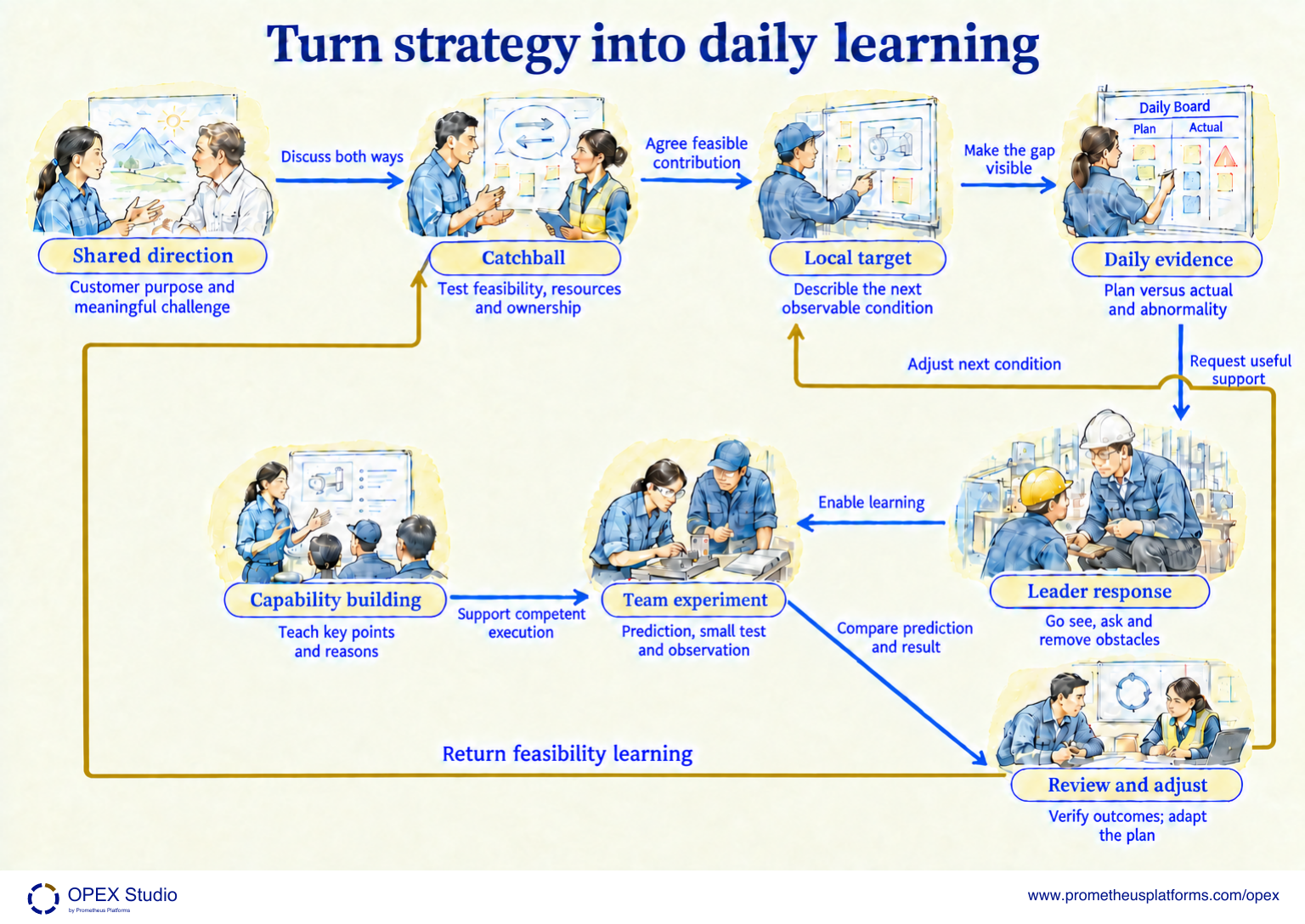
Direction becomes useful through discussion of actual capability and resources. Catchball links organizational intent with local feasibility rather than cascading unsupported targets. A daily board then exposes the gap between the agreed plan and observed work. Leaders go to the work, ask what is understood and remove obstacles while developing the team’s problem-solving ability. A small experiment records its prediction and observed result. Job instruction supports the competence required to execute safely and consistently. Review checks evidence of effect, not merely completed actions or attendance, and carries learning back to both local targets and the wider plan.
Daily management supports response and learning; a board alone is not the system.
Catchball includes feasibility and horizontal resource conflicts.
A completed action is not proof of an improved or sustained result.
A board lists all actions complete, but no later condition check exists. What should the leader ask next?
Ask what changed in the work, where it was observed and when it will be checked again. Keep effectiveness pending until evidence is available.
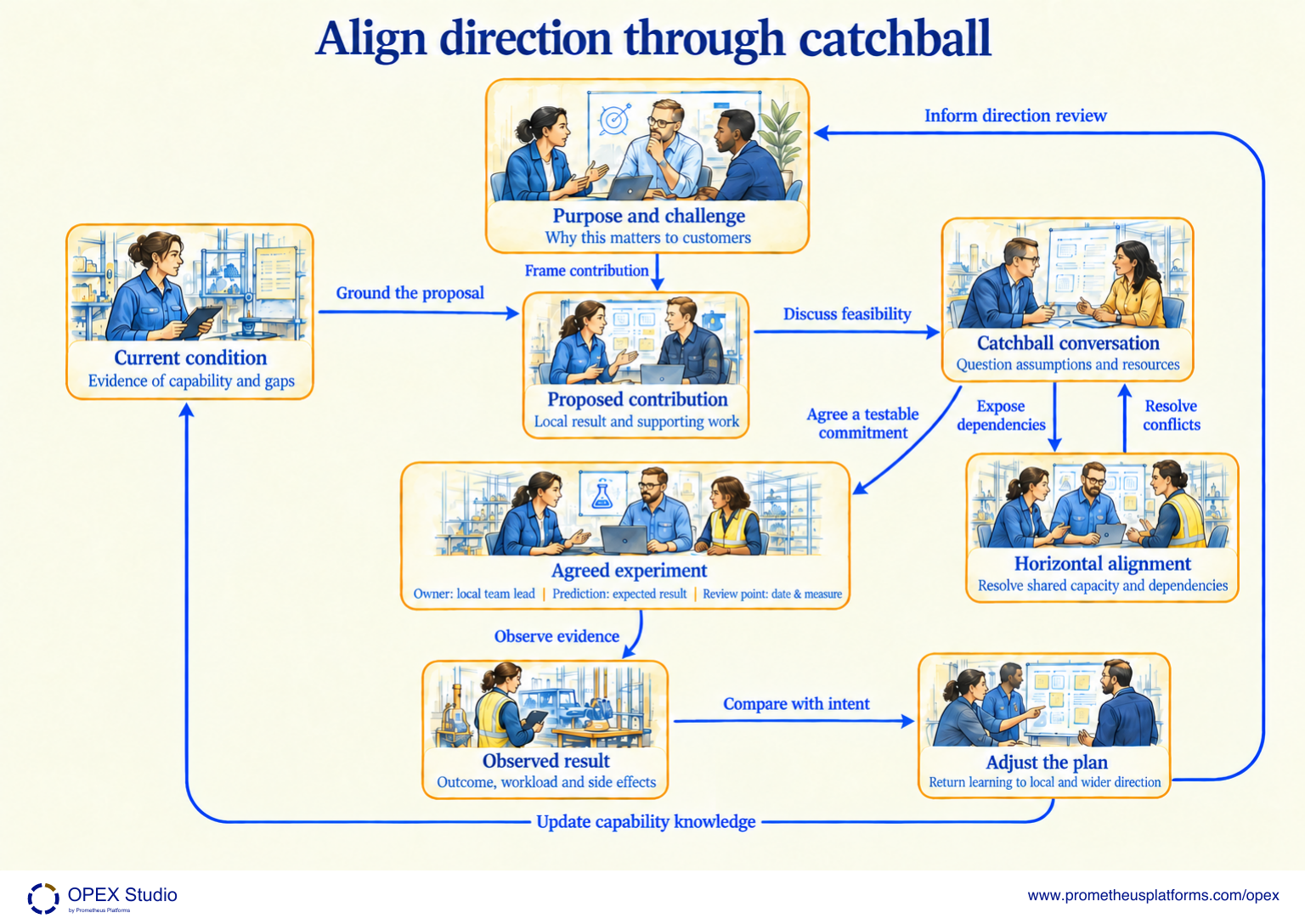
Catchball is a dialogue about purpose, contribution and feasibility. Begin with current evidence, then propose how a local team can contribute. Make resource needs and cross-team dependencies visible; the same specialist cannot be promised to incompatible work at the same time. Agree a bounded experiment or commitment with an owner, prediction and review point. Observe the result and its effect on workload and neighboring processes. Bring that learning back to both local plans and wider direction. The system depends on honest negotiation and learning; a cascade of targets without discussion does not provide the same mechanism.
Catchball is two-way discussion, including horizontal dependencies.
A proposed target is not an achieved outcome.
A shared resource needs an explicit feasible allocation.
Two teams each promise daily support from the same specialist, whose capacity allows only one team per day. What should the catchball conversation produce?
Expose the conflict and agree priorities, timing, scope or another feasible support arrangement. Record the resulting commitment and review evidence; do not approve both promises merely to preserve the target cascade.
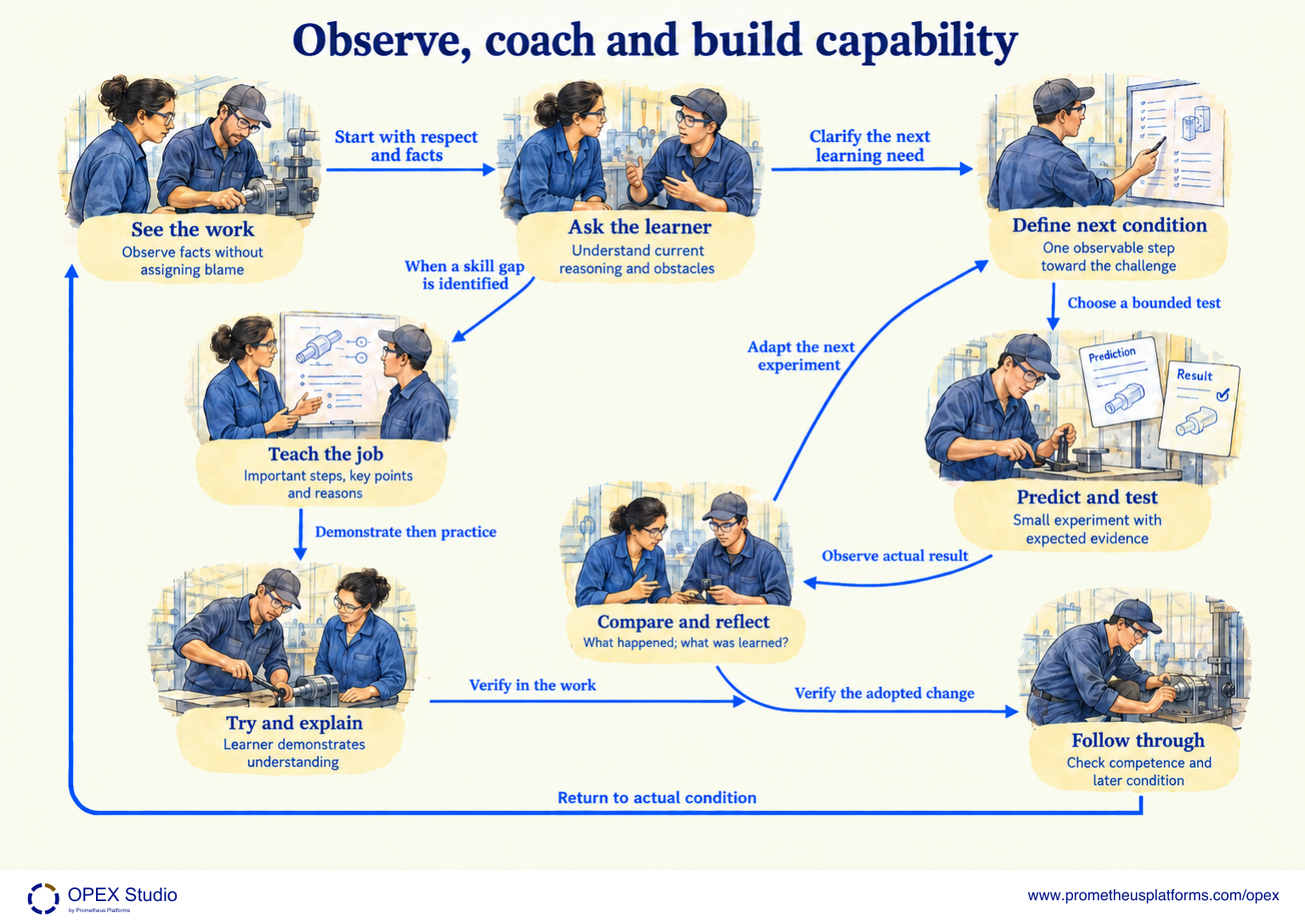
Observe what actually happens and separate facts from interpretations. Ask the learner how the work is understood and what obstructs the next condition. Where uncertainty calls for learning, use a small experiment with a prediction and compare the observation with that prediction. Where the need is competence in an established job, use job instruction: prepare, present the important steps with key points and reasons, let the learner try and explain, then follow up. These are related but distinct routes. Leader standard work creates time and responsibility for this support. Attendance, a coaching conversation or a completed demonstration alone does not establish sustained competence.
Gemba observation does not justify conclusions about unseen events.
Coaching an experiment differs from teaching an established job.
Follow-up should verify understanding and performance, not attendance alone.
A learner repeats a step correctly once but cannot explain the identity check. Is the instruction complete?
Not yet. Revisit the key point and reason, let the learner explain and demonstrate the full method, then follow up under appropriate supervision until competence is evidenced.
Vertical/horizontal alignment, PDCA and capability development
Method reference; original OPEX scenario and diagram are synthetic teaching content, not source case results.Daily standards/abnormalities and strategic feedback; do not copy source diagram
Method reference; original OPEX scenario and diagram are synthetic teaching content, not source case results.Gemba, reflection, andon response, accountability and mentoring
Method reference; original OPEX scenario and diagram are synthetic teaching content, not source case results.Challenge, current condition, target condition, experiments and coaching
Method reference; original OPEX scenario and diagram are synthetic teaching content, not source case results.Prepare, present, try out, follow up; steps/key points/reasons
Method reference; original OPEX scenario and diagram are synthetic teaching content, not source case results.Leaders observe work and coach capability rather than blame or take over
Method reference; original OPEX scenario and diagram are synthetic teaching content, not source case results.Read the lessons online or use these PDFs to prepare, practise and review with your team. No sign-in needed.
Case objectives, demonstration plans, debriefs, common mistakes and application checks across all 81 workplace cases and method lessons.
Download Facilitator guide PDF · 166 pages · 65.1 MBPrintable case worksheets, blank observation records and five calculation exercises; answers are separate.
Download Learner workbook PDF · 169 pages · 10.7 MBReasoned sample responses, worked calculations and coaching guidance; fictional examples are clearly labelled.
Download Answer key and coaching notes PDF · 105 pages · 8.5 MBThe native method mechanisms and worked applications for all 68 detailed lessons, in a separate bookmarked portrait reference.
Download Method and application reference PDF · 141 pages · 10.2 MBFive illustrated system chapters: 15 Flare concept maps and 26 original workplace teaching cards, with links to all 81 supporting cases and method lessons.
Download Illustrated systems atlas PDF · 69 pages · 55.8 MBPrimary teaching mechanism belongs to leadership and daily learning. Supporting links identify application dependencies; they do not make the methods interchangeable.
Explore the connected method →Primary teaching mechanism belongs to leadership and daily learning. Supporting links identify application dependencies; they do not make the methods interchangeable.
Explore the connected method →Primary teaching mechanism belongs to leadership and daily learning. Supporting links identify application dependencies; they do not make the methods interchangeable.
Explore the connected method →Primary teaching mechanism belongs to leadership and daily learning. Supporting links identify application dependencies; they do not make the methods interchangeable.
Explore the connected method →Primary teaching mechanism belongs to leadership and daily learning. Supporting links identify application dependencies; they do not make the methods interchangeable.
Explore the connected method →Primary teaching mechanism belongs to leadership and daily learning. Supporting links identify application dependencies; they do not make the methods interchangeable.
Explore the connected method →Primary teaching mechanism belongs to leadership and daily learning. Supporting links identify application dependencies; they do not make the methods interchangeable.
Explore the connected method →Primary teaching mechanism belongs to lean flow and system performance. Supporting links identify application dependencies; they do not make the methods interchangeable.
Explore the connected method →Primary teaching mechanism belongs to lean flow and system performance. Supporting links identify application dependencies; they do not make the methods interchangeable.
Explore the connected method →Primary teaching mechanism belongs to lean flow and system performance. Supporting links identify application dependencies; they do not make the methods interchangeable.
Explore the connected method →Primary teaching mechanism belongs to lean flow and system performance. Supporting links identify application dependencies; they do not make the methods interchangeable.
Explore the connected method →Primary teaching mechanism belongs to lean flow and system performance. Supporting links identify application dependencies; they do not make the methods interchangeable.
Explore the connected method →Primary teaching mechanism belongs to lean flow and system performance. Supporting links identify application dependencies; they do not make the methods interchangeable.
Explore the connected method →Primary teaching mechanism belongs to lean flow and system performance. Supporting links identify application dependencies; they do not make the methods interchangeable.
Explore the connected method →Primary teaching mechanism belongs to lean flow and system performance. Supporting links identify application dependencies; they do not make the methods interchangeable.
Explore the connected method →Primary teaching mechanism belongs to lean flow and system performance. Supporting links identify application dependencies; they do not make the methods interchangeable.
Explore the connected method →Primary teaching mechanism belongs to lean flow and system performance. Supporting links identify application dependencies; they do not make the methods interchangeable.
Explore the connected method →Primary teaching mechanism belongs to lean flow and system performance. Supporting links identify application dependencies; they do not make the methods interchangeable.
Explore the connected method →Primary teaching mechanism belongs to lean flow and system performance. Supporting links identify application dependencies; they do not make the methods interchangeable.
Explore the connected method →Primary teaching mechanism belongs to lean flow and system performance. Supporting links identify application dependencies; they do not make the methods interchangeable.
Explore the connected method →Primary teaching mechanism belongs to lean flow and system performance. Supporting links identify application dependencies; they do not make the methods interchangeable.
Explore the connected method →Primary teaching mechanism belongs to lean flow and system performance. Supporting links identify application dependencies; they do not make the methods interchangeable.
Explore the connected method →Primary teaching mechanism belongs to lean flow and system performance. Supporting links identify application dependencies; they do not make the methods interchangeable.
Explore the connected method →Primary teaching mechanism belongs to lean flow and system performance. Supporting links identify application dependencies; they do not make the methods interchangeable.
Explore the connected method →Primary teaching mechanism belongs to lean flow and system performance. Supporting links identify application dependencies; they do not make the methods interchangeable.
Explore the connected method →Primary teaching mechanism belongs to lean flow and system performance. Supporting links identify application dependencies; they do not make the methods interchangeable.
Explore the connected method →Primary teaching mechanism belongs to lean flow and system performance. Supporting links identify application dependencies; they do not make the methods interchangeable.
Explore the connected method →Primary teaching mechanism belongs to lean flow and system performance. Supporting links identify application dependencies; they do not make the methods interchangeable.
Explore the connected method →Primary teaching mechanism belongs to lean flow and system performance. Supporting links identify application dependencies; they do not make the methods interchangeable.
Explore the connected method →Primary teaching mechanism belongs to lean flow and system performance. Supporting links identify application dependencies; they do not make the methods interchangeable.
Explore the connected method →Primary teaching mechanism belongs to lean flow and system performance. Supporting links identify application dependencies; they do not make the methods interchangeable.
Explore the connected method →Primary teaching mechanism belongs to lean flow and system performance. Supporting links identify application dependencies; they do not make the methods interchangeable.
Explore the connected method →Primary teaching mechanism belongs to quality control and dependable evidence. Supporting links identify application dependencies; they do not make the methods interchangeable.
Explore the connected method →Primary teaching mechanism belongs to problem solving and verified change. Supporting links identify application dependencies; they do not make the methods interchangeable.
Explore the connected method →Primary teaching mechanism belongs to problem solving and verified change. Supporting links identify application dependencies; they do not make the methods interchangeable.
Explore the connected method →Primary teaching mechanism belongs to problem solving and verified change. Supporting links identify application dependencies; they do not make the methods interchangeable.
Explore the connected method →Primary teaching mechanism belongs to problem solving and verified change. Supporting links identify application dependencies; they do not make the methods interchangeable.
Explore the connected method →Primary teaching mechanism belongs to problem solving and verified change. Supporting links identify application dependencies; they do not make the methods interchangeable.
Explore the connected method →Primary teaching mechanism belongs to problem solving and verified change. Supporting links identify application dependencies; they do not make the methods interchangeable.
Explore the connected method →Primary teaching mechanism belongs to problem solving and verified change. Supporting links identify application dependencies; they do not make the methods interchangeable.
Explore the connected method →Primary teaching mechanism belongs to problem solving and verified change. Supporting links identify application dependencies; they do not make the methods interchangeable.
Explore the connected method →Primary teaching mechanism belongs to problem solving and verified change. Supporting links identify application dependencies; they do not make the methods interchangeable.
Explore the connected method →Primary teaching mechanism belongs to problem solving and verified change. Supporting links identify application dependencies; they do not make the methods interchangeable.
Explore the connected method →Primary teaching mechanism belongs to problem solving and verified change. Supporting links identify application dependencies; they do not make the methods interchangeable.
Explore the connected method →Primary teaching mechanism belongs to problem solving and verified change. Supporting links identify application dependencies; they do not make the methods interchangeable.
Explore the connected method →Primary teaching mechanism belongs to problem solving and verified change. Supporting links identify application dependencies; they do not make the methods interchangeable.
Explore the connected method →Primary teaching mechanism belongs to problem solving and verified change. Supporting links identify application dependencies; they do not make the methods interchangeable.
Explore the connected method →Primary teaching mechanism belongs to problem solving and verified change. Supporting links identify application dependencies; they do not make the methods interchangeable.
Explore the connected method →Primary teaching mechanism belongs to problem solving and verified change. Supporting links identify application dependencies; they do not make the methods interchangeable.
Explore the connected method →Primary teaching mechanism belongs to equipment wellness and oee. Supporting links identify application dependencies; they do not make the methods interchangeable.
Explore the connected method →Primary teaching mechanism belongs to equipment wellness and oee. Supporting links identify application dependencies; they do not make the methods interchangeable.
Explore the connected method →Primary teaching mechanism belongs to equipment wellness and oee. Supporting links identify application dependencies; they do not make the methods interchangeable.
Explore the connected method →