Facilitator guide
Case objectives, demonstration plans, debriefs, common mistakes and application checks across all 81 workplace cases and method lessons.
Download Facilitator guide PDF · 166 pages · 65.1 MB OPEXSTUDIO
Test direct flow feasibility. Follow the visual, practise a decision, then check your thinking.
Fictional teaching examples and AI-generated illustrations. Proposed changes and goals are not achieved results. Use the written instructions and check local conditions before applying a method.
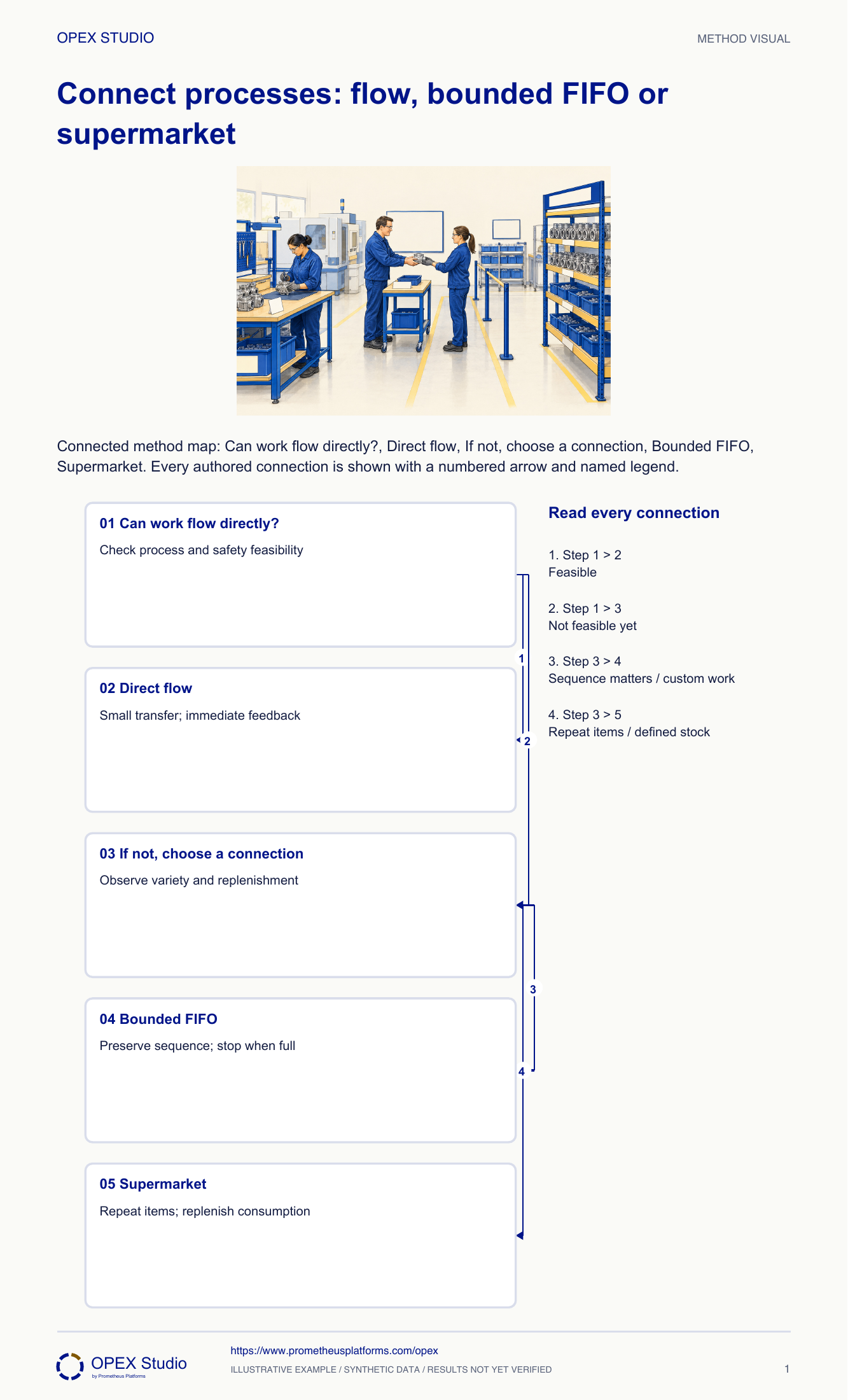
Connect adjacent work directly when the process can safely support it. When that is not feasible, make the waiting mechanism explicit. A bounded FIFO lane preserves arrival sequence and creates a clear response when full. A supermarket holds defined quantities of repeat items and replenishes what is consumed. Neither is a license for unlimited stock. Consider product variety, required sequence, replenishment reliability and quality status before choosing. In custom administrative work, a finite sequenced queue may be more useful than pretending every possible request can be stocked. Review end-to-end delay after the connection changes.
FIFO is not infinite storage.
A supermarket is not uncontrolled inventory.
WIP bounds support lead-time control; Quality segregation preserves sequence integrity.
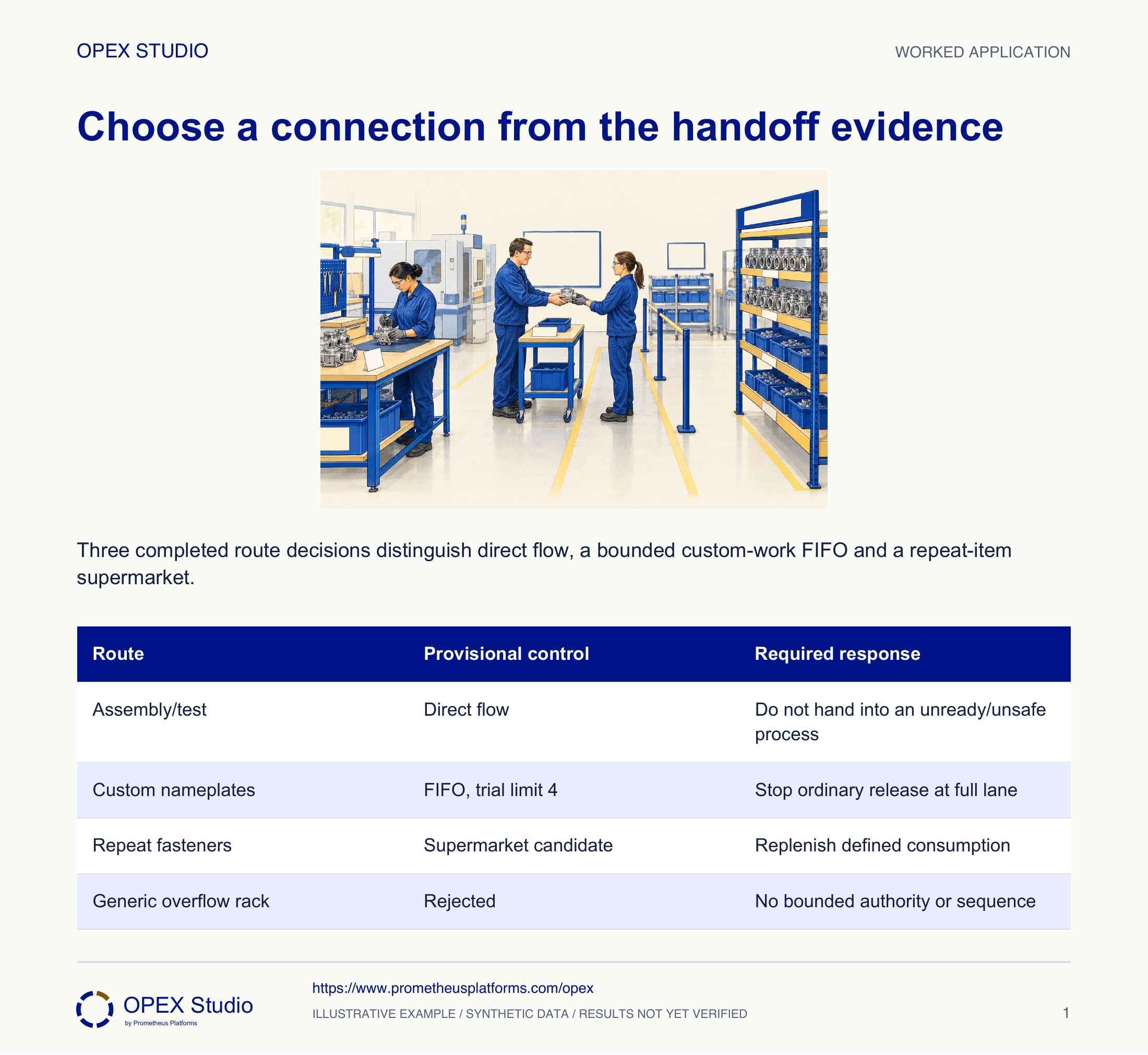
Fictional mixed-products workshop: planner Omar reviews adjacent assembly and test, a custom-nameplate queue before curing, and repeat fasteners supplied to several benches. Management proposes putting every item into the same open storage rack.
Retain identity and hold status, notify the owner and apply the approved hold/sequence rule; do not assume moving it away opens an ordinary release slot.
Physical movement, eligibility and commitment are different facts. The response must preserve all three.
Select a provisional connection between processes from identity, sequence and replenishment evidence, and specify what happens when the connection is full or blocked.
Fictional mixed-products workshop: planner Omar reviews adjacent assembly and test, a custom-nameplate queue before curing, and repeat fasteners supplied to several benches. Management proposes putting every item into the same open storage rack.
Role: Material-flow designer with operators from both sides of each handoff.
The connection preserves identity, appropriate sequence and response to demand without uncontrolled accumulation.
A generic rack does not say which item moves next, how much may wait or what authorizes replenishment.
| Handoff | Observed condition |
|---|---|
| Assembly → test | Adjacent stations; one verified unit can move when test is ready |
| Custom nameplates → cure | Unique customer identities; curing prevents immediate direct flow |
| Fasteners → benches | Repeat items with defined identities and regular consumption |
| Proposed rack | No maximum, sequence rule or response owner |
Omar asks whether assembly can hand one eligible unit directly to a ready test position while preserving the approved method. He checks both process timing and safe access.
Why: Direct connection removes a separate waiting location only when the work can genuinely move. Proximity alone is insufficient.
Evidence: Provisional assembly/test choice: direct flow, subject to verified feasibility.
For custom nameplates, he proposes a four-position FIFO lane with visible oldest-to-newest order and traceable customer identity. The exact limit is an illustrative local trial setting.
Why: Making stock for unknown custom orders would not create useful availability. A bounded sequence makes both age and excess release visible.
Evidence: Custom lane: four defined positions; downstream takes the next eligible ordered item.
For repeat fasteners, he records each item’s location, eligible stock boundary and consumption signal before proposing a supermarket. Quantity parameters require separate usage and lead-time evidence.
Why: A supermarket is a controlled connection for replenishment. Calling any shelf a supermarket does not supply its missing authorization rules.
Evidence: Repeat-item proposal names identity, location, replenishment signal and parameter owner.
When all four FIFO positions are occupied, upstream does not put a fifth item beside the lane. The owner checks downstream blockage and follows an explicit release/exception rule. A held item retains its quality status.
Why: The limit loses meaning if overflow is hidden. Sequence and eligibility are separate; a local rule must govern any held item rather than silently bypassing it.
Evidence: Full-lane record names the blocked handoff, owner and next review time.
Observe demand, WIP, waiting age, stockouts and quality after a limited trial. Keep alternative connection choices open if product variety or process constraints change.
Why: The diagram is a design decision based on observed conditions, not a permanent label attached to a department.
Evidence: Connection review links the choice and limit to actual operating evidence.
| Route | Provisional control | Required response |
|---|---|---|
| Assembly/test | Direct flow | Do not hand into an unready/unsafe process |
| Custom nameplates | FIFO, trial limit 4 | Stop ordinary release at full lane |
| Repeat fasteners | Supermarket candidate | Replenish defined consumption |
| Generic overflow rack | Rejected | No bounded authority or sequence |
The first custom nameplate becomes held while the other three positions remain occupied.
Retain identity and hold status, notify the owner and apply the approved hold/sequence rule; do not assume moving it away opens an ordinary release slot.
Physical movement, eligibility and commitment are different facts. The response must preserve all three.
Hold disposition and any authorized resequencing are traceable.
Separate fictional repair center: unique customer instruments wait for an off-site calibration slot. Standard packing inserts are consumed repeatedly. Final label verification occurs beside packing and can receive one completed instrument at a time.
| Route | Condition |
|---|---|
| Repair → calibration | Unique units; no immediate transfer |
| Inserts → packing | Repeat consumption |
| Verification → packing | Adjacent and ready for single units |
Unique instruments suggest a bounded, traceable FIFO or explicitly scheduled sequence; do not manufacture a supermarket of customer-owned repairs.
Repeat inserts can use defined replenishment stock. Adjacent verification/packing can test direct flow if all feasibility conditions hold.
A calibration queue limit needs lead-time and service evidence; a full queue must trigger controlled release and customer-response decisions.
| Route | Choice | Condition / response |
|---|---|---|
| Customer instruments | Bounded traceable queue | Respect identity and agreed sequence |
| Packing inserts | Supermarket candidate | Usage/lead-time parameters needed |
| Verified instrument | Direct-flow candidate | Check readiness and safe transfer |
Which fact makes a custom item different from a repeat fastener?
What must be known before calling a shelf a supermarket?
Who may change sequence or release?
Which observation would reverse your provisional choice?
Draw one evidence-to-choice branch for each route and audit the exception before opening the answer.
Owner: End-to-end material-flow owner
Record: Connection decision, declared limits and full/hold exception log
Review: After the limited trial and whenever mix or process constraints change
Evidence: Controlled WIP, preserved identity, reliable replenishment and known queue age
Revisit feasibility and parameters with both process owners; remove untracked overflow paths.
FIFO work release and bounded queues in service workflows
Method reference; original OPEX scenario and diagram are synthetic teaching content, not source case results.Predetermined stock locations and consumption-triggered replenishment
Method reference; original OPEX scenario and diagram are synthetic teaching content, not source case results.Read the lessons online or use these PDFs to prepare, practise and review with your team. No sign-in needed.
Case objectives, demonstration plans, debriefs, common mistakes and application checks across all 81 workplace cases and method lessons.
Download Facilitator guide PDF · 166 pages · 65.1 MBPrintable case worksheets, blank observation records and five calculation exercises; answers are separate.
Download Learner workbook PDF · 169 pages · 10.7 MBReasoned sample responses, worked calculations and coaching guidance; fictional examples are clearly labelled.
Download Answer key and coaching notes PDF · 105 pages · 8.5 MBThe native method mechanisms and worked applications for all 68 detailed lessons, in a separate bookmarked portrait reference.
Download Method and application reference PDF · 141 pages · 10.2 MBFive illustrated system chapters: 15 Flare concept maps and 26 original workplace teaching cards, with links to all 81 supporting cases and method lessons.
Download Illustrated systems atlas PDF · 69 pages · 55.8 MBExplore this connected method and its separate application conditions.
Explore the connected method →Explore this connected method and its separate application conditions.
Explore the connected method →Explore this connected method and its separate application conditions.
Explore the connected method →Explore this connected method and its separate application conditions.
Explore the connected method →Explore this connected method and its separate application conditions.
Explore the connected method →