Facilitator guide
Case objectives, demonstration plans, debriefs, common mistakes and application checks across all 81 workplace cases and method lessons.
Download Facilitator guide PDF · 166 pages · 65.1 MB OPEXSTUDIO
Schedule constraint. Follow the visual, practise a decision, then check your thinking.
Fictional teaching examples and AI-generated illustrations. Proposed changes and goals are not achieved results. Use the written instructions and check local conditions before applying a method.
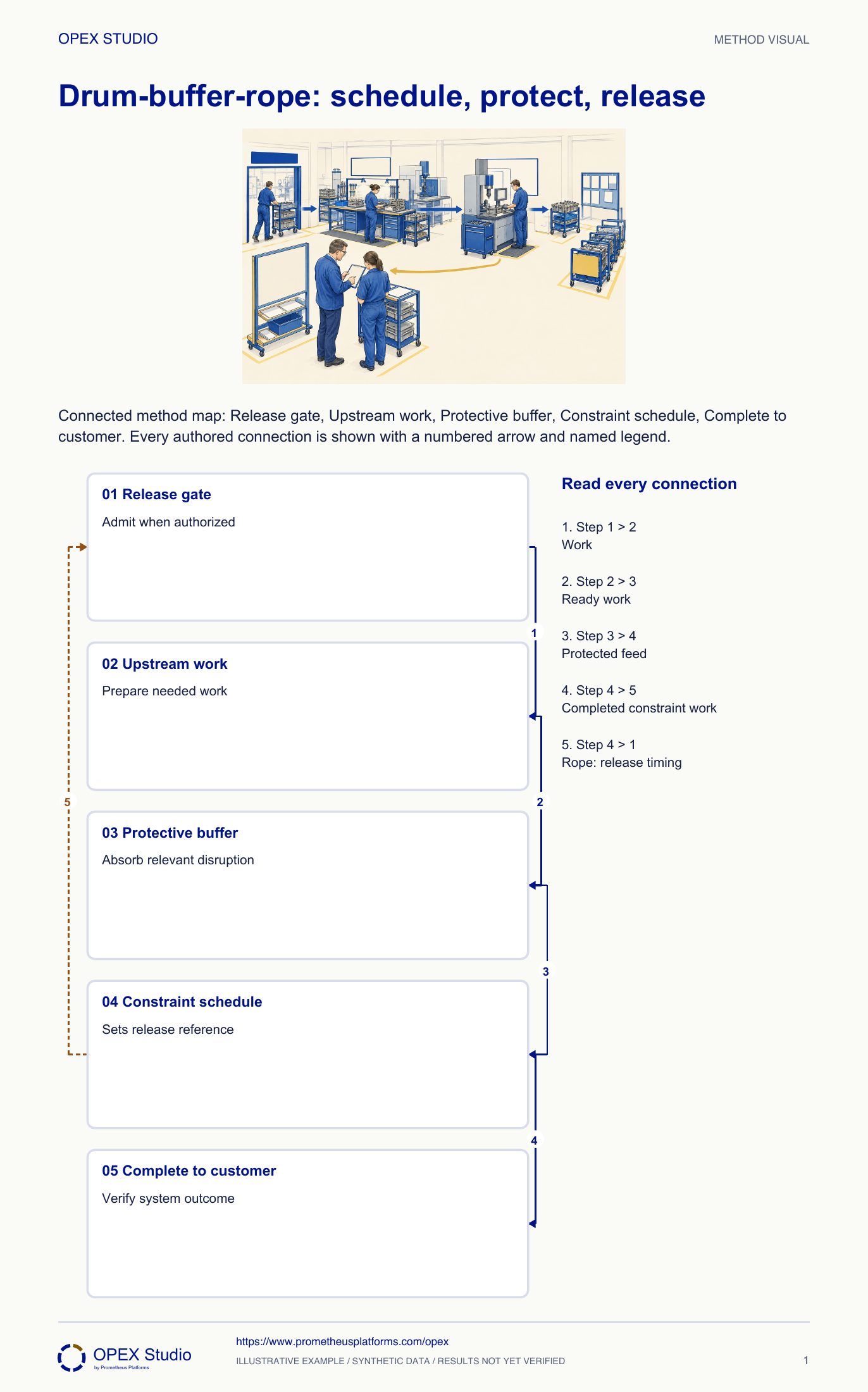
Releasing work early can create congestion without bringing completion forward. Drum-buffer-rope links release to the schedule of a verified constraint. The drum sets the relevant pace, the buffer protects it from disruption, and the rope communicates when upstream work should enter. Draw the control signal separately from the movement of work. Choose protection from the process conditions rather than copying an arbitrary quantity. Monitor starvation, missed commitments and excess work while trialing the rule. This is a constraint-based release mechanism; it should not be presented as identical to a supermarket replenishment loop or a customer takt calculation.
Buffer is protection, not unlimited WIP.
Rope is information control, not physical transport.
SMED and maintenance protect drum; Buffer history directs improvement.
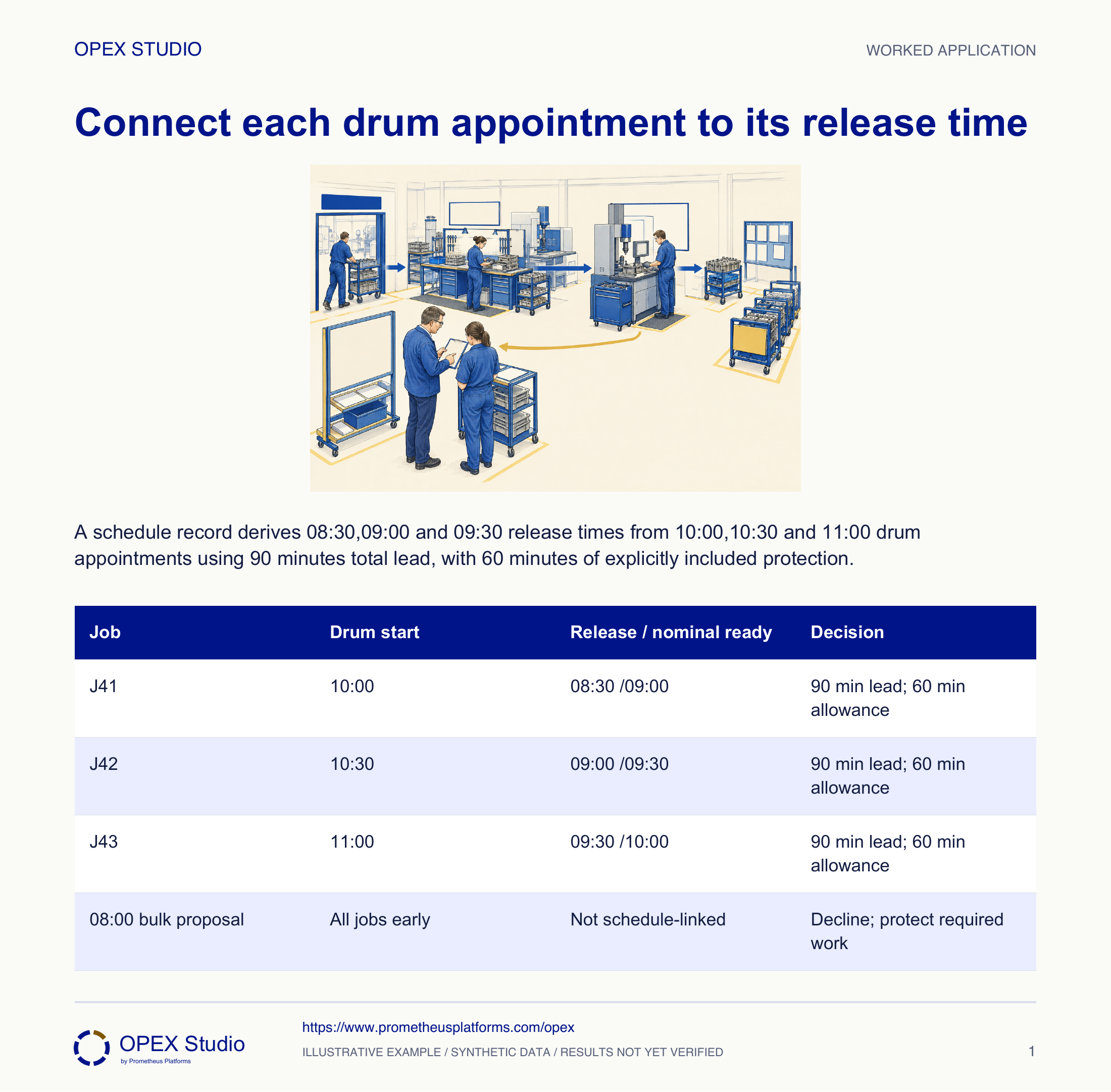
Fictional job-shop exercise: a specialist test station is the validated constraint for the current product mix. Planner Arun has scheduled jobs J41, J42 and J43 there. Upstream preparation is faster but has variable interruptions. Releasing all jobs at 08:00 fills the aisle and obscures which one the test station needs next.
Escalate J42’s specific blocking condition and review the drum schedule through its owner. Do not feed unverified work, silently swap incompatible jobs or release every later order.
The protective allowance is exhausted for this prediction. More unrelated WIP does not recover the threatened appointment.
Derive controlled release times from a supplied constraint schedule and protective lead, respond to a threatened job, and avoid early release that adds congestion without protecting throughput.
Fictional job-shop exercise: a specialist test station is the validated constraint for the current product mix. Planner Arun has scheduled jobs J41, J42 and J43 there. Upstream preparation is faster but has variable interruptions. Releasing all jobs at 08:00 fills the aisle and obscures which one the test station needs next.
Role: Planner coordinating upstream preparation, material movement and the constraint operator.
The release gate follows the approved constraint schedule and protects timely arrival of the required, quality-ready work.
The upstream supervisor wants to release the whole day’s work immediately to keep every local station busy.
| Job / rule | Supplied schedule |
|---|---|
| J41 drum start | 10:00 |
| J42 drum start | 10:30 |
| J43 drum start | 11:00 |
| Nominal upstream time | 30 min per job under stated conditions |
| Protective allowance | 60 min |
| Release-to-drum lead | 90 min total; start time minus 90 min |
| Quality condition | Only verified ready work may feed the drum |
Arun confirms the three drum appointments and relevant routing. He keeps the supplied constraint assumption visible and checks that release is tied to these jobs, not an upstream utilization target.
Why: The rope is an information rule anchored to the system’s limiting schedule. Keeping an unconstrained resource busy can produce work the drum cannot yet use.
Evidence: J41/J42/J43 have explicit 10:00 / 10:30 / 11:00 drum starts.
He records 30 minutes nominal upstream time and 60 minutes protective allowance, totaling 90 minutes from release to scheduled drum start.
Why: Ambiguous use of buffer can accidentally add the allowance twice or assume that inventory quantity alone provides protection.
Evidence: The teaching schedule states exactly what the 90 minutes includes; actual protection must be tuned from operating evidence.
Subtract 90 minutes from each drum start: J41 at 08:30, J42 at 09:00 and J43 at 09:30. Communicate these controlled appointments to the upstream gate.
Why: A release appointment lets required work enter with planned protection while avoiding admission hours earlier merely because capacity is free.
Evidence: Each job keeps a stable identity and a release-to-drum connection; no physical rope is implied.
The team compares expected ready time with the scheduled drum appointment. If a needed job is delayed, it identifies the blocking step and uses the agreed escalation to protect the appointment.
Why: The protective allowance is consumed by disruption. The response should address the threatened job, not flood the route with unrelated work.
Evidence: The readiness record names estimated arrival, remaining time, blocking condition and owner.
After the trial, Arun reviews drum starvation, missed commitments, excess released work and causes of protective-time consumption. Changes to release lead or schedule follow that evidence.
Why: A copied buffer size or a perfect-looking release table is not proof that the operating system is protected.
Evidence: Keep actual timestamps and system outcomes distinct from the planned schedule; revise the rule through its owner.
| Job | Drum start | Release / nominal ready | Decision |
|---|---|---|---|
| J41 | 10:00 | 08:30 /09:00 | 90 min lead; 60 min allowance |
| J42 | 10:30 | 09:00 /09:30 | 90 min lead; 60 min allowance |
| J43 | 11:00 | 09:30 /10:00 | 90 min lead; 60 min allowance |
| 08:00 bulk proposal | All jobs early | Not schedule-linked | Decline; protect required work |
At 09:50 the upstream owner estimates J42 will be verified ready at 10:40, ten minutes after its 10:30 drum appointment. J43 is not a technically interchangeable substitute.
Escalate J42’s specific blocking condition and review the drum schedule through its owner. Do not feed unverified work, silently swap incompatible jobs or release every later order.
The protective allowance is exhausted for this prediction. More unrelated WIP does not recover the threatened appointment.
The record names the ten-minute predicted miss, blocker, recovery estimate and authorized schedule decision; a recovery outcome is not invented.
New fictional schedule: K11 is due at the validated constraint at 13:00 and K12 at 13:40. The release-to-drum lead is 100 minutes, including 40 minutes nominal preparation/travel and 60 minutes protection. K11 actually starts upstream at 11:50 rather than its planned release.
| Input | Value |
|---|---|
| K11 drum start | 13:00 |
| K12 drum start | 13:40 |
| Total release lead | 100 min =40 nominal +60 protection |
| K11 actual upstream start | 11:50 |
| New K11 ready estimate | 13:10, after another disruption |
K11 release is 11:20 and nominal ready time 12:00. K12 release is 12:00 and nominal ready time 12:40. Each initially has 60 minutes protective allowance.
Starting K11 at 11:50 with 40 minutes preparation predicts 12:30 readiness, leaving 30 minutes to 13:00. The 30-minute late start consumes half the original 60-minute allowance.
A later 13:10 ready estimate predicts a 10-minute miss. Escalate the actual blocker and seek an authorized recovery/schedule decision; record whether the forecast or outcome changes.
| Job / condition | Time calculation | Protection / response |
|---|---|---|
| K11 planned | 11:20 release | 12:00 nominal ready; 60 min protection |
| K12 planned | 12:00 release | 12:40 nominal ready; 60 min protection |
| K11 starts 11:50 | 12:30 nominal ready | 30 min remaining |
| K11 estimate 13:10 | 10 min after drum | Escalate blocker; schedule owner decides |
Which resource’s need governs release here?
What is included in 90 minutes?
How much protection remains after the late start?
Would more unrelated work help J42 arrive?
Draw planned and revised timestamps on one timeline, then explain the information return from drum to release.
Owner: Constraint schedule owner with upstream and material-flow leaders
Record: Job release/readiness log linked to the drum schedule
Review: At release/readiness checks and after representative operating cycles
Evidence: Actual release/arrival, readiness, starvation, missed commitments and excess WIP
Reassess blocker, protective lead and constraint assumptions; approve schedule/rule changes deliberately rather than bypassing release discipline.
Constraint schedule, protection and release control; English synthesis from Japanese primary text
Method reference; original OPEX scenario and diagram are synthetic teaching content, not source case results.Read the lessons online or use these PDFs to prepare, practise and review with your team. No sign-in needed.
Case objectives, demonstration plans, debriefs, common mistakes and application checks across all 81 workplace cases and method lessons.
Download Facilitator guide PDF · 166 pages · 65.1 MBPrintable case worksheets, blank observation records and five calculation exercises; answers are separate.
Download Learner workbook PDF · 169 pages · 10.7 MBReasoned sample responses, worked calculations and coaching guidance; fictional examples are clearly labelled.
Download Answer key and coaching notes PDF · 105 pages · 8.5 MBThe native method mechanisms and worked applications for all 68 detailed lessons, in a separate bookmarked portrait reference.
Download Method and application reference PDF · 141 pages · 10.2 MBFive illustrated system chapters: 15 Flare concept maps and 26 original workplace teaching cards, with links to all 81 supporting cases and method lessons.
Download Illustrated systems atlas PDF · 69 pages · 55.8 MBExplore this connected method and its separate application conditions.
Explore the connected method →Explore this connected method and its separate application conditions.
Explore the connected method →Explore this connected method and its separate application conditions.
Explore the connected method →