Facilitator guide
Case objectives, demonstration plans, debriefs, common mistakes and application checks across all 81 workplace cases and method lessons.
Download Facilitator guide PDF · 166 pages · 65.1 MB OPEXSTUDIO
Kit standard + quality at source. Follow the visual, practise a decision, then check your thinking.
Fictional teaching examples and AI-generated illustrations. Proposed changes and goals are not achieved results. Use the written instructions and check local conditions before applying a method.
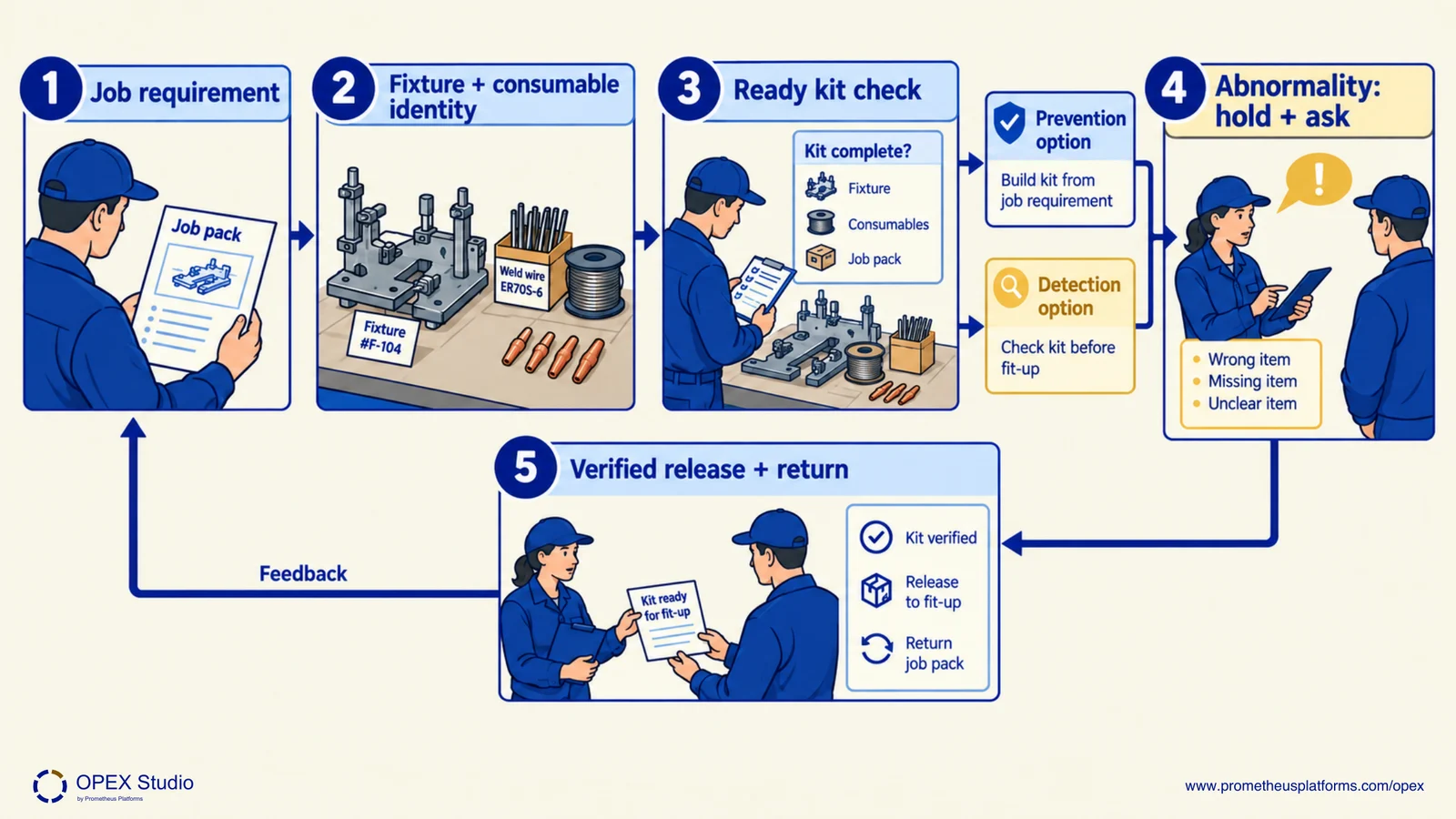
The retained twelve preparation-search observations have an 8-minute median and 3-minute goal. A kit standard must make the right item easier to select, not merely make all items look organized. Teach quality at source through visible identity, readiness and abnormality response. A proposed physical cue may prevent selection error; a check may detect one. Each needs verification. Welding parameters, extraction and other technical controls remain with approved practice.
Retained kit-preparation search: 12 observations, median 8 minutes; proposed goal 3 minutes. Start with the approved job pack and finish with correct verified fixtures and consumables at fit-up.
A prevention mechanism avoids the selection error; a detection check finds an error that still occurs. Test each proposed mechanism before claiming effectiveness.
How does a shaped fixture location differ from a final visual inspection?
It may prevent an incorrect selection; inspection detects a condition. Neither should be claimed effective without a test.
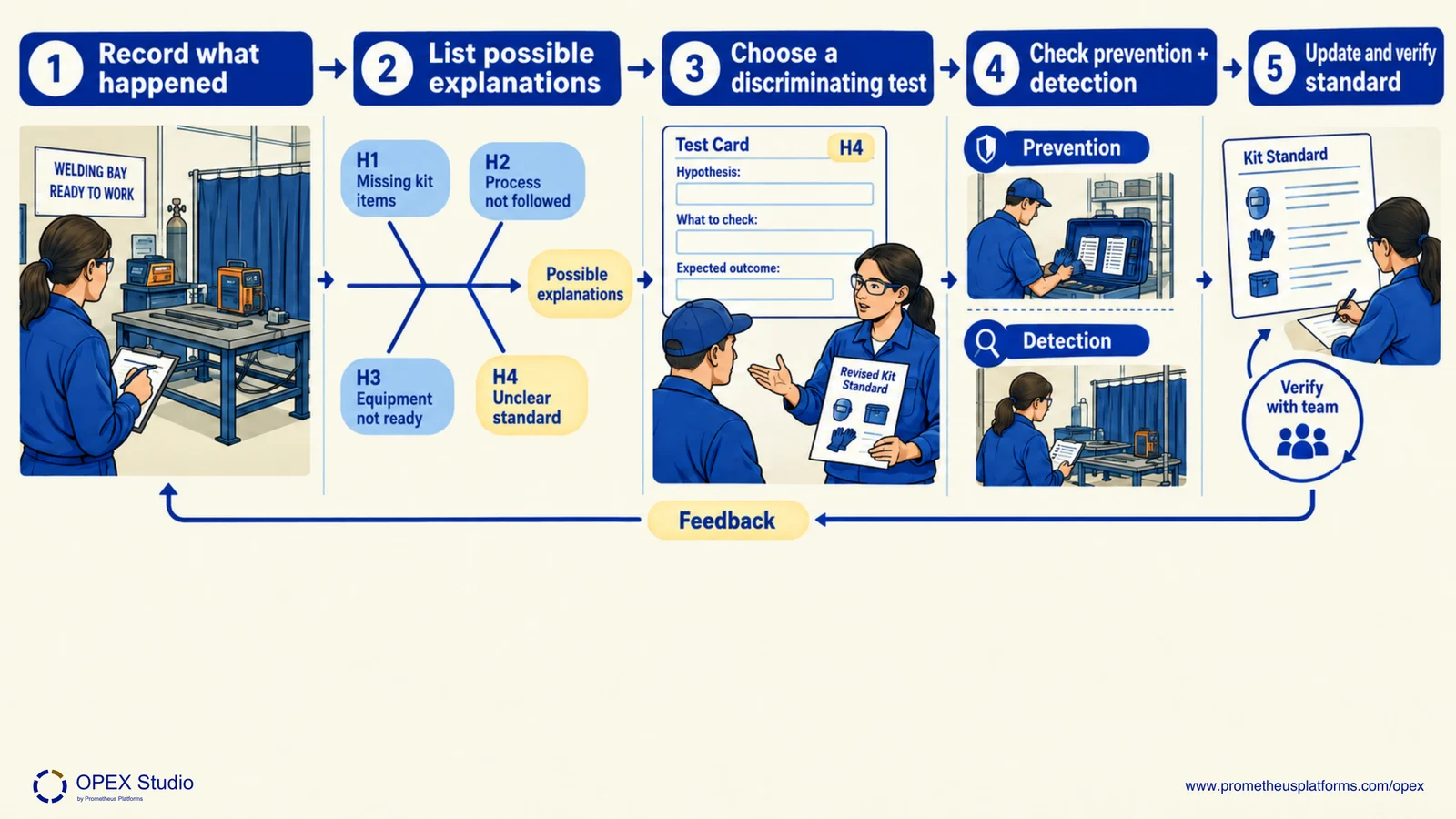
Record the exact wrong or missing item, job context and consequence. Ask the people doing the work how the kit is prepared. Use a cause diagram to organize possible explanations, then test the useful ones. Check both whether the proposed change prevents the error and whether remaining errors are detected. Repeated exposure after implementation is needed before claiming recurrence prevention.
Record the wrong or missing item, job conditions and consequence as observations. A cause-diagram branch remains a hypothesis until tested.
Predict what should change in a discriminating test, record contrary evidence and check both occurrence prevention and remaining-error detection.
Is Operator careless an adequate causal statement?
No. Investigate the conditions, information, standard and system that shaped the action.
Jidoka enables people or equipment to detect abnormal conditions and stop work so quality is built into the process and causes can be addressed.
Do not reduce jidoka to ordinary automation or downstream final inspection.Fishbone diagrams organize possible explanations into categories to support exploration and further analysis.
A diagram branch is a candidate explanation, not automatically a verified cause.Direct observation and inquiry where value-producing work occurs establish current conditions before action; following a process across departments can reveal its end-to-end operation.
Gemba applies to service and office work as well as manufacturing.Production standardized work combines takt, work sequence and necessary in-process stock. Operator-machine combination tables clarify manual work, walking and automatic processing; the standard remains a basis for improvement.
Read the lessons online or use these PDFs to prepare, practise and review with your team. No sign-in needed.
Case objectives, demonstration plans, debriefs, common mistakes and application checks across all 81 workplace cases and method lessons.
Download Facilitator guide PDF · 166 pages · 65.1 MBPrintable case worksheets, blank observation records and five calculation exercises; answers are separate.
Download Learner workbook PDF · 169 pages · 10.7 MBReasoned sample responses, worked calculations and coaching guidance; fictional examples are clearly labelled.
Download Answer key and coaching notes PDF · 105 pages · 8.5 MBThe native method mechanisms and worked applications for all 68 detailed lessons, in a separate bookmarked portrait reference.
Download Method and application reference PDF · 141 pages · 10.2 MBFive illustrated system chapters: 15 Flare concept maps and 26 original workplace teaching cards, with links to all 81 supporting cases and method lessons.
Download Illustrated systems atlas PDF · 69 pages · 55.8 MBOccurrence and escape analysis help distinguish preventing a wrong kit from detecting an error that remains.
Explore the connected method →Teach back the revised kit method and use repeated observations to test whether the new standard works.
Explore the connected method →