Facilitator guide
Case objectives, demonstration plans, debriefs, common mistakes and application checks across all 81 workplace cases and method lessons.
Download Facilitator guide PDF · 166 pages · 65.1 MB OPEXSTUDIO
Identify constraint. Follow the visual, practise a decision, then check your thinking.
Fictional teaching examples and AI-generated illustrations. Proposed changes and goals are not achieved results. Use the written instructions and check local conditions before applying a method.
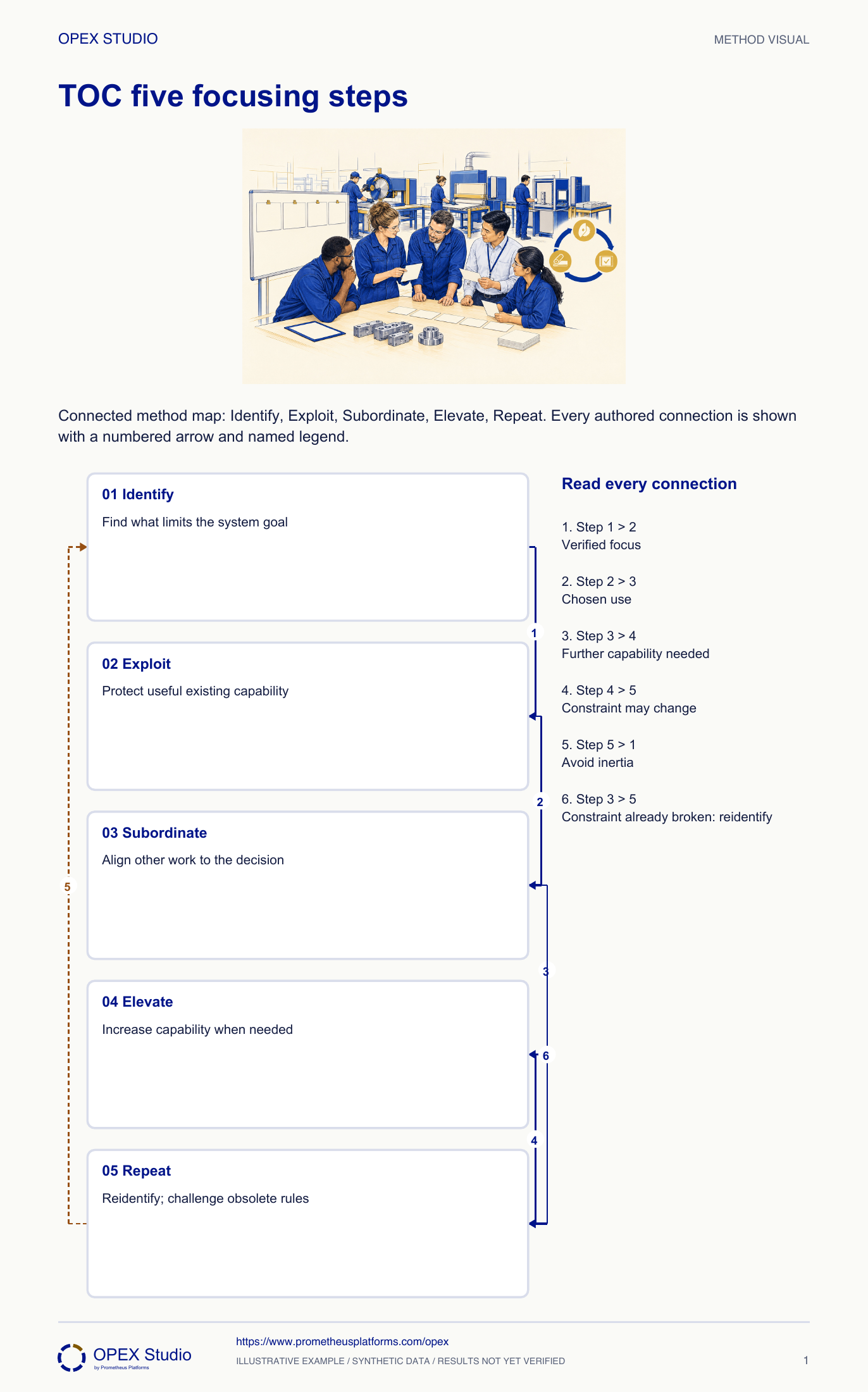
Define the system goal and identify what currently limits it. First examine how to use the existing constraint effectively, then align other work to support that decision. Add capacity or make a larger change when the evidence shows it is needed. After improvement, look again: the limiting factor may move, and old rules can become the next obstacle. The loop is about system performance, not making every resource equally busy. Exploiting a constraint means protecting useful capability, not overburdening people or bypassing maintenance and quality. Verify the result through the defined system outcome and repeat the learning cycle.
Exploit means use wisely, not overwork people.
Do not buy capacity before examining existing loss.
Lean methods can improve constraint performance; Daily measures verify system effect.
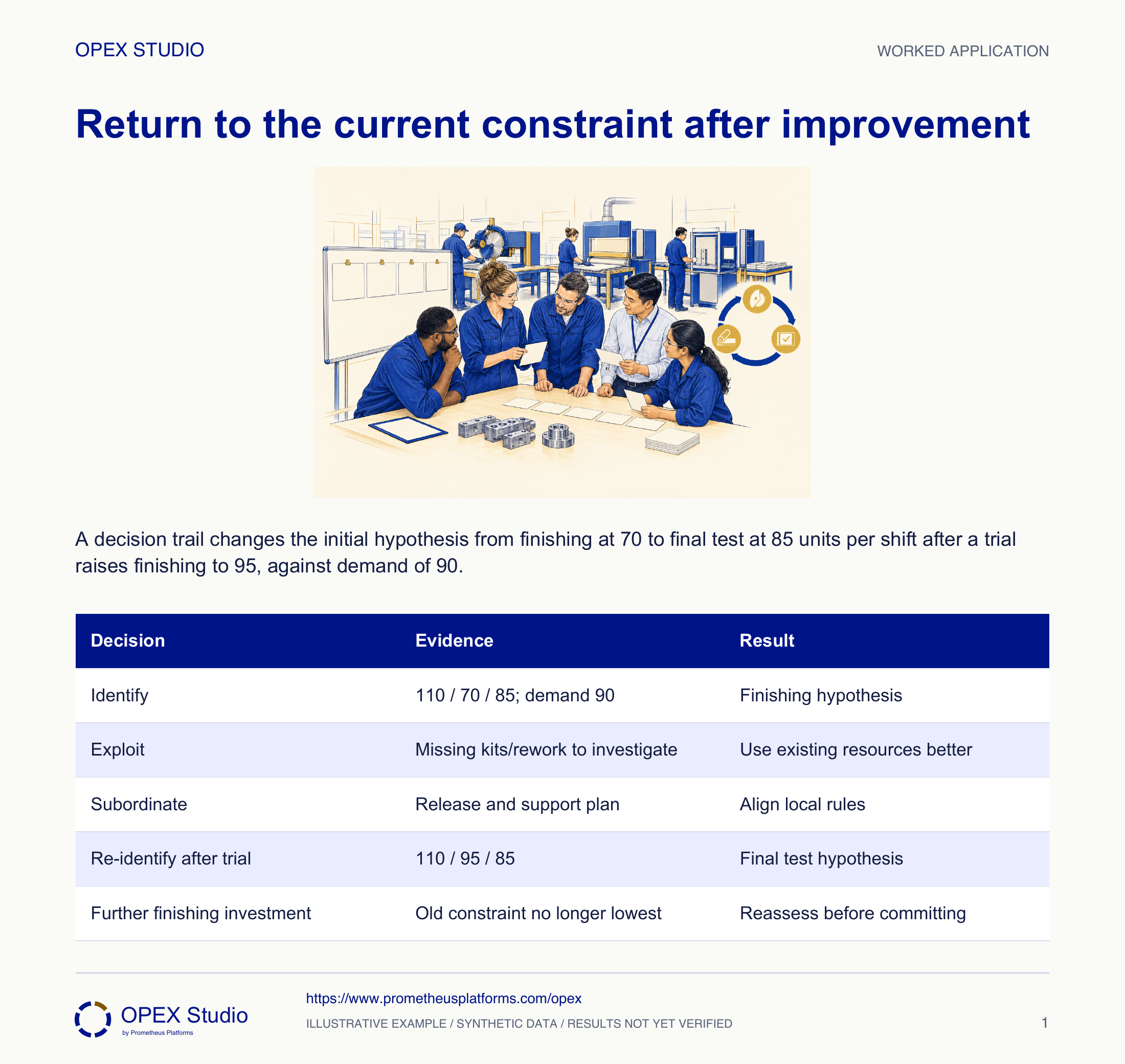
Fictional pump route: customer demand is 90 accepted units per shift. Comparable effective capacities are cutting 110, finishing 70 and final test 85. Manager Priya initially identifies finishing as the limiting stage. A controlled improvement later demonstrates finishing at 95, while final test remains 85.
Reconsider the system boundary and market/demand limitation rather than declaring finishing a binding internal constraint against this demand.
The slowest resource can have spare capacity relative to current demand.
Apply the five focusing steps to a stated system outcome, distinguish using existing capacity from adding capacity, and return to identification when the limiting condition moves.
Fictional pump route: customer demand is 90 accepted units per shift. Comparable effective capacities are cutting 110, finishing 70 and final test 85. Manager Priya initially identifies finishing as the limiting stage. A controlled improvement later demonstrates finishing at 95, while final test remains 85.
Role: System owner coordinating the affected process leaders.
Improvement increases reliable system delivery while maintaining quality and other necessary conditions.
The team plans another finishing investment even after final test has become the lower-capacity stage.
| Stage / demand | Before | After finishing trial |
|---|---|---|
| Cutting | 110 units/shift | 110 |
| Finishing | 70 | 95 |
| Final test | 85 | 85 |
| Customer demand | 90 | 90 |
Priya defines the delivery boundary and compares 110, 70 and 85 with demand 90. She treats finishing at 70 as the initial constraint hypothesis and checks actual operating evidence.
Why: The biggest department or queue is not automatically the system constraint. The comparison must use like-for-like effective capacity and real demand.
Evidence: Initial model limit: finishing 70 accepted units per shift.
The finishing team investigates lost time from missing kits and avoidable rework, and protects the approved work sequence and quality readiness using current resources.
Why: Exploitation seeks better use of the existing limiting resource. It is not a demand to overburden people or skip controls.
Evidence: Existing-resource action plan names loss evidence, owner and expected system effect.
Upstream release, material readiness and downstream response are aligned to the finishing plan. Local output targets are reviewed so cutting does not flood the route with unwanted WIP.
Why: Supporting stages must help the system’s limiting decision rather than maximize their own activity independently.
Evidence: Release/support rules are explicit; idle nonconstraint capacity is not automatically a failure.
If the verified limitation remains after appropriate exploitation and subordination, evaluate additional capability or capacity with cost, quality and demand evidence. Recheck the constraint after any improvement, including earlier steps.
Why: Elevation is not mandatory if the limiting condition has already moved. The five steps are not a purchasing checklist.
Evidence: Any additional-capacity proposal has a remaining system gap and evidence-based justification.
After finishing demonstrates 95, compare again: cutting 110, finishing 95, test 85, demand 90. Final test is now the first internal constraint hypothesis; revise support rules and investigate its losses.
Why: Continuing to optimize finishing through habit would not remove the current modeled 85-unit delivery limit.
Evidence: Return to identification; modeled system gap is now 5 units against demand, not the old 20.
| Decision | Evidence | Result |
|---|---|---|
| Identify | 110 / 70 / 85; demand 90 | Finishing hypothesis |
| Exploit | Missing kits/rework to investigate | Use existing resources better |
| Subordinate | Release and support plan | Align local rules |
| Re-identify after trial | 110 / 95 / 85 | Final test hypothesis |
| Further finishing investment | Old constraint no longer lowest | Reassess before committing |
Confirmed demand falls to 60 while all stages retain the original 110, 70 and 85 capacities.
Reconsider the system boundary and market/demand limitation rather than declaring finishing a binding internal constraint against this demand.
The slowest resource can have spare capacity relative to current demand.
Demand basis and constraint hypothesis are revised together.
Separate fictional route: intake 50, technical review 32 and approval 40 requests per day; demand 45. A verified review improvement raises technical review to 46.
| Stage | Before → after |
|---|---|
| Intake | 50 → 50/day |
| Technical review | 32 → 46/day |
| Approval | 40 → 40/day |
| Demand | 45/day |
Technical review at 32 is initially lowest against demand 45, a modeled gap of 13 per day.
After review reaches 46, approval at 40 is lowest, leaving a gap of 5 per day.
Align readiness and release with the current approval limitation and investigate its losses. More technical-review capacity alone does not remove the 40-per-day model limit.
| Condition | Comparison | Decision |
|---|---|---|
| Before | 32 versus demand 45 | Review; gap 13/day |
| After | 40 versus demand 45 | Approval; gap 5/day |
| Next step | Return to identification | Revise support rules |
What counts as accepted system output?
Which actions use existing capacity and which add it?
Why return to step one before buying more finishing capacity?
Which local rule could undermine the new focus?
Write the limiting comparison before and after, then connect each supporting rule to the current result.
Owner: System owner with current constraint and supporting-process leaders
Record: Constraint hypothesis, focusing decisions and system-output observations
Review: After each material improvement and at the ongoing system review
Evidence: Reliable accepted delivery, current constraint evidence and aligned support decisions
Reopen the boundary or hypothesis; do not preserve obsolete rules because the previous project was successful.
Identify, exploit, subordinate, elevate, repeat without inertia
Method reference; original OPEX scenario and diagram are synthetic teaching content, not source case results.The focusing process underpins TOC applications and ongoing system improvement.
Current public presentation synopsis only; no restricted presentation content is claimed.Read the lessons online or use these PDFs to prepare, practise and review with your team. No sign-in needed.
Case objectives, demonstration plans, debriefs, common mistakes and application checks across all 81 workplace cases and method lessons.
Download Facilitator guide PDF · 166 pages · 65.1 MBPrintable case worksheets, blank observation records and five calculation exercises; answers are separate.
Download Learner workbook PDF · 169 pages · 10.7 MBReasoned sample responses, worked calculations and coaching guidance; fictional examples are clearly labelled.
Download Answer key and coaching notes PDF · 105 pages · 8.5 MBThe native method mechanisms and worked applications for all 68 detailed lessons, in a separate bookmarked portrait reference.
Download Method and application reference PDF · 141 pages · 10.2 MBFive illustrated system chapters: 15 Flare concept maps and 26 original workplace teaching cards, with links to all 81 supporting cases and method lessons.
Download Illustrated systems atlas PDF · 69 pages · 55.8 MBExplore this connected method and its separate application conditions.
Explore the connected method →Explore this connected method and its separate application conditions.
Explore the connected method →Explore this connected method and its separate application conditions.
Explore the connected method →