Facilitator guide
Case objectives, demonstration plans, debriefs, common mistakes and application checks across all 81 workplace cases and method lessons.
Download Facilitator guide PDF · 166 pages · 65.1 MB OPEXSTUDIO
Determine applicable process, customer and qualification scope.. Follow the visual, practise a decision, then check your thinking.
Fictional teaching examples and AI-generated illustrations. Proposed changes and goals are not achieved results. Use the written instructions and check local conditions before applying a method.
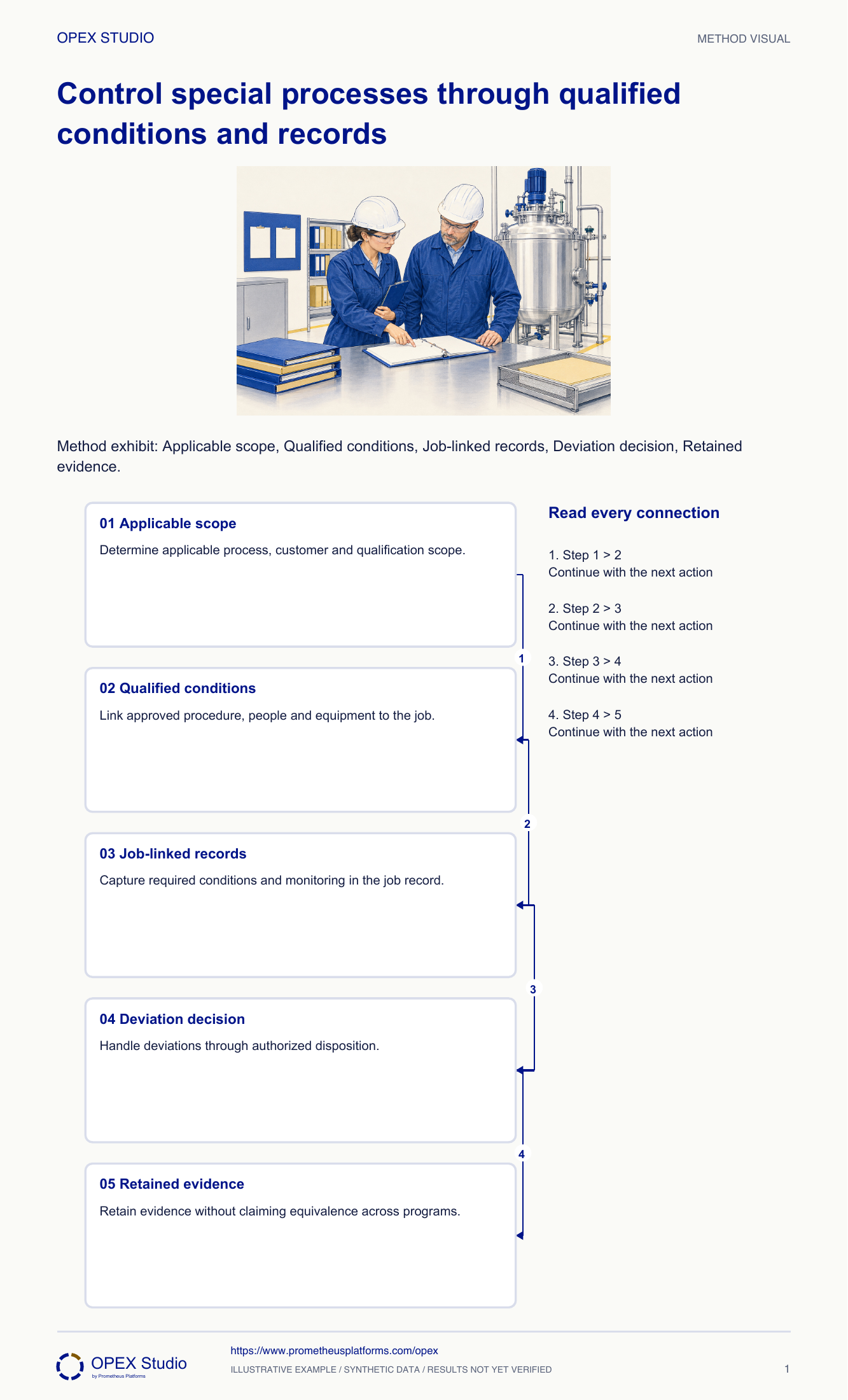
Special-process control links the job to qualified conditions and objective records. Determine the relevant process, customer and scope requirements before deciding which qualifications or assessments apply. Connect approved procedures, competent personnel, equipment status and required monitoring to the actual job identity. When conditions deviate, preserve the evidence and use the authorized disposition route instead of assuming final appearance proves acceptability. Automotive special-process assessments and aerospace Nadcap accreditation are distinct programs with their own applicability. This lesson teaches the evidence chain only. It deliberately provides no furnace recipe, chemical limit, welding parameter or claim that one generic checklist satisfies every special process.
Link job identity → approved process revision → recorded run.
No temperature, chemistry or machine recipe is supplied.
Automotive CQI assessments and Nadcap have distinct applicability.
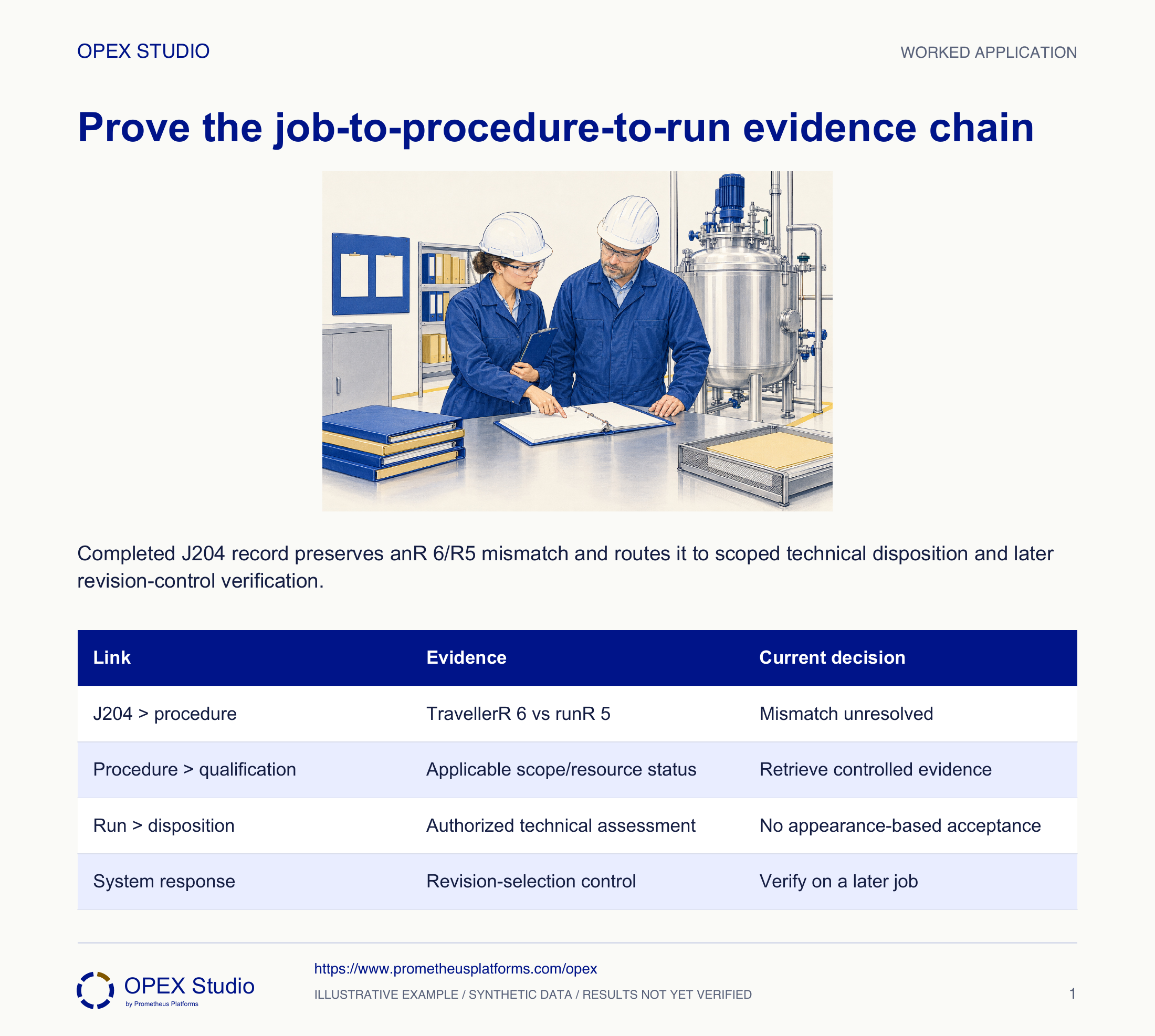
Fictional case: a special-process job J204 has a traveller naming procedure revision R6, but the retained run record references R5. Coordinator Sam must determine whether the job was performed under the applicable approved conditions. The core lesson retains the three evidence links—job identity, approved process revision and recorded run—with no technical recipe values.
Verify the actual accredited scope and applicable customer requirement; do not treat the unrelated record as evidence for J204.
Qualification and accreditation are scope-specific. Similar branding or company ownership does not establish coverage.
Connect a job to applicable scope, qualified conditions and retained run evidence, and route deviations through the authorized process.
Fictional case: a special-process job J204 has a traveller naming procedure revision R6, but the retained run record references R5. Coordinator Sam must determine whether the job was performed under the applicable approved conditions. The core lesson retains the three evidence links—job identity, approved process revision and recorded run—with no technical recipe values.
Role: Special-process coordinator with responsible engineering and quality
Applicable customer/program scope, procedure, personnel, equipment and run evidence are connected to the actual job; deviations have defined authority.
The team proposes accepting the job because the finished surface looks good, without resolving the procedure-revision mismatch.
| Evidence link | Supplied status |
|---|---|
| Job identity | J204 traveller |
| Approved procedure reference | R6 on traveller |
| Run record reference | R5 recorded |
| Qualified scope and resources | Must be checked against applicable authority |
| Final appearance | Looks acceptable; does not resolve process evidence gap |
Sam identifies the actual process, site, customer and program requirements. He checks which qualification or assessment framework applies rather than borrowing another commodity’s checklist.
Why: A broad company certificate cannot establish every special-process scope. Applicability precedes evidence evaluation.
Evidence: The review names the relevant process scope and authorized requirement source.
He matches J204 to the controlled procedure, required personnel/equipment status and applicable revision. The teaching record points to those authorities without supplying technical settings.
Why: The job must be traceable to the conditions that were actually approved for it. A generic “qualified” label omits the scope and time of that status.
Evidence: The evidence map identifies procedure and resource-status records.
Sam compares R6 on the traveller with R5 in the run evidence and retrieves controlled change and execution records. He preserves both original references.
Why: A revision mismatch may reflect recording error, wrong execution or a change that needs technical assessment. Rewriting the run reference before investigation would erase that distinction.
Evidence: The gap is logged as unresolved, with source records retained.
Responsible engineering and quality determine the necessary evidence, product status and disposition under the applicable requirements. Sam does not infer acceptance from appearance or invent a reprocessing recipe.
Why: Some process characteristics cannot be fully verified by later inspection alone. The correct response depends on the actual process and requirement authority.
Evidence: The deviation record names the decision owner and required technical review.
After an actual decision, the team retains its basis, corrects records through controlled amendments and addresses the revision-selection weakness. A subsequent job checks the improved linkage.
Why: A tidy folder is not enough; the underlying job-to-procedure-to-run relationship must be reliable. Closure distinguishes product disposition from the system action.
Evidence: The follow-up verifies a later job using the intended controlled revision.
| Link | Evidence | Current decision |
|---|---|---|
| J204→procedure | TravellerR 6 vs runR 5 | Mismatch unresolved |
| Procedure→qualification | Applicable scope/resource status | Retrieve controlled evidence |
| Run→disposition | Authorized technical assessment | No appearance-based acceptance |
| System response | Revision-selection control | Verify on a later job |
The supplier presents an accreditation record for a different commodity or site.
Verify the actual accredited scope and applicable customer requirement; do not treat the unrelated record as evidence for J204.
Qualification and accreditation are scope-specific. Similar branding or company ownership does not establish coverage.
The review identifies the mismatch and requests the correct scope evidence.
New fictional job J311 references the correct approved procedure, but a required portion of its run record is missing. An operator remembers that the run was normal.
| Evidence | Status |
|---|---|
| Job/procedure identity | Matches |
| Run record | Required segment missing |
| Operator recollection | Normal run recalled |
| Technical disposition | Not supplied |
Correct job/procedure identity does not fill the missing run segment. Preserve existing records and recollection as separately labelled evidence, then use the applicable technical/quality process to determine disposition and any permitted reconstruction.
Verify the corrected record-capture control on relevant later jobs. Do not fabricate missing measurements or use a remembered normal run as equivalent to required contemporaneous evidence.
| Claim | Evidence status | Action |
|---|---|---|
| Correct procedure | Established by supplied identity | Retain |
| Required run conditions | Incomplete evidence | Authorized assessment |
| System fix | Not yet verified | Check later complete capture |
Which process and site are actually covered?
What different explanations fitR 5/R6?
Which evidence must not be invented?
How will the next job prove the capture fix?
Draw the three evidence links and mark each as established, inconsistent or missing.
Owner: Special-process engineering and quality owners
Record: Scoped job/procedure/run evidence and authorized deviation decisions
Review: At each required job review and after controlled changes
Evidence: Correct identity, applicable qualification and complete required records
Escalate missing or inconsistent evidence; verify the corrective control on later relevant work.
Special-process CQI assessments provide process-specific quality disciplines; they are distinct from Nadcap accreditation.
Do not transplant one commodity checklist, process setting or acceptance criterion into another process.Nadcap is an industry-managed accreditation program for critical processes; process scope and task-group criteria matter.
A company/QMS certificate does not itself establish Nadcap accreditation for a particular process/site.Read the lessons online or use these PDFs to prepare, practise and review with your team. No sign-in needed.
Case objectives, demonstration plans, debriefs, common mistakes and application checks across all 81 workplace cases and method lessons.
Download Facilitator guide PDF · 166 pages · 65.1 MBPrintable case worksheets, blank observation records and five calculation exercises; answers are separate.
Download Learner workbook PDF · 169 pages · 10.7 MBReasoned sample responses, worked calculations and coaching guidance; fictional examples are clearly labelled.
Download Answer key and coaching notes PDF · 105 pages · 8.5 MBThe native method mechanisms and worked applications for all 68 detailed lessons, in a separate bookmarked portrait reference.
Download Method and application reference PDF · 141 pages · 10.2 MBFive illustrated system chapters: 15 Flare concept maps and 26 original workplace teaching cards, with links to all 81 supporting cases and method lessons.
Download Illustrated systems atlas PDF · 69 pages · 55.8 MBExplore this connected method and its separate application conditions.
Explore the connected method →Explore this connected method and its separate application conditions.
Explore the connected method →Explore this connected method and its separate application conditions.
Explore the connected method →Explore this connected method and its separate application conditions.
Explore the connected method →