Facilitator guide
Case objectives, demonstration plans, debriefs, common mistakes and application checks across all 81 workplace cases and method lessons.
Download Facilitator guide PDF · 166 pages · 65.1 MB OPEXSTUDIO
Identify the suspect input or output and its scope.. Follow the visual, practise a decision, then check your thinking.
Fictional teaching examples and AI-generated illustrations. Proposed changes and goals are not achieved results. Use the written instructions and check local conditions before applying a method.
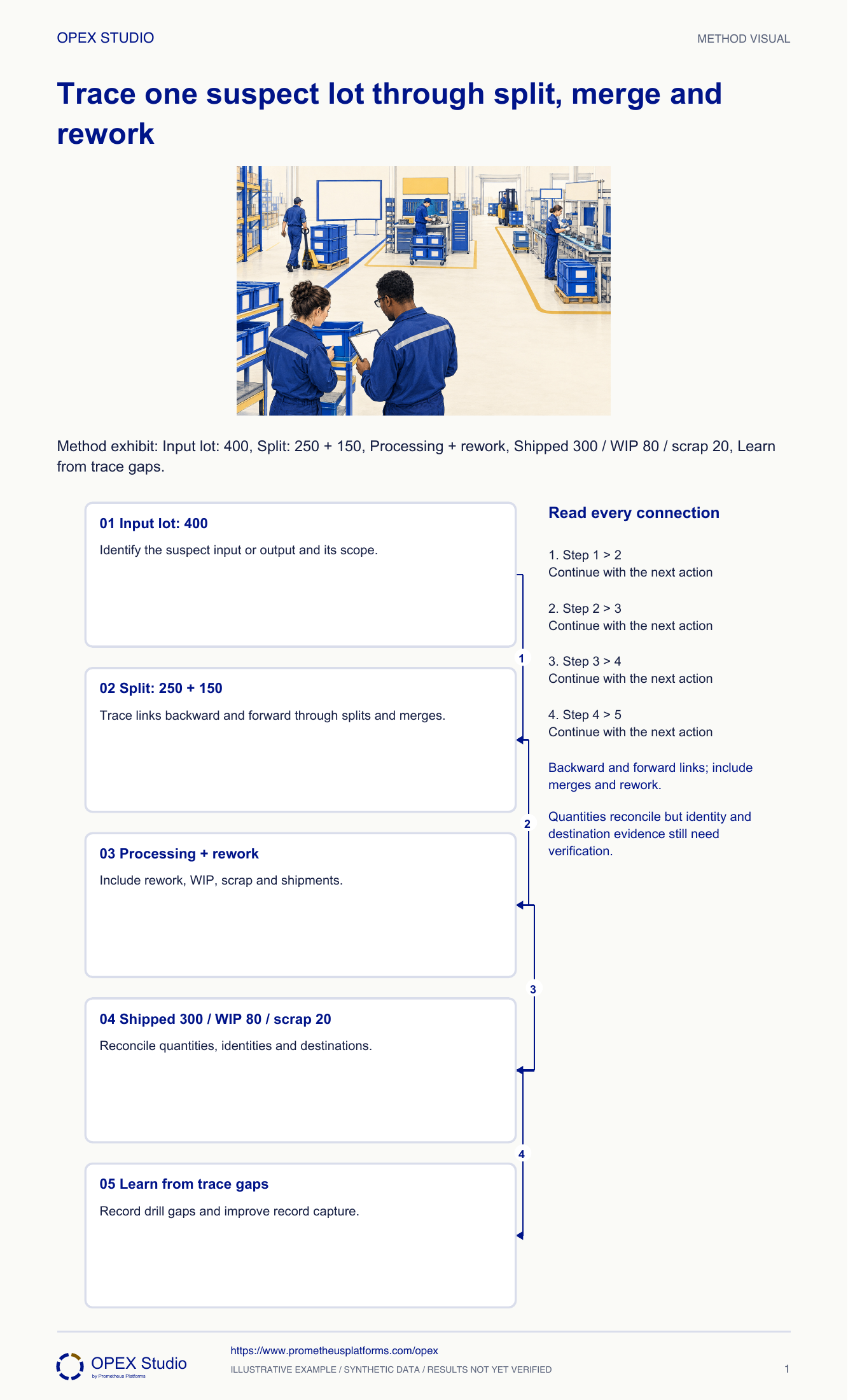
Product traceability preserves identity through changes in material and work. A useful trace links inputs to outputs in both directions and follows splits, merges, rework and shipments. Start a drill with a clearly scoped suspect input or output, then collect the linked records and reconcile quantities and locations. A balanced total is necessary but not sufficient: records may still name the wrong destination or omit a rework link. Record gaps and improve the capture process before an actual containment event. The method supports locating affected product; it is distinct from metrological traceability, which concerns the reference chain and uncertainty of a measurement result.
400 input splits250+150.
300shipped+80WIP+20scrap=400.
Verify identity and destinations as well as quantities.
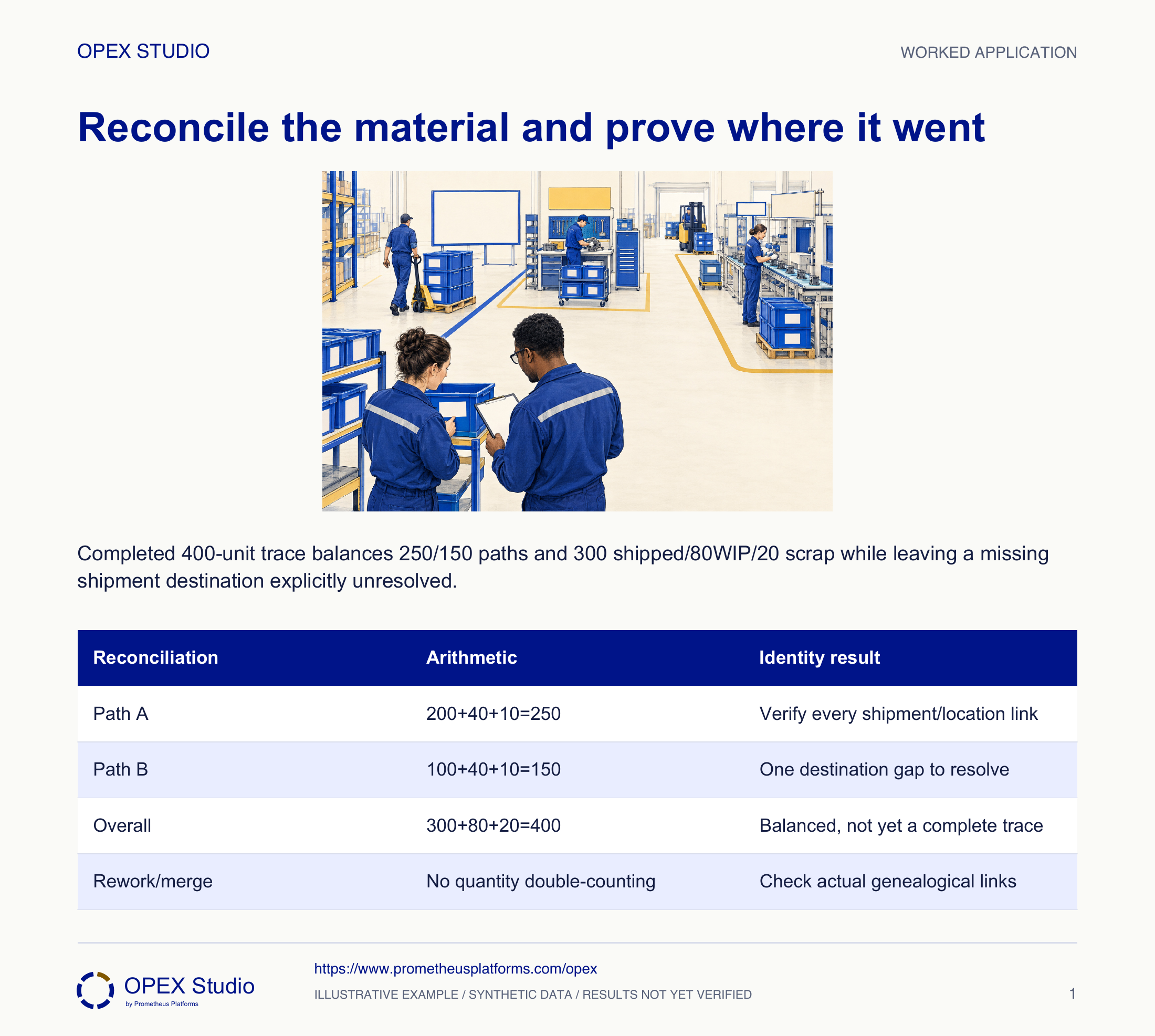
Fictional case: input lot L70 contains 400 units and splits into path A250 and path B150. The retained core totals are 300 shipped,80 in work and 20 scrapped. Trace coordinator Luis must identify where suspect material went. A balanced total is available, but one shipment record lacks its destination identity.
Trace the merged output identity and quantities for both inputs, and determine affected downstream scope through the authorized quality process.
A merge creates a relationship to retain, not permission to assign all output to one convenient original lot.
Trace a suspect lot through both quantity and identity links, including split paths, destinations, WIP and scrap.
Fictional case: input lot L70 contains 400 units and splits into path A250 and path B150. The retained core totals are 300 shipped,80 in work and 20 scrapped. Trace coordinator Luis must identify where suspect material went. A balanced total is available, but one shipment record lacks its destination identity.
Role: Trace coordinator with warehouse, production and quality owners
Every transformation or movement preserves source/output identity, quantities, status and destination. Rework links do not create or erase material.
The team declares the trace complete because 300+80+20=400, even though the recipient of part of the shipped population is unresolved.
| Path | Shipped | WIP | Scrap |
|---|---|---|---|
| A:250 input | 200 | 40 | 10 |
| B:150 input | 100 | 40 | 10 |
| Total 400 | 300 | 80 | 20 |
Luis identifies L70 and the reason for the trace, then follows both upstream and downstream links relevant to the scope. He records the starting evidence and any uncertainty.
Why: A trace needs a precise starting identity. Searching only a convenient downstream batch can miss other descendants of the same input.
Evidence: The drill scope names L70 and both split paths.
He reconciles A as 200+40+10=250 and B as 100+40+10=150. He retains the path identities rather than merely summing the plant-wide totals.
Why: Separate reconciliation exposes a missing or duplicated path that a coincidentally balanced total could hide.
Evidence: Both paths have linked output/status records.
For the 300 shipped units, Luis verifies shipment IDs, destinations and quantities. He locates the 80 WIP units and verifies the 20 scrap records and actual disposition evidence.
Why: A quantity without a destination cannot support a complete exposure response. WIP and scrap labels need real identity/status evidence.
Evidence: Every known quantity has a location or retained destination record, except the declared gap.
He checks whether either path entered rework or merged with other lots. Rework is a status/process link, not extra production to add to the total.
Why: A material path can be correct arithmetically yet broken genealogically. Merges can extend the set of affected outputs beyond a simple two-branch drawing.
Evidence: The trace record contains explicit rework/merge checks rather than an assumption of none.
Luis reports the missing destination as unresolved, assigns the warehouse owner and preserves the balanced quantity evidence. Quality determines any required response using the actual scope.
Why: A truthful partial trace is more useful than a false complete label. Closure requires identity, destination and disposition evidence as well as arithmetic.
Evidence: The drill record states what is known, what remains uncertain and who resolves it.
| Reconciliation | Arithmetic | Identity result |
|---|---|---|
| Path A | 200+40+10=250 | Verify every shipment/location link |
| Path B | 100+40+10=150 | One destination gap to resolve |
| Overall | 300+80+20=400 | Balanced, not yet a complete trace |
| Rework/merge | No quantity double-counting | Check actual genealogical links |
Path B material was merged with a second input lot during rework.
Trace the merged output identity and quantities for both inputs, and determine affected downstream scope through the authorized quality process.
A merge creates a relationship to retain, not permission to assign all output to one convenient original lot.
The record links both parent lots to the reworked output and its destinations.
New input lot L91 has 240 units split 160 and 80. Recorded outputs are 150 shipped,60 WIP and 20 scrapped. A rework log mentions ten units but does not identify their current status.
| Evidence | Quantity |
|---|---|
| Input | 240 |
| Shipped / WIP / scrap | 150 /60 /20 |
| Rework mention | 10; status/location unresolved |
Known dispositions sum 150+60+20=230, leaving 10 units unresolved. The rework mention may explain their path, but current status and identity must be verified before assigning them to WIP, shipment or scrap.
Do not add the ten again if they are already included in another total. Trace the rework input/output IDs, location and disposition records, then reconcile the final mutually exclusive statuses.
| Calculation | Result | Action |
|---|---|---|
| Known status sum | 230 | Compare with 240 input |
| Unresolved difference | 10 | Trace rework identity/status |
| Closure | Quantity and destination evidence | No automatic complete label |
Which descendants must be followed?
Can the total balance while one path is wrong?
What does the rework note actually prove?
Which destination evidence remains necessary?
Draw the lot links, then attach each quantity to a verified status and destination.
Owner: Traceability owner with warehouse and quality
Record: Genealogy, movement, status and drill-gap records
Review: At defined trace drills and after relevant process/record changes
Evidence: Complete identities, quantities and destinations across split/merge/rework
Repair record capture and verify a new trace opportunity when a drill exposes missing links.
Traceability supports product visibility and bounded recall; the guide includes self-assessment and traceability exercises.
Public primary-source summary; underlying paid standards/forms are not reproduced.Read the lessons online or use these PDFs to prepare, practise and review with your team. No sign-in needed.
Case objectives, demonstration plans, debriefs, common mistakes and application checks across all 81 workplace cases and method lessons.
Download Facilitator guide PDF · 166 pages · 65.1 MBPrintable case worksheets, blank observation records and five calculation exercises; answers are separate.
Download Learner workbook PDF · 169 pages · 10.7 MBReasoned sample responses, worked calculations and coaching guidance; fictional examples are clearly labelled.
Download Answer key and coaching notes PDF · 105 pages · 8.5 MBThe native method mechanisms and worked applications for all 68 detailed lessons, in a separate bookmarked portrait reference.
Download Method and application reference PDF · 141 pages · 10.2 MBFive illustrated system chapters: 15 Flare concept maps and 26 original workplace teaching cards, with links to all 81 supporting cases and method lessons.
Download Illustrated systems atlas PDF · 69 pages · 55.8 MBExplore this connected method and its separate application conditions.
Explore the connected method →Explore this connected method and its separate application conditions.
Explore the connected method →Explore this connected method and its separate application conditions.
Explore the connected method →Explore this connected method and its separate application conditions.
Explore the connected method →