Facilitator guide
Case objectives, demonstration plans, debriefs, common mistakes and application checks across all 81 workplace cases and method lessons.
Download Facilitator guide PDF · 166 pages · 65.1 MB OPEXSTUDIO
Protect current operation. Follow the visual, practise a decision, then check your thinking.
Fictional teaching examples and AI-generated illustrations. Proposed changes and goals are not achieved results. Use the written instructions and check local conditions before applying a method.
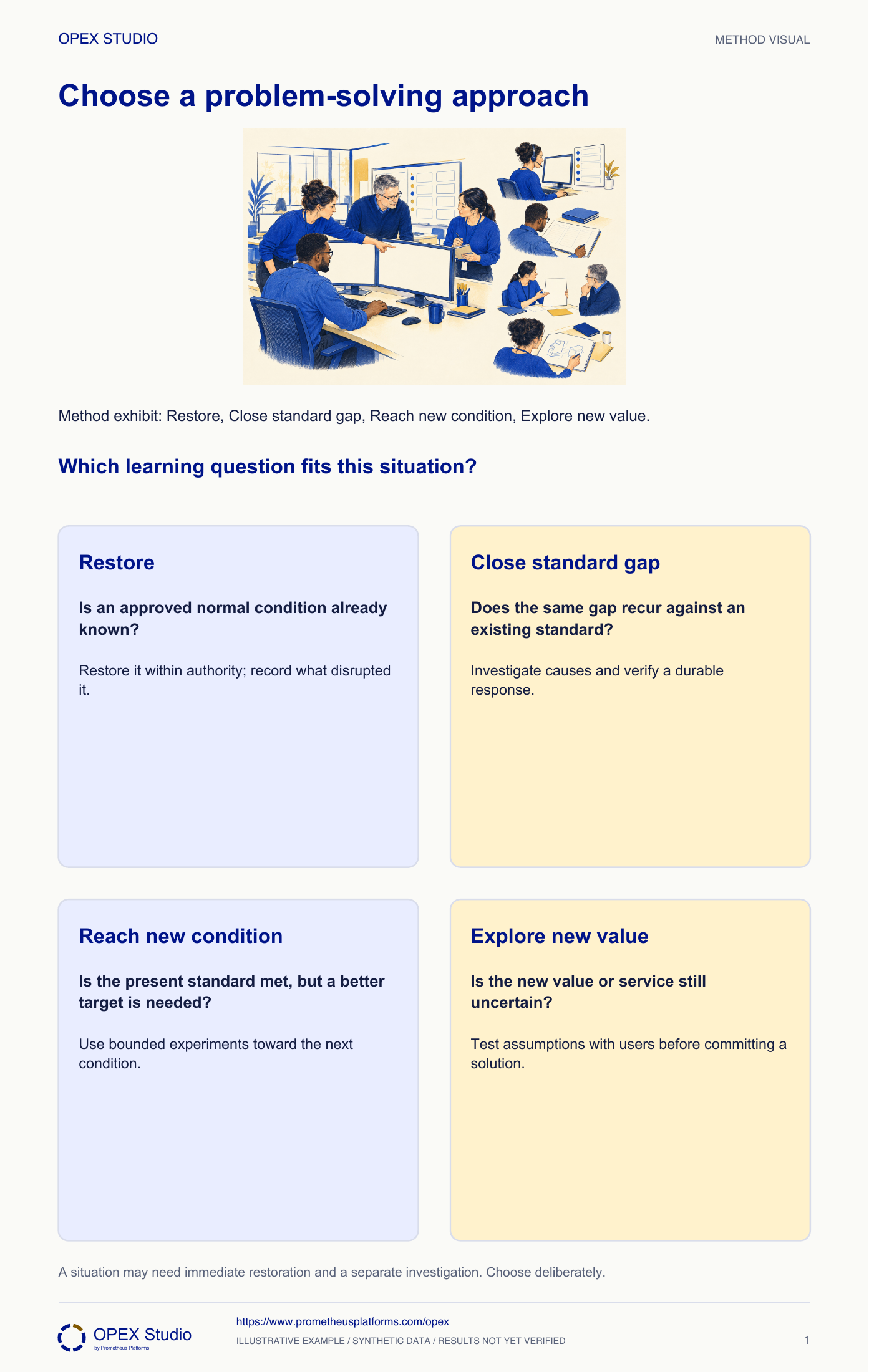
First protect the operation when a current abnormality needs immediate attention. Then decide what kind of learning is required. Restoring a known condition differs from investigating a recurring gap, reaching a better future condition or exploring a new service. The four examples help choose proportionate effort, ownership and cadence. A large project template can slow a simple response, while a quick fix can leave a systemic cause untouched. Revisit the choice as evidence develops. Methods such as A3, DMAIC or experiments should support the problem, not become rituals imposed on every situation regardless of need.
Not every issue needs DMAIC.
Quick restoration does not prove root cause removal.
Daily management routes recurring gaps; Kata helps unknown path to target.
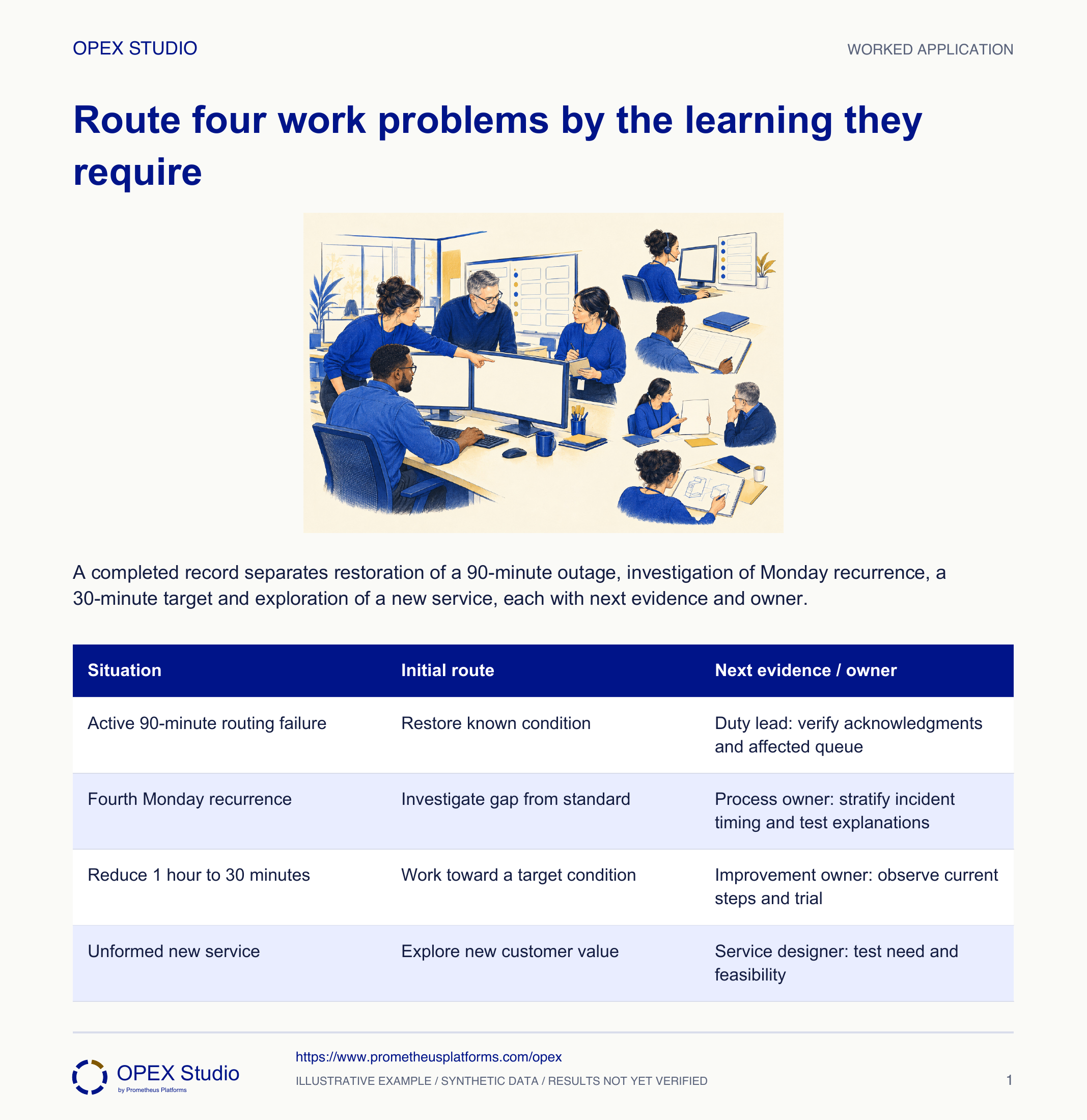
Fictional service-desk case: Harbor Support processes customer change requests. Every Monday the routing service stops sending acknowledgments. A documented restart restores routing. The duty lead has marked four weekly incidents complete after restarting, but the same failure has returned. A separate improvement request asks for faster handling of routine changes.
Clarify the customer commitment and operating definition with the responsible owner before labeling the team below standard. Address the live customer need while gathering facts.
A gap cannot be measured against an invented or ambiguous reference. Clarification may reveal a performance gap, a target discussion or a service-design problem.
Use a known standard, observed gap and learning need to choose an initial problem-solving route, while separating immediate restoration from recurrence investigation.
Fictional service-desk case: Harbor Support processes customer change requests. Every Monday the routing service stops sending acknowledgments. A documented restart restores routing. The duty lead has marked four weekly incidents complete after restarting, but the same failure has returned. A separate improvement request asks for faster handling of routine changes.
Role: Duty lead deciding the immediate response and process owner assigning subsequent learning.
The current service standard is acknowledgment within one working hour. The restoration procedure returns the service to that condition.
Four Monday incidents breach the standard; the reason for recurrence has not been established.
| Case fact | What is actually known |
|---|---|
| Current incident | No acknowledgments for 90 minutes; standard 1 working hour |
| History | Four Monday incidents; each restored by documented restart |
| Cause evidence | No tested explanation recorded |
| Improvement request | Routine requests currently meet 1-hour standard; propose 30 minutes |
| New opportunity | Customers ask for a service category the team does not yet offer |
The duty lead compares the 90-minute interruption with the one-hour standard and initiates authorized restoration, recording affected requests and verification.
Why: An urgent known-condition gap needs response now. Opening a lengthy analysis template must not postpone the immediate service response.
Evidence: Restoration record shows what resumed and which requests still need acknowledgment.
The process owner opens a separate learning record for four repeated Monday failures. The problem statement names frequency, condition and impact without asserting a software cause.
Why: Repeated restoration demonstrates that the immediate action did not prevent recurrence. A gap-from-standard investigation is needed even when the latest queue clears.
Evidence: Incident history and an explicit untested-cause status remain attached to the problem.
The 30-minute request is classified as a target-condition challenge where the existing one-hour standard is currently met. The owner asks what current steps consume time and proposes bounded experiments.
Why: Calling all improvement a defect hunt can make a new performance ambition look like employee noncompliance.
Evidence: Current standard, proposed target and the gap to that target are separately recorded.
The new service category is routed to customer-value exploration with stated unknowns and a small learning activity. It is not assigned an invented current operating standard.
Why: Where the service and value proposition are not yet known, a routine restoration checklist cannot supply the missing knowledge.
Evidence: The record names the customer question and what the first conversation or prototype should establish.
The lead links today’s restoration to the recurring-gap owner, and the owner can later use experiments to test a cause or a target. The classification is reviewed as evidence changes.
Why: These are different learning purposes, not sealed departments or competing branded forms. One incident can require both immediate response and deeper work.
Evidence: The handoff names the next owner, evidence and review point instead of merely assigning a category.
| Situation | Initial route | Next evidence / owner |
|---|---|---|
| Active 90-minute routing failure | Restore known condition | Duty lead: verify acknowledgments and affected queue |
| Fourth Monday recurrence | Investigate gap from standard | Process owner: stratify incident timing and test explanations |
| Reduce 1 hour to 30 minutes | Work toward a target condition | Improvement owner: observe current steps and trial |
| Unformed new service | Explore new customer value | Service designer: test need and feasibility |
A fifth complaint concerns a request type whose promised response time is disputed. Sales says one day; operations has no approved definition or time basis.
Clarify the customer commitment and operating definition with the responsible owner before labeling the team below standard. Address the live customer need while gathering facts.
A gap cannot be measured against an invented or ambiguous reference. Clarification may reveal a performance gap, a target discussion or a service-design problem.
Retain the promise, request type, time basis and who can resolve the standard; revise classification only after this is clear.
New fictional dispatch team: a missing printer roll stops labels, and the approved replenishment procedure restores printing. Records show no earlier roll shortage. Meanwhile address errors occur every Friday despite repeated rework, and the team wants to reduce a reliably met two-day dispatch standard to one day.
| Case | Supplied evidence |
|---|---|
| Printer roll | First recorded shortage; known refill procedure |
| Address errors | Five Friday recurrences; cause untested |
| Faster dispatch | Current 2-day standard met; new 1-day aim |
| Ambiguous complaint | Customer says late; promised date not recorded |
The first roll shortage starts with restoration and verification. Evidence of repeated shortages or a systemic replenishment failure would justify deeper gap investigation; a single event does not prohibit learning.
Five recurring Friday address errors require structured investigation beyond rework. The one-day dispatch aim is a target condition beyond the supplied two-day standard.
For the ambiguous complaint, establish the promise and actual timing before asserting the category. Make the customer response explicit while resolving that uncertainty.
| Case | Initial learning route | Next evidence / response |
|---|---|---|
| Roll shortage | Restore | Review if recurrence or broader evidence emerges |
| Address errors | Gap-from-standard investigation | Owner tests causes using Friday/non-Friday comparison |
| One-day dispatch | Target-condition learning | Observe current work; define bounded trial |
| Unrecorded promise | Clarify reference | Obtain customer commitment and timing |
What closes an outage? What prevents its return?
Which case lacks a current service standard?
What fact supports your category?
What evidence would make you change your answer?
Write your assumptions before naming a route, then compare your reasoning rather than only the category label.
Owner: Frontline lead and the owner of the affected process
Record: Brief problem-selection and handoff record linked to the live response
Review: At the next daily review and when new evidence changes the problem definition
Evidence: Clear current condition, standard/target, observed gap, tested versus unknown cause and assigned next learning step
Escalate an unclear standard or missing ownership; retain containment/restoration records without declaring recurrence solved.
Troubleshooting, gap from standard, target condition and open-ended innovation
Method reference; original OPEX scenario and diagram are synthetic teaching content, not source case results.Read the lessons online or use these PDFs to prepare, practise and review with your team. No sign-in needed.
Case objectives, demonstration plans, debriefs, common mistakes and application checks across all 81 workplace cases and method lessons.
Download Facilitator guide PDF · 166 pages · 65.1 MBPrintable case worksheets, blank observation records and five calculation exercises; answers are separate.
Download Learner workbook PDF · 169 pages · 10.7 MBReasoned sample responses, worked calculations and coaching guidance; fictional examples are clearly labelled.
Download Answer key and coaching notes PDF · 105 pages · 8.5 MBThe native method mechanisms and worked applications for all 68 detailed lessons, in a separate bookmarked portrait reference.
Download Method and application reference PDF · 141 pages · 10.2 MBFive illustrated system chapters: 15 Flare concept maps and 26 original workplace teaching cards, with links to all 81 supporting cases and method lessons.
Download Illustrated systems atlas PDF · 69 pages · 55.8 MBExplore this connected method and its separate application conditions.
Explore the connected method →Explore this connected method and its separate application conditions.
Explore the connected method →Explore this connected method and its separate application conditions.
Explore the connected method →