Facilitator guide
Case objectives, demonstration plans, debriefs, common mistakes and application checks across all 81 workplace cases and method lessons.
Download Facilitator guide PDF · 166 pages · 65.1 MB OPEXSTUDIO
Define gap. Follow the visual, practise a decision, then check your thinking.
Fictional teaching examples and AI-generated illustrations. Proposed changes and goals are not achieved results. Use the written instructions and check local conditions before applying a method.
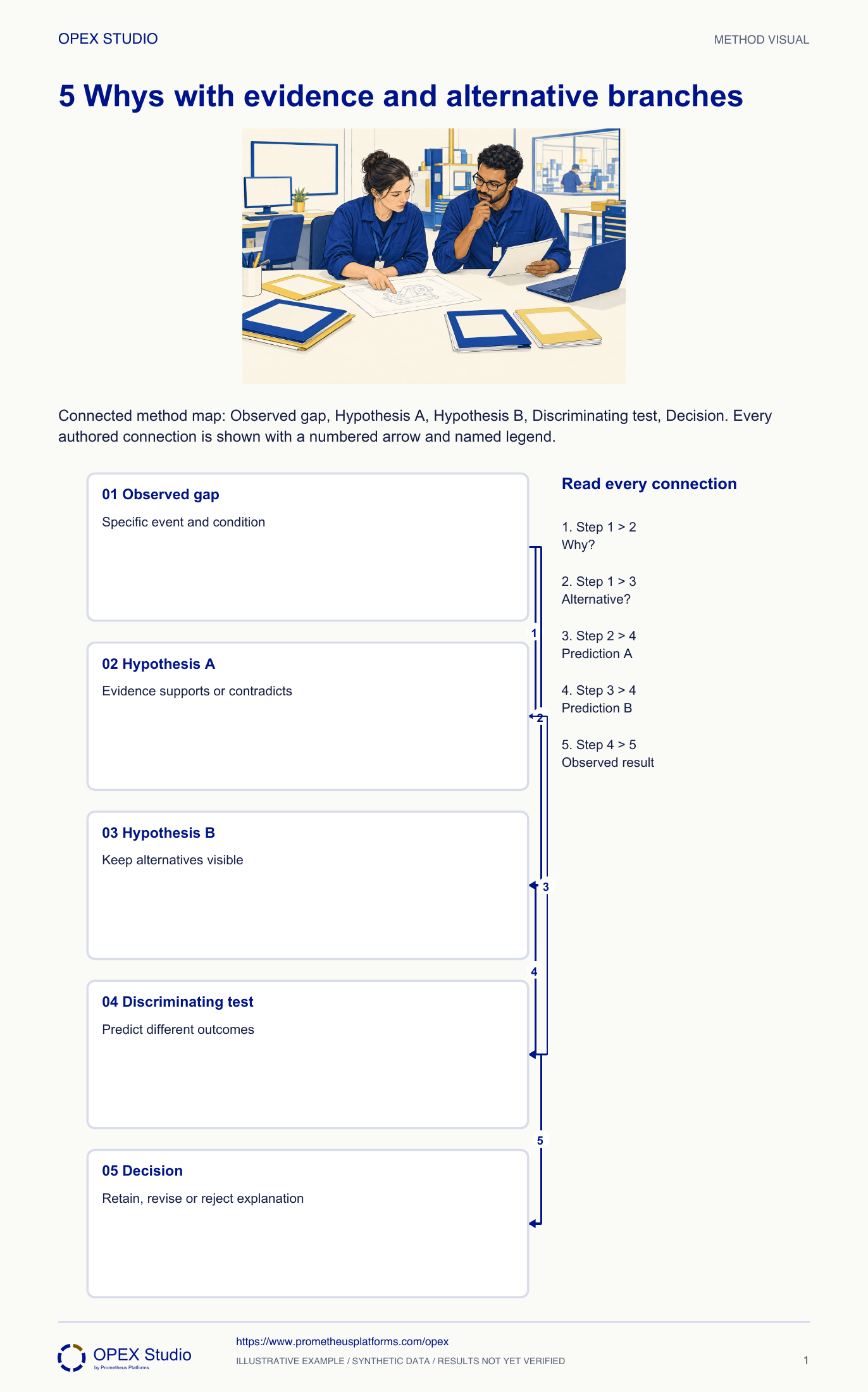
Begin with a specific observed gap. For each proposed cause, ask what evidence supports the link and what observation would contradict it. Keep alternative explanations visible when the evidence branches. The number of questions is less important than reaching a cause that can be tested and acted on. Do not stop at a label such as human error, and do not invent certainty to complete a chain. A countermeasure should change the mechanism and be checked for effectiveness. Complex interacting variables may require another analysis method. The diagram supports disciplined reasoning; it is not proof by itself.
Five is not a mandatory count.
Human error is not a sufficient causal explanation.
Feeds A3/8D; Use multivariate methods where needed.
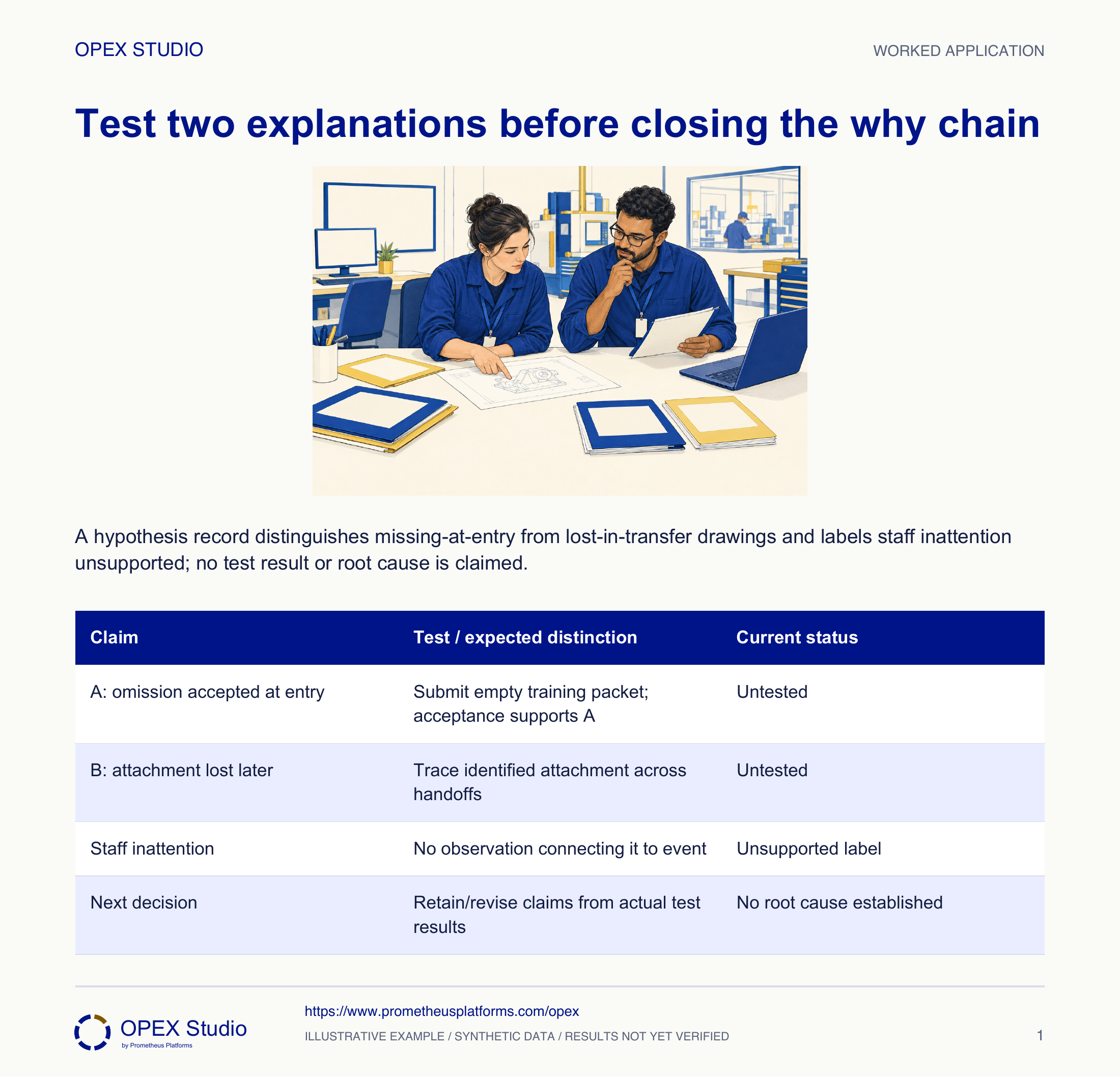
Fictional service team: three change-request packets arrived without a required drawing. Reviewer Sol is asked to finish a five-whys form that already ends with staff not paying attention. The team can inspect packet histories and reproduce submission in a training environment.
Keep two evidenced branches and their affected scopes; test responses for both. Do not force all events into the first explanation.
A recurring outcome may have multiple mechanisms.
Build a causal explanation with evidence at each link, retain a competing explanation and define a test whose result could change the decision.
Fictional service team: three change-request packets arrived without a required drawing. Reviewer Sol is asked to finish a five-whys form that already ends with staff not paying attention. The team can inspect packet histories and reproduce submission in a training environment.
Role: Process owner and frontline colleague investigating the specific omission.
Every submitted change packet includes the applicable drawing or an explicit approved exception.
Three recorded omissions; no evidence yet connects them to attention.
| Fact | Status |
|---|---|
| Three omitted drawings | Observed in packets R11, R14 and R19 |
| Submission routes | Email and portal both used; route for each not yet reconciled |
| Claim A | Portal may permit submission without attachment |
| Claim B | Attachment may be lost during transfer |
| Attention claim | No supporting observation supplied |
Sol records packet identities, required drawing and point of detection. He asks where the attachment should first enter the process and separates that point from review.
Why: Investigating where the omission was found can miss where it arose.
Evidence: Event statement and expected handoff are explicit.
The team asks why a packet could arrive without the drawing and labels each proposed answer observed, hypothesized or unknown. It does not copy staff inattention into the cause field.
Why: A judgment about people does not describe a mechanism that can be checked.
Evidence: Portal acceptance and transfer loss remain separate hypotheses.
Use a training packet without a drawing to test whether the portal accepts submission; separately send a packet with a uniquely identified test drawing and trace whether it survives each handoff.
Why: The two tests distinguish omission at entry from loss after entry. One generic successful submission cannot distinguish them.
Evidence: Before testing, record predicted results for each explanation and retain actual results separately.
If the portal rejects an empty attachment, revise the entry hypothesis rather than adding more unsupported whys. If a trace loses a drawing, inspect that precise transition and test the proposed change.
Why: Contrary evidence narrows learning. A cause claim needs a verified mechanism and an effective response, not a filled chain.
Evidence: The completed planning record leaves results open and defines the next decision for each outcome.
| Claim | Test / expected distinction | Current status |
|---|---|---|
| A: omission accepted at entry | Submit empty training packet; acceptance supports A | Untested |
| B: attachment lost later | Trace identified attachment across handoffs | Untested |
| Staff inattention | No observation connecting it to event | Unsupported label |
| Next decision | Retain/revise claims from actual test results | No root cause established |
In a fictional follow-up, one route permits an empty packet and another loses an attachment during conversion.
Keep two evidenced branches and their affected scopes; test responses for both. Do not force all events into the first explanation.
A recurring outcome may have multiple mechanisms.
Link each reproduced event to route, condition and observation; verify occurrence and escape controls separately.
New fictional office case: four handoff records lack receiver acknowledgment. The sender says the receiver forgot; the receiver says the notification never arrived. No delivery log has been checked.
| Evidence | Supplied status |
|---|---|
| Four missing acknowledgments | Observed |
| Notification sent | Sender assertion only |
| Notification received | Unknown |
| Receiver forgot | Hypothesis, not verified |
Missing acknowledgments are observed; sending, delivery and forgetting are not yet established.
Trace one synthetic notification end to end and observe the receiver acknowledgment step. Confirmed delivery with no acknowledgment points to a different transition than failed delivery.
A delivered message does not by itself prove forgetting: access, task clarity or competing workflow may explain the next gap. Continue from facts.
| Claim / evidence | Interpretation / next step |
|---|---|
| No acknowledgment | Observed outcome |
| Delivery absent | Investigate notification transition |
| Delivery confirmed | Observe acknowledgment conditions |
| Preferred cause contradicted | Revise branch; do not blame |
Which claim could another observer verify?
What result differs between A and B?
What would disprove your explanation?
Must there be one cause?
Write the competing prediction before imagining any result, then check the suggested reasoning.
Owner: Process owner with people performing the affected handoffs
Record: Evidence-labelled cause/test record
Review: After each test and after the proposed response is trialed
Evidence: Reproducible mechanism, contrary evidence and recurrence/escape verification
Retain uncertainty, improve observation or use a more suitable analysis method.
Cause chain, not exactly five repetitions; gap-from-standard focus
Method reference; original OPEX scenario and diagram are synthetic teaching content, not source case results.Read the lessons online or use these PDFs to prepare, practise and review with your team. No sign-in needed.
Case objectives, demonstration plans, debriefs, common mistakes and application checks across all 81 workplace cases and method lessons.
Download Facilitator guide PDF · 166 pages · 65.1 MBPrintable case worksheets, blank observation records and five calculation exercises; answers are separate.
Download Learner workbook PDF · 169 pages · 10.7 MBReasoned sample responses, worked calculations and coaching guidance; fictional examples are clearly labelled.
Download Answer key and coaching notes PDF · 105 pages · 8.5 MBThe native method mechanisms and worked applications for all 68 detailed lessons, in a separate bookmarked portrait reference.
Download Method and application reference PDF · 141 pages · 10.2 MBFive illustrated system chapters: 15 Flare concept maps and 26 original workplace teaching cards, with links to all 81 supporting cases and method lessons.
Download Illustrated systems atlas PDF · 69 pages · 55.8 MBExplore this connected method and its separate application conditions.
Explore the connected method →Explore this connected method and its separate application conditions.
Explore the connected method →Explore this connected method and its separate application conditions.
Explore the connected method →Explore this connected method and its separate application conditions.
Explore the connected method →