
Understand the exposure
Consider production, setup, cleaning, jams, fault recovery, maintenance and connected equipment. Identify where people could reach a hazard or be struck by movement or ejected material. A recurring jam is a design and work-method signal; it should not become a routine reason to defeat protection.
Design and establish protection
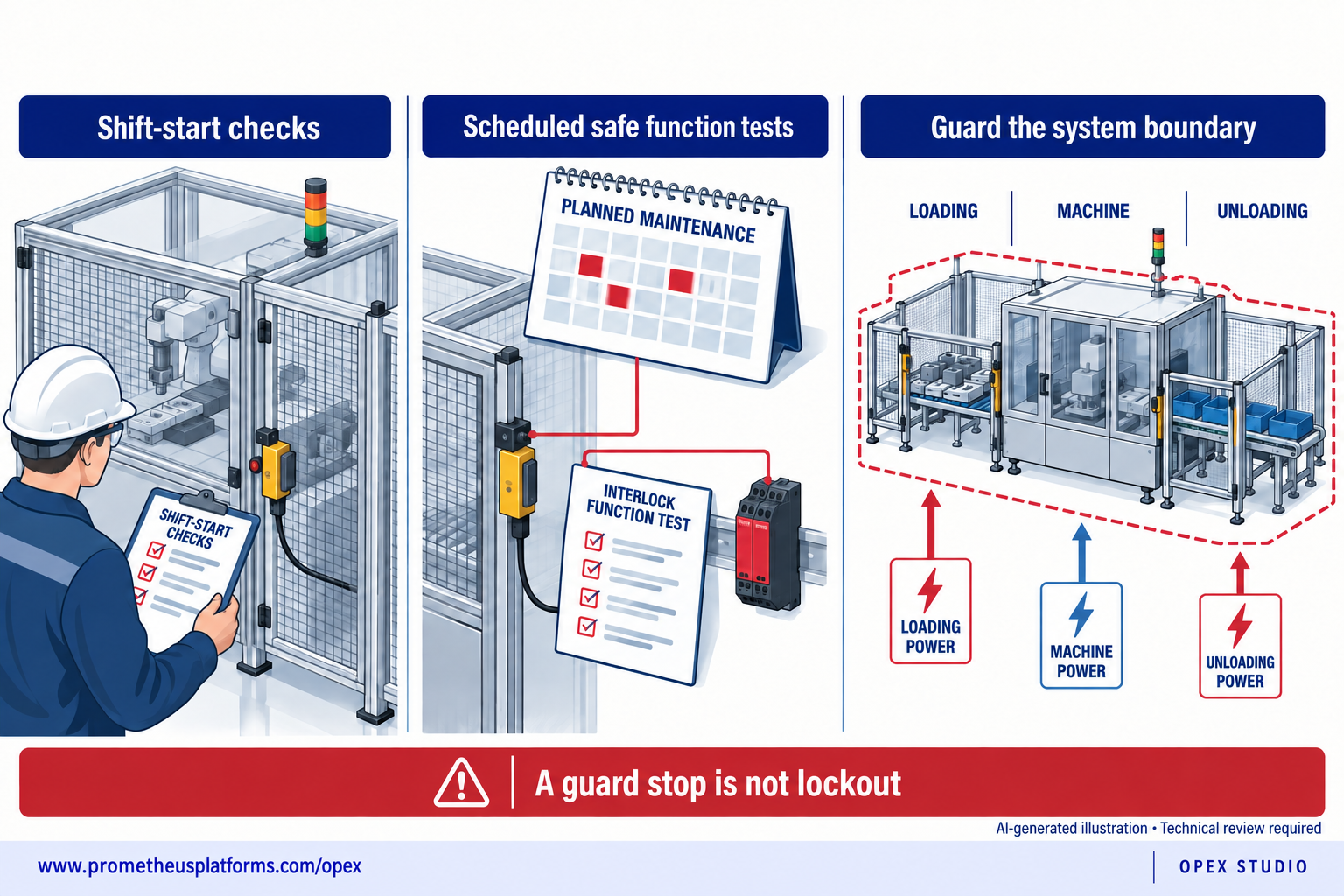
Select accepted engineering that prevents hazardous access or movement as required by the design. Define protective functions, limitations, tamper resistance, maintenance and safe verification. Guarding and isolation serve different purposes: when the task requires full isolation, a guard interlock or stopped cycle is not a replacement.
Verify before and during work
The control owner translates these teaching prompts into asset-specific performance requirements and a safe checking method. Record the actual evidence, its scope and the responsible role. Missing evidence remains Unknown; a required control that fails or cannot be verified creates a STOP condition for dependent exposure.
- Approved external readiness checks show the expected guard condition.
- Specified maintenance/function tests establish protective performance safely.
- Defects, repeated jams and unauthorized changes trigger a controlled response.
Practise a decision
A machine has an open guard during jam clearing. Someone argues that it cannot run until the guard is closed. What needs to be resolved before access?
Feedback: Prevent exposure and apply the accepted method for the actual task. Establish whether isolation is required and account for stored energy and connected movement. Do not use a generic expectation about an interlock as permission to enter.
Changed condition: The guard is restored, but resetting a recurring fault may initiate movement elsewhere. Keep the relevant restriction while the competent owner assesses the complete machine response. A local reset is not evidence that every affected person and connected section is clear.
Support the people doing the work
People can normalize recurring faults when production repeatedly recovers. Use reports to improve the cause of the fault and the recovery method. Verification must never require defeating a safeguard or creating exposure simply to demonstrate that a hazard exists.
Transfer the learning
Choose one relevant task and explain the hazard, protective function, evidence needed and condition that would stop the work. Then identify who can resolve a gap and what must be rebriefed before designated restart. Use an approved classroom or tabletop example; do not create a hazardous condition for assessment.
This topic is educational guidance, not an approved equipment procedure or a competence certificate. C8-07 is the stable program identifier. Local technical acceptance, emergency capability and understood instructions remain prerequisites for actual work.
Learning material for team discussion. Apply your site’s approved procedures, competent-person assessments and applicable requirements to actual work.
Take this learning to the team
Choose the language and format for your session. Review drafts with your safety and operations leads before adapting them to local work. A download is learning material, not authorization to perform a hazardous task.
English resources
- Learner practice workbook (DOCX, 11 KB) ↓Teaching and local review edition · v1.0
- Critical 8 one-page recaps (PDF, 732 KB) ↓Design and review draft · v0.13
- Critical 8 teaching slides (PPTX, 3.9 MB) ↓Design and review draft · v0.13
Sources & further reading
Use the original source to check its scope, terminology and current requirements.