
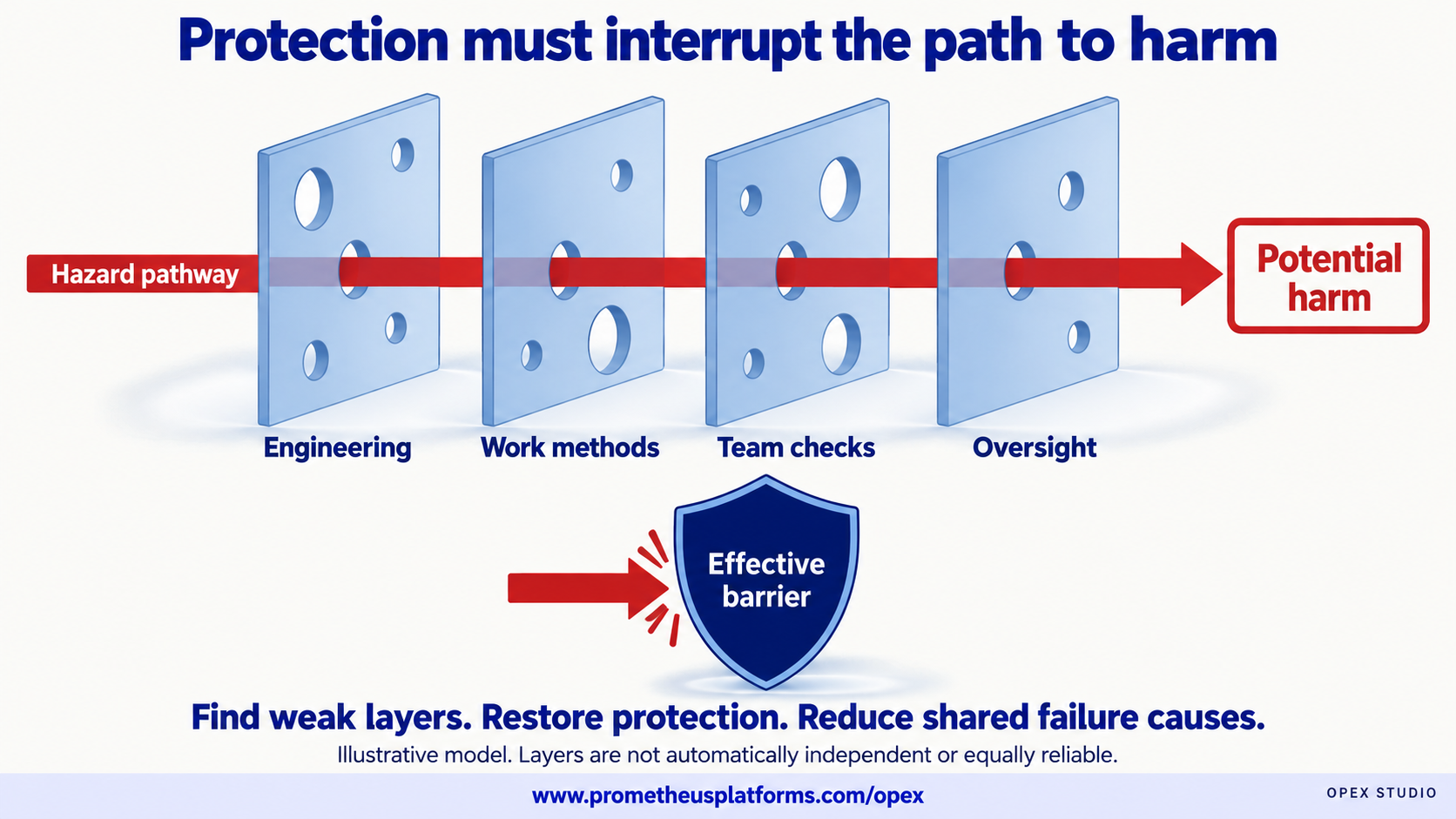
What you will take awayDesign the exposure out. Choose protective functions that keep people away from serious harm.
Choose higher-order options first
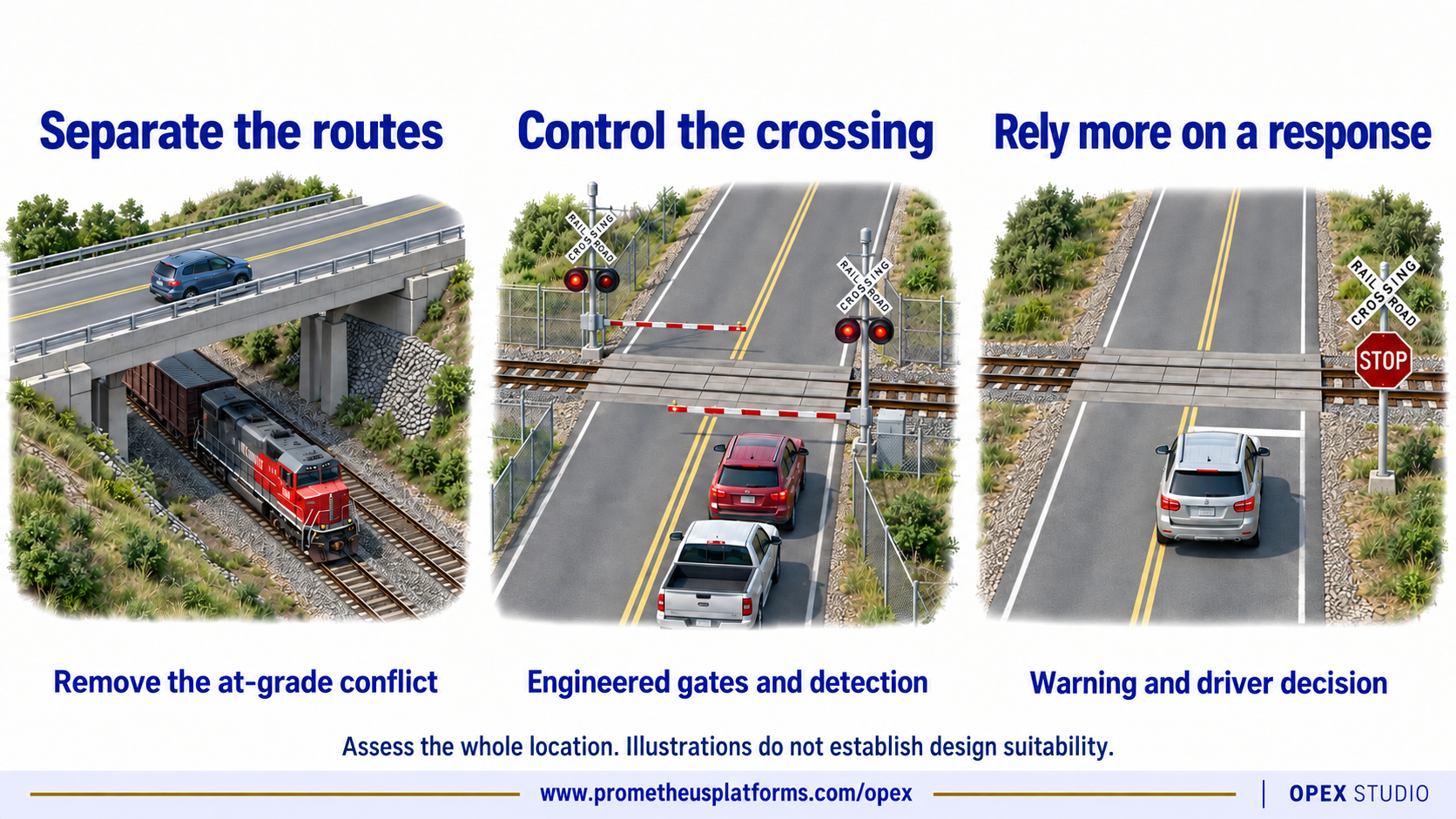
Separating routes removes the at-grade crossing conflict. Gates and detection control the crossing; signs depend more on a response. Assess the whole location: this comparison does not establish design suitability. AI-generated conceptual illustration; not a verified installation or equipment-specific instruction.
View full-size visual ↗Elimination removes the hazard or the need for a particular hazardous task. Substitution replaces a source or process with a safer alternative, which must itself be assessed. Engineering changes equipment or the workplace to prevent contact, separate people or contain hazardous energy or material. Administrative controls and PPE support the remaining protection.
Describe precisely what changes. Moving assembly to floor level can remove a particular elevated task, while introducing lifting or handling questions. A separated crossing can remove a traffic conflict at that location without eliminating all transport hazards. Avoid claiming that any one improvement creates zero risk.
Swipe or scroll across the diagram →
Name the protective function
Distinguish preventing an unwanted event from limiting its consequences. Ask what the design must prevent, detect, restrain, isolate, contain or mitigate, and under which conditions. Define the limits, dependencies and evidence needed before the design is accepted.
Several measures can fail together if they depend on the same power supply, sensor, maintenance practice or assumption. Drawing several layers does not prove independence or quantify reliability. This lesson is a conceptual discussion, not a formal protection-layer calculation.
- Identify the full system and adjacent work, including stored energy and temporary connections.
- Compare elimination, substitution and engineering options; record reasons and unresolved questions.
- Specify safe verification, maintenance, deterioration response and change control.
Practise: bring an elevated task down
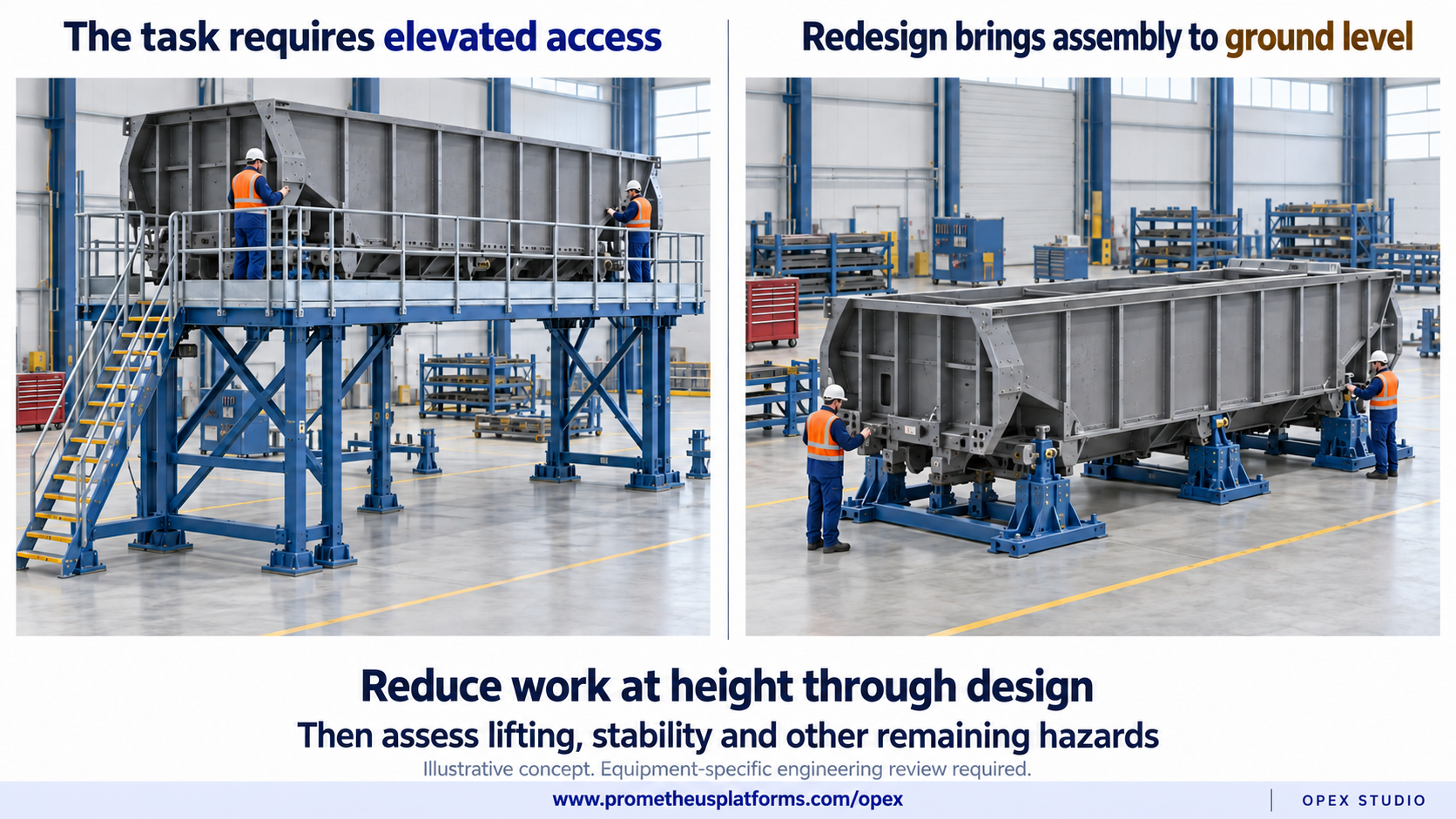
Bringing the task to ground level can remove that elevated exposure. Assess lifting, stability and other remaining hazards before accepting a redesign. AI-generated conceptual illustration; not a verified installation or equipment-specific instruction.
View full-size visual ↗A team proposes a larger platform for repeated assembly work at height. Before selecting it, ask whether prefabrication or relocation could remove the elevated task. Consider access, component weight, lifting, stability, utilities and the subsequent installation step.
Feedback: a platform may be a useful engineered option, but selecting it first can miss a stronger design change. Compare feasible alternatives against the actual system. If floor-level assembly is selected, its handling and installation hazards still need controls and technical acceptance.
Changed condition: a product variation cannot use the new fixture. Do not extend the accepted method by assumption. Keep the affected work within an approved protected arrangement while the owner reassesses the variation.
Verify and revisit the design
Completion of a purchase or installation is not evidence of effective protection. Confirm that the specified function is implemented, test it through an accepted safe method and check its behavior in representative use. Record deviations and the owner responsible for resolution.
Revisit the assessment after equipment changes, control failures, new information or recurring dependence on workarounds. The objective is sustained protection under real conditions. A capital plan or future improvement date does not create permission for uncontrolled exposure today.
Learning material for team discussion. Apply your site’s approved procedures, competent-person assessments and applicable requirements to actual work.
Take this learning to the team
Choose the language and format for your session. Review drafts with your safety and operations leads before adapting them to local work. A download is learning material, not authorization to perform a hazardous task.
English resources
- Engineered protection learning module (PPTX, 168 KB) ↓Teaching and local review edition · v1.0
- Learner practice workbook (DOCX, 11 KB) ↓Teaching and local review edition · v1.0
- Facilitator discussion guide (DOCX, 12 KB) ↓Teaching and local review edition · v1.0
Sources & further reading
Use the original source to check its scope, terminology and current requirements.