
Choose a resource for the learning task
Start with the integrated overview to connect engineered protection, Critical 8 systems and Human Performance. Use a workstream module to go deeper, then choose relevant topic scenarios rather than presenting every possible example in one session. The reference guide supports preparation and follow-up.
Learner materials should invite an initial answer before model reasoning is revealed. Facilitator material helps explain the decision, challenge unsupported assumptions and introduce a changed condition. Editable discussion tools support adaptation through the appropriate local content owner; editability is not approval for field use.
Understand the edition and language
This public edition uses Fatality and Serious Injury Prevention as its title. The earlier bilingual source package used FSI for Fatality or Serious Incident. Both recognize credible serious-harm potential even when no injury occurs. Stable Critical 8 and scenario identifiers preserve continuity.
The new web lessons are English. Where a resource is offered in Mexican Spanish, its language is identified explicitly. Do not infer that an English page or newly authored exhibit has a reviewed Spanish counterpart. Technical meaning, local terminology and learner understanding require review before operational use.
Keep educational evidence separate from field evidence
The examples use fictional conditions and proposed management practices. They do not report a real site’s compliance, safety performance, appointments or control effectiveness. Reading a lesson, attending training or completing a worksheet does not establish equipment authorization.
Before applying a method at work, the accountable local organization must establish the actual scope, asset-specific technical acceptance, competent roles, emergency arrangements, understood instructions and applicable requirements. Any required safeguard that is failed or unknown remains a reason to stop dependent exposure.
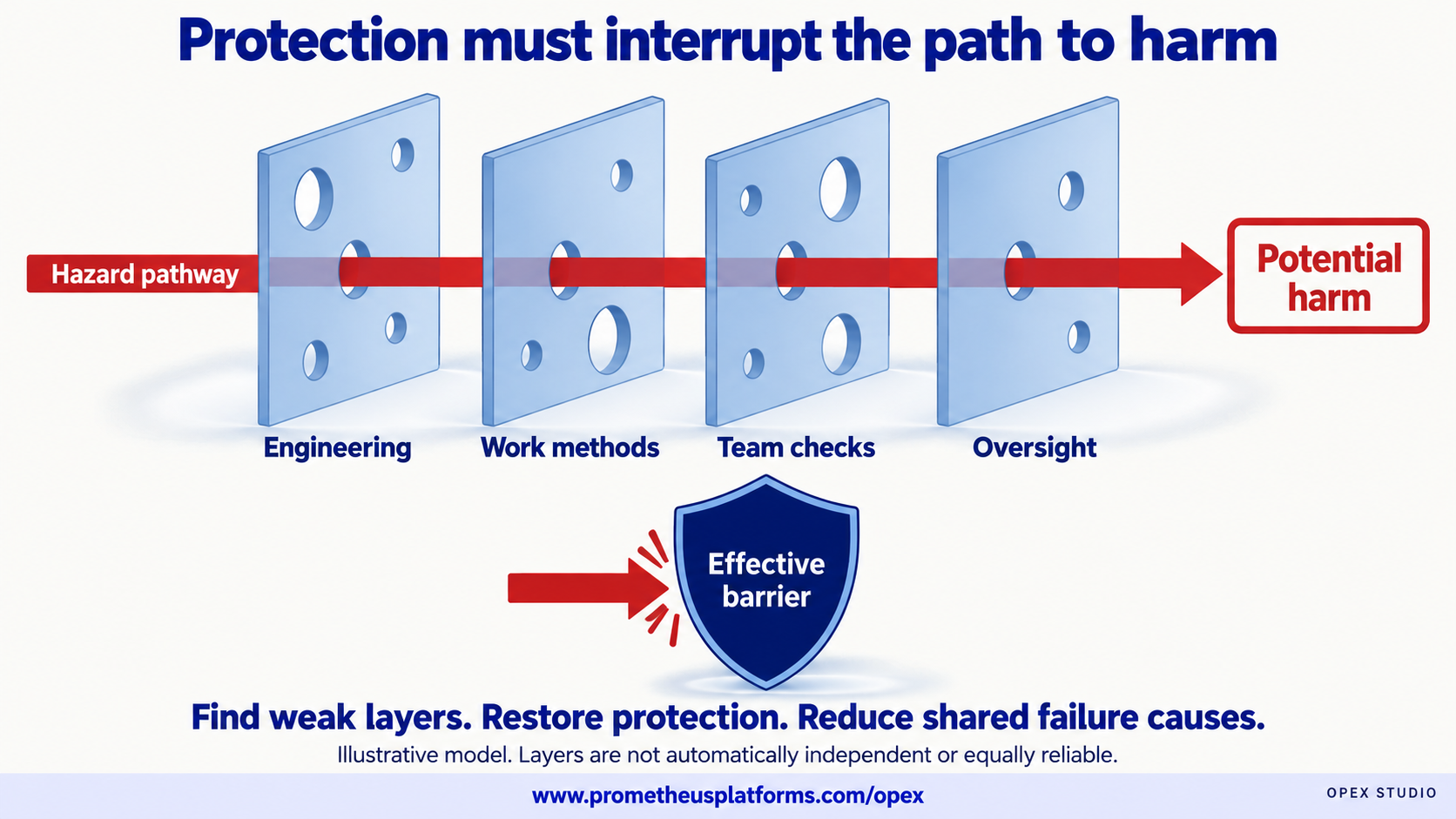
Images and diagrams explain concepts. They are not installation drawings, safe operating procedures or proof that depicted equipment is suitable. Use approved actual asset information for equipment-specific instruction.
Read sources in their context
NIOSH informs the hierarchy of controls. HSE informs the treatment of human failure and the conditions that influence it. DOE’s 2009 Human Performance handbook informs STAR and briefing tools. ICMM’s 2026 guide informs control performance, accountability and verification.
These references come from different sectors and jurisdictions. Their inclusion supports an educational explanation, not a claim that every provision applies to every workplace. OPEX’s Critical 8 organization, daily-priority aid and worked scenarios are authored adaptations. No source organization endorses this package.
Source links on each lesson identify relevant primary references. Retained proprietary source documents, historical company records and private working files are not part of the public package. Future revisions should preserve the source relationship and update connected diagrams, tools and downloads together.
Learning material for team discussion. Apply your site’s approved procedures, competent-person assessments and applicable requirements to actual work.
Download the working materials
Choose the language and format for your session. Review drafts with your safety and operations leads before adapting them to local work. A download is learning material, not authorization to perform a hazardous task.
English resources
- Integrated prevention learning overview (PPTX, 276 KB) ↓Teaching and local review edition · v1.0
- Engineered protection learning module (PPTX, 168 KB) ↓Teaching and local review edition · v1.0
- Critical controls learning module (PPTX, 187 KB) ↓Teaching and local review edition · v1.0
- Human performance learning module (PPTX, 169 KB) ↓Teaching and local review edition · v1.0
- Coordinated prevention learning guide (DOCX, 14 KB) ↓Teaching and local review edition · v1.0
- Learner practice workbook (DOCX, 11 KB) ↓Teaching and local review edition · v1.0
- Facilitator discussion guide (DOCX, 12 KB) ↓Teaching and local review edition · v1.0
- Critical 8 one-page recaps (DOCX, 3.0 MB) ↓Design and review draft · v0.13
- Critical 8 one-page recaps (PDF, 732 KB) ↓Design and review draft · v0.13
- Critical 8 teaching slides (PPTX, 3.9 MB) ↓Design and review draft · v0.13
- Facilitator guide (DOCX, 2.8 MB) ↓Design and review draft · v0.13
- Field forms (XLSX, 127 KB) ↓Design and review draft · v0.12
- Field guide (DOCX, 1.5 MB) ↓Design and review draft · v0.12
- Foundation training library (PPTX, 9.7 MB) ↓Design and review draft · v0.13
- Governance register (XLSX, 37 KB) ↓Design and review draft · v0.12
- Governance and rollout guide (DOCX, 741 KB) ↓Design and review draft · v0.12
- Human Performance briefing guide (DOCX, 2.3 MB) ↓Design and review draft · v0.12
- Human Performance briefings (PPTX, 4.4 MB) ↓Design and review draft · v0.12
- Program KPI tracker (XLSX, 65 KB) ↓Design and review draft · v0.12
- Learner practice (DOCX, 47 KB) ↓Design and review draft · v0.12
- Location program management (XLSX, 224 KB) ↓Design and review draft · v0.12
- A0 poster campaign (PDF, 29.7 MB) ↓Design and review draft · v0.12
- A0 poster campaign (PPTX, 21.6 MB) ↓Design and review draft · v0.12
- Program manual (DOCX, 4.1 MB) ↓Design and review draft · v0.13
- Sponsor governance (PPTX, 2.5 MB) ↓Design and review draft · v0.12
- Resource attribution and license notices (TXT, 10 KB) ↓Attribution · 2026-09-30
Recursos en español (México)
- Critical 8 one-page recaps (DOCX, 3.1 MB) ↓Design and review draft · v0.13
- Critical 8 one-page recaps (PDF, 767 KB) ↓Design and review draft · v0.13
- Critical 8 teaching slides (PPTX, 4.0 MB) ↓Design and review draft · v0.13
- Facilitator guide (DOCX, 2.9 MB) ↓Design and review draft · v0.13
- Field forms (XLSX, 133 KB) ↓Design and review draft · v0.12
- Field guide (DOCX, 1.5 MB) ↓Design and review draft · v0.12
- Foundation training library (PPTX, 9.9 MB) ↓Design and review draft · v0.13
- Governance register (XLSX, 38 KB) ↓Design and review draft · v0.12
- Governance and rollout guide (DOCX, 751 KB) ↓Design and review draft · v0.12
- Human Performance briefing guide (DOCX, 2.4 MB) ↓Design and review draft · v0.12
- Human Performance briefings (PPTX, 4.5 MB) ↓Design and review draft · v0.12
- Learner practice (DOCX, 47 KB) ↓Design and review draft · v0.12
- Location program management (XLSX, 228 KB) ↓Design and review draft · v0.12
- A0 poster campaign (PDF, 29.8 MB) ↓Design and review draft · v0.12
- A0 poster campaign (PPTX, 21.5 MB) ↓Design and review draft · v0.12
- Program manual (DOCX, 4.2 MB) ↓Design and review draft · v0.13
Sources & further reading
Use the original source to check its scope, terminology and current requirements.