
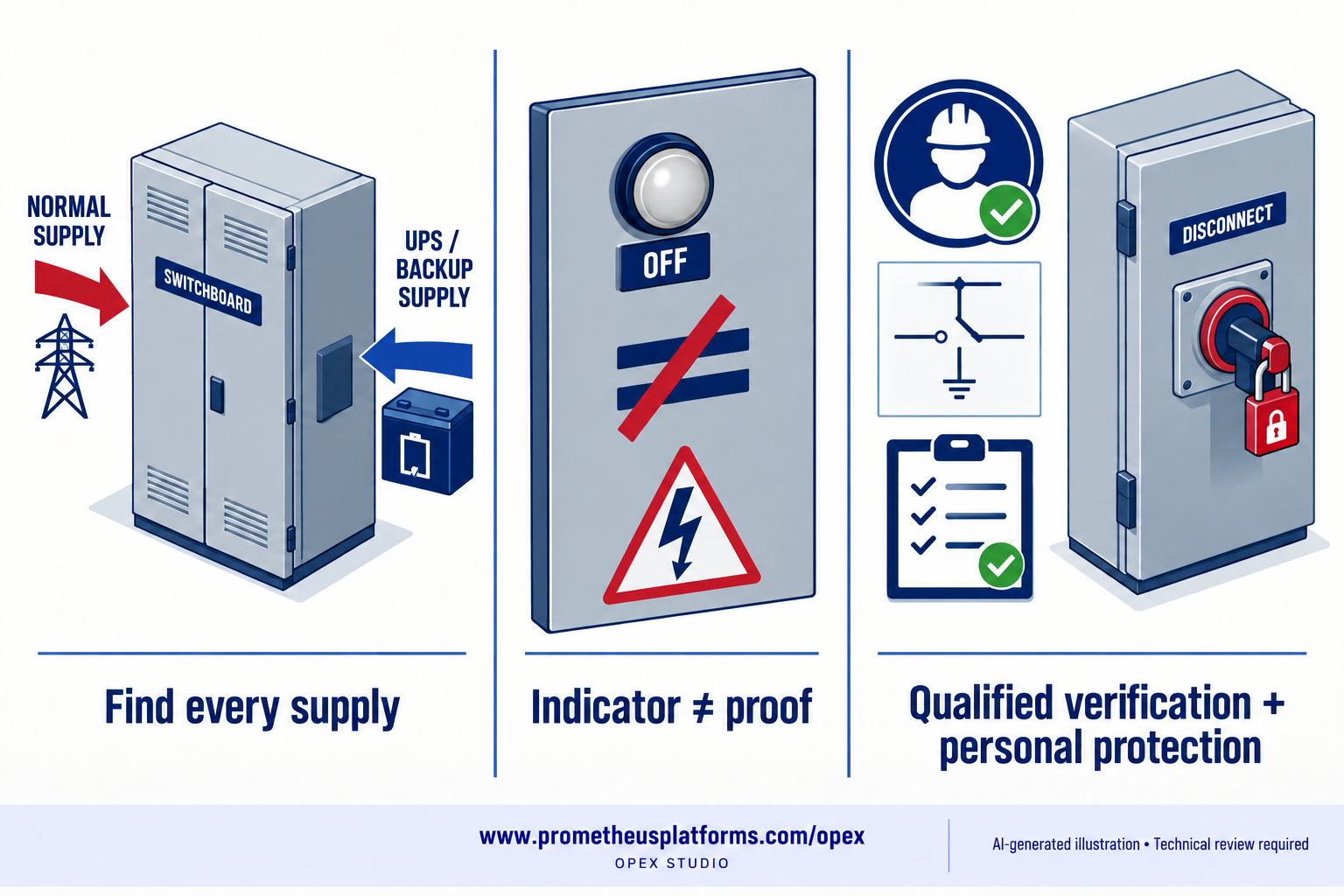
Understand the exposure
Assess the actual circuit, possible alternate supplies, stored energy, adjacent live parts and changes introduced by troubleshooting. Drawings, labels and physical configuration must be reconciled through a competent process. A command that stops the equipment or a try-start check does not by itself establish the absence of voltage.
Design and establish protection
Prefer designs and work arrangements that remove the need for hazardous exposure. Where electrical work remains, the accepted procedure must specify qualified people, boundaries, equipment suitability, required tests and protective measures. This educational material does not provide live-work instructions, test sequences or equipment ratings.
Verify before and during work
The control owner translates these teaching prompts into asset-specific performance requirements and a safe checking method. Record the actual evidence, its scope and the responsible role. Missing evidence remains Unknown; a required control that fails or cannot be verified creates a STOP condition for dependent exposure.
- The controlled method matches the actual circuit and every relevant supply.
- People, instruments and protective measures fit the authorized scope.
- Required evidence and boundaries remain valid through configuration changes.
Practise a decision
A drawing identifies one supply, but the technician finds another cable and cannot establish its purpose. Is the original method sufficient?
Feedback: No assumption about the extra connection can substitute for evidence. Maintain the affected restriction and obtain competent resolution of the complete system. Update the controlled information and accepted method before dependent work resumes.
Changed condition: The system is understood, but diagnosis now requires a different configuration from the approved task. Treat that as changed scope. It requires its own competent assessment and authorization rather than a continuation under the earlier approval.
Support the people doing the work
Look-alike panels, incomplete labels and fault pressure are practical error traps. Select exact identification and procedure checks, and stop when the task no longer fits the rule. STAR can support an authorized action; it cannot fill a missing electrical assessment.
Transfer the learning
Choose one relevant task and explain the hazard, protective function, evidence needed and condition that would stop the work. Then identify who can resolve a gap and what must be rebriefed before designated restart. Use an approved classroom or tabletop example; do not create a hazardous condition for assessment.
This topic is educational guidance, not an approved equipment procedure or a competence certificate. C8-05 is the stable program identifier. Local technical acceptance, emergency capability and understood instructions remain prerequisites for actual work.
Learning material for team discussion. Apply your site’s approved procedures, competent-person assessments and applicable requirements to actual work.
Take this learning to the team
Choose the language and format for your session. Review drafts with your safety and operations leads before adapting them to local work. A download is learning material, not authorization to perform a hazardous task.
English resources
- Learner practice workbook (DOCX, 11 KB) ↓Teaching and local review edition · v1.0
- Critical 8 one-page recaps (PDF, 732 KB) ↓Design and review draft · v0.13
- Critical 8 teaching slides (PPTX, 3.9 MB) ↓Design and review draft · v0.13
Sources & further reading
Use the original source to check its scope, terminology and current requirements.