
Understand the exposure
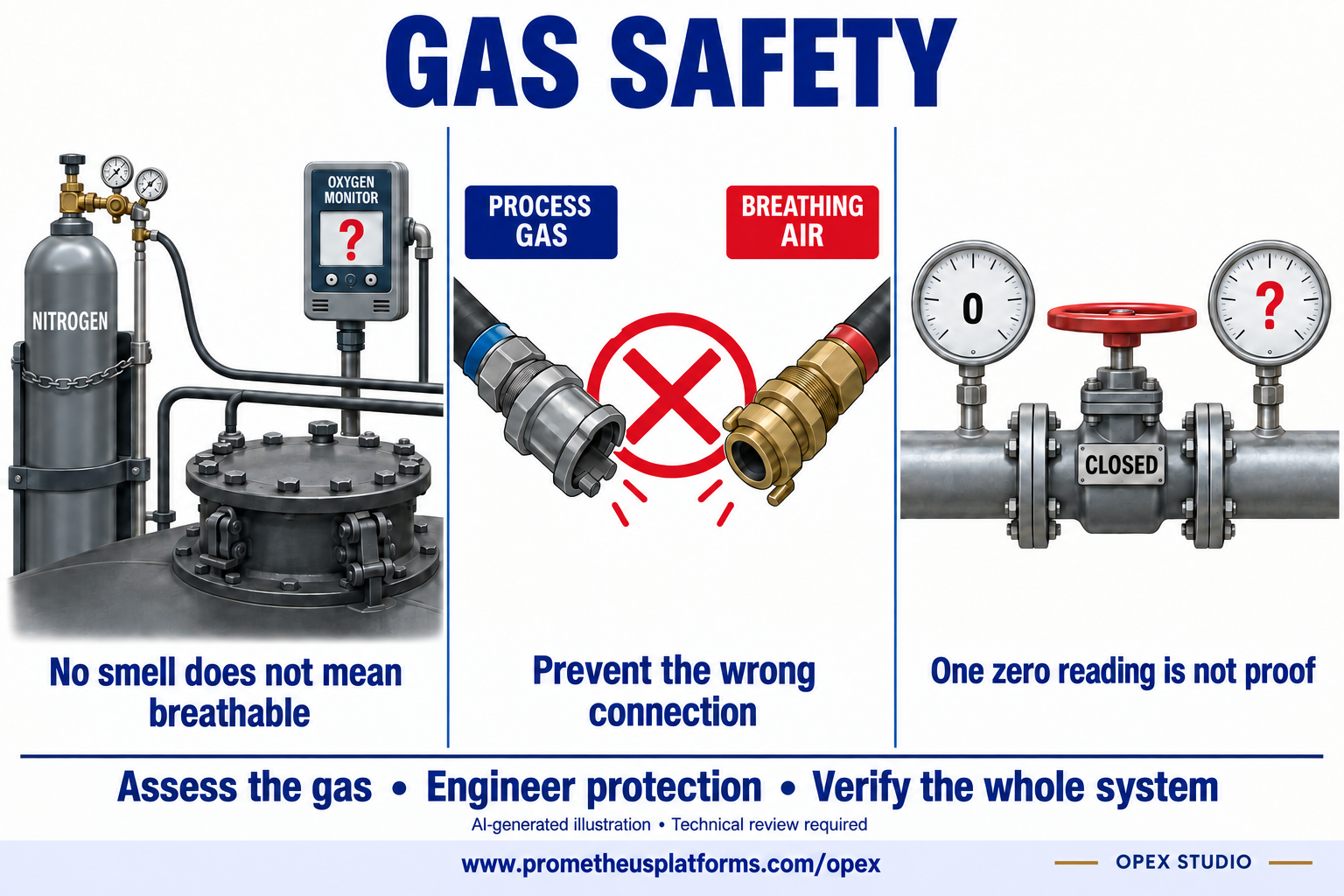
Assess gases and connected systems from source to point of use, including temporary hoses, incompatible connections, ventilation, enclosed areas and stored pressure. A fitting that connects does not establish gas identity or suitability. Absence of smell is not evidence that an atmosphere is safe.
Design and establish protection
Consider eliminating the hazardous use or substituting a safer process where feasible. Engineering may prevent unsuitable connections, contain a release or maintain the required extraction/atmosphere protection. The competent specification must define performance and verification for the actual substances and process; generic setpoints are not supplied here.
Verify before and during work
The control owner translates these teaching prompts into asset-specific performance requirements and a safe checking method. Record the actual evidence, its scope and the responsible role. Missing evidence remains Unknown; a required control that fails or cannot be verified creates a STOP condition for dependent exposure.
- Substance, source, destination and compatible equipment are established.
- Required containment, extraction and atmosphere controls meet accepted criteria.
- Pressure, ignition and adjacent-work interfaces are included in the method.
Practise a decision
A replacement hose can be adapted to a nearby manifold, but the source and approved service are uncertain. What is the next defensible action?
Feedback: Stop before connection and keep the hose out of use while the competent owner establishes the source, destination and accepted design. Consider engineering that prevents incompatible selection. A label, adapter or lack of odor is not sufficient proof.
Changed condition: The connection is now correct, but required atmosphere monitoring is unavailable near an enclosed work area. Maintain the affected restriction until the required protection is restored and verified. Solving one problem does not clear an independent missing prerequisite.
Support the people doing the work
A running fan does not itself prove adequate extraction. Likewise, one gauge reading may not establish the condition of every trapped volume. Escalate uncertain evidence to the competent specialist; never approach a leak or loosen a fitting to investigate an unknown hazardous state.
Transfer the learning
Choose one relevant task and explain the hazard, protective function, evidence needed and condition that would stop the work. Then identify who can resolve a gap and what must be rebriefed before designated restart. Use an approved classroom or tabletop example; do not create a hazardous condition for assessment.
This topic is educational guidance, not an approved equipment procedure or a competence certificate. C8-08 is the stable program identifier. Local technical acceptance, emergency capability and understood instructions remain prerequisites for actual work.
Learning material for team discussion. Apply your site’s approved procedures, competent-person assessments and applicable requirements to actual work.
Take this learning to the team
Choose the language and format for your session. Review drafts with your safety and operations leads before adapting them to local work. A download is learning material, not authorization to perform a hazardous task.
English resources
- Learner practice workbook (DOCX, 11 KB) ↓Teaching and local review edition · v1.0
- Critical 8 one-page recaps (PDF, 732 KB) ↓Design and review draft · v0.13
- Critical 8 teaching slides (PPTX, 3.9 MB) ↓Design and review draft · v0.13
Sources & further reading
Use the original source to check its scope, terminology and current requirements.
- NIOSH: Hierarchy of Controls ↗
- ICMM: Critical Control Management Good Practice Guide (2026) ↗
- DOE Human Performance Improvement Handbook, Volume 2 (2009) ↗
- HSE INDG297: Safety in gas welding, cutting and similar processes ↗
- OSHA safety bulletin: Incompatible breathing-air connections and asphyxiation hazards (2004) ↗